Tag Archives: journalism

Reporting on gun violence and gun control

By Christopher B. Daly 

The recent massacre of innocents at a school in Connecticut is bound to spur a renewal of debate over gun control. Based on President Obama’s comments on Friday, it appears likely that — finally — something might happen. If you are reporting on that issue, or just reading about it, the dialogue could be elevated if the reporting were deepened.

One place to start: the highly worthwhile site Journalist’s Resource, sponsored by the Shorenstein Center at Harvard’s Kennedy School.

Here is a page of results from a keyword search for “gun control.”

It is a start toward bringing the best of fact-based research to bear on this enormous problem.

HKSlogo_sub_shoren

2 Comments

Filed under Journalism

Memo to Britain

By Christopher B. Daly 

I’ll keep this brief. Just 11 words, in fact:

CONGRESS SHALL MAKE NO LAW ABRIDGING THE FREEDOM OF THE PRESS. 

It has worked here (on the whole) since 1791. As the Brits grapple with the fallout from the multiple disasters in their news media inflicted by the minions of conservative media mogul Rupert Murdoch, they might want to consider doing nothing.

Keep calm and carry on and all that. Not to be missed: The Guardian‘s comprehensive coverage.

leveson-report-government-prepares-draft-bill-live-coverage

Leave a comment

Filed under First Amendment, Journalism, Murdoch scandal, Uncategorized

The power of reporting

By Christopher B. Daly

Today presents a good example of what makes the New York Times so valuable. When the “controversy” over the anti-Muhammad movie called “Innocence of Muslims” broke a couple of months ago, many news organizations covered it for a few days. Eventually, to judge by the evidence so far, they all threw in the towel and gave up trying to get to the bottom of the story of the Coptic deadbeat/activist Nakoula Basseley Nakoula (if that really is his name). All except the Times. In today’s edition, the paper presents a page-1 story with a double byline. Top billing went to Pulitzer-winner Serge Kovaleski, backed up by Brooks Barnes. But that’s not all. At the bottom of the story is a credit line that mentions four more people:

Ana Facio-Krajcer and Noah Gilbert contributed reporting from Los Angeles, and Mai Ayyad from Cairo. Jack Begg contributed research.

So, that is six journalists and counting. All of which is not to mention the folks on the photo desk and the several layers of editors who worked on this piece as well. In all, I would estimate that the full team was in the low double digits.

That is real reporting power. That is the Times’s way of saying: We don’t care how long it takes or how many people it takes, if we get interested in something, we are going to pursue it.

Is the Times perfect? Does the Times pursue every story you would like it to. Obviously not, but where would we be without it?

A man identified as Nakoula Basseley Nakoula (in white scarf) engages in a “perp walk” in California in September. Photo: Bret Hartman / Reuters

1 Comment

Filed under Journalism, New York Times

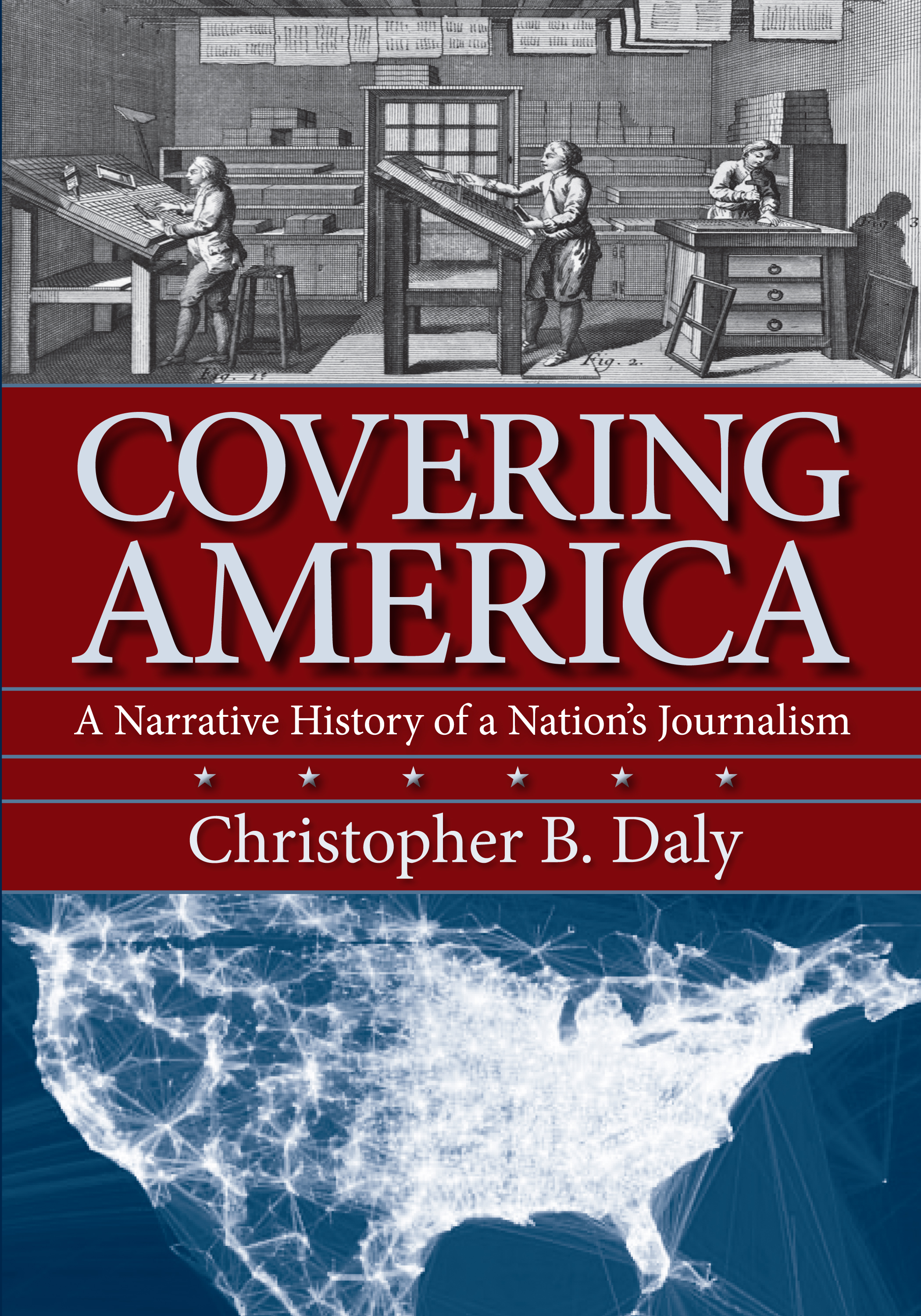
Rave review for “Covering America”

By Christopher B. Daly 

My book Covering America drew an insanely enthusiastic review in the Providence Journal on Sunday. The timing reminds me: IMHO, this book would make a great holiday gift for anyone who cares about American journalism, American history, American politics, the tech revolution in news, Jefferson/Lincoln/FDR, WWI/WWI/Vietnam, and a whole bunch of other stuff.

Have I left anyone out?

Leave a comment

Filed under Covering America, history, Journalism, journalism history

It’s so much fun to be a journalist

. . .until it isn’t.

As this story suggests, Tweeting is a form of “publishing” and brings with it the responsibility not to make factual assertions about identifiable individuals that are libelous. Statements are libelous (at least in the United States) if they are

false,

damaging to the person’s reputation,

–and costly to the victim in some tangible way.

So, to everyone online, I say: welcome to the ranks of  “the media.” Check your facts.

This is why the news media, for all their faults, have fact-checkers, editors, lawyers, standards, and schools of journalism. You should know your song well before you start singing.


AN UPDATE: Here is a different view, from Jonathan Zittrain. It ran in the Financial Times, but I can’t find a free way to read it. (Good for them, not so good for me.)

Leave a comment

Filed under Journalism

New NYT exec: Up to the job?

By Christopher B. Daly 

Mark Thompson is wrapping up his first week as the new president and chief executive of the New York Times Company. That role puts him in a critical position in U.S. journalism, and he has little margin for error in leading the

Carl Court / AFP-Getty

Carl Court / AFP-Getty

country’s most important news-gathering organization through dangerous and economically challenging times. We all need him to succeed.

And yet.

It is beginning to appear that the Times Company’s principal owner and publisher of the flagship newspaper, Arthur Sulzberger Jr., may have picked the wrong person for the job. The reason for that has to do with Thompson’s last job, as an executive with the BBC. The British broadcasting empire, a tower of journalistic probity, is going through its own scandal.

To its credit, the Times is pursuing the question of what Thompson knew and when he knew it — apparently without much fear or favor. This is as it should be. My concern is that, fairly or unfairly, Thompson may be so damaged by his BBC baggage that he has to go.

Tentatively, I would say Thompson either knew of serious wrongdoing at the BBC and did nothing, or else he did not know and should have. Either way, he is compromised.


Leave a comment

Filed under broadcasting, Journalism, New York Times

Math for journalists (and everyone else too)

By Christopher B. Daly 

In the wake of last week’s election, many Republicans seems to be facing not only a political problem but also an epistemological one. Epistemology is the term philosophers use for the study of knowledge itself. It is an inquiry that asks: How do we know what we know? (or, How do we know what we think we know?)

Two recent pieces raise the issue.

David Carr,in his column in the New York Times, emphasizes the crisis that overtook Fox News on election night, when some professionals at the conservative news network were forced to choose — live, on television — between Republican orthodoxy and journalistic empiricism. Carr rightly applauds Megyn Kelly for insisting on a fact-based approach while she was on-air with Republican Party strategist, fund-raiser, consultant (have I left any roles out?) Karl Rove, who doubles as a paid news “analyst” for Fox. As the Ohio vote was being counted last Tuesday night, it was becoming clear that Obama would win the state and, thus, the country. Rove insisted that Fox set aside the facts and hold off on placing Ohio in the president’s camp.

Inexplicably, though, Carr did not cite the definitive quote in the exchange. Kelly turned to Rove and asked:

“Is this just math that you do as a Republican to make yourself feel better, or is this real?”

(Jon Stewart rightly pounced on it as a moment of political/journalistic/epistemological crisis, and you can see the video.)


How about math we do as Americans to determine reality?


Many of the same issues are raised in a searching piece in Politico today about the “cocooning” of many Republicans. On election night, some Republicans found it difficult to believe that Obama was actually winning, largely because they only watch Fox News and only hear the views of analysts like Karl Rove. The piece, by Jonathan Martin, points in the direction of the book I am working on about the rise of conservative media after WWII, with the working title: Inside the Meme Factory: The Rise of Conservative Media and Think Tanks. Stay tuned for that. (If you think that an idea/slogan like “the rich are job-creators” arises spontaneously, you got another think coming!)


Leave a comment

Filed under broadcasting, Fox News, Journalism, Politics

Who are Mitt Romney’s people?

by Christopher B. Daly 

Readers of this blog are obviously an intelligent, discerning, and deeply informed group of people, curious about many things and knowledgable about many others. So, here goes:

How many presidential candidates in U.S. history have ever gotten elected without carrying their home states?

A bonus question: who were they?

Turns out, of the 44 men who have won the office, only three failed to carry their home state (that is, the one they were living in when they ran for president). They were James K. Polk of Tennessee, Woodrow Wilson of New Jersey, and Richard Nixon of New York.

Now, consider Mitt Romney.

–He was born in Michigan.

–He spent the bulk of his adult life in Massachusetts — racking up two degrees from Harvard (when’s the last time he mentioned either of those? Don’t forget: he has a law degree.), then working at Bain in Boston and later becoming governor. This is the state where he votes.

–He also has a vacation home in New Hampshire.

–And he is building some kind of pleasure dome in La Jolla, Calif.

So, that makes four states where he has roots or homes, and according to the polls, he is going to lose all four of those states on Tuesday. What does that say about him? He could lose Massachusetts, the state where he has lived the longest, by 20 points. How is that not a story? Just imagine if Obama were poised to lose Illinois by 20 points. . . (or Hawaii!)

[the Romney mansion in Belmont, Mass. It’s an affluent place, but still, no one lives like this.]

Leave a comment

Filed under Politics

Newsweek: R.I.P.

By Christopher B. Daly 

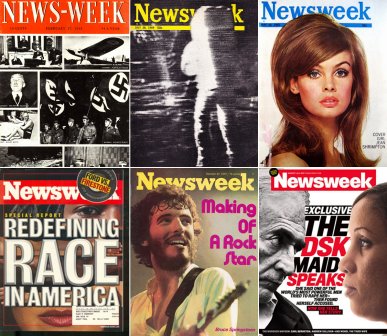
Another legacy news institution dies. The latest print publication to fail to make the transition to a digital ecology is Newsweek — a fixture on the American scene since its founding in 1933. After decades as a profitable division of the Washington Post Co., the weekly news magazine peaked at a paid circulation of just over 3.1 million a week, in 2001. Less than a decade later, with circulation plummeting and debts mounting, the Post company sold Newsweek for one dollar, just to try to stop the bleeding, and the magazine merged with the Daily Beast. 


Newsweek was important as an alternative to the Luce empire’s older and bigger TIME magazine in the weekly news-magazine market, and it did some fine reporting and photography over the years. 

Technically, Newsweek is ceasing to publish in print. It will go online-only and be folded into the Daily Beast website, founded and run by Tina Brown.

Here’s a collection of Newsweek covers from today’s Daily Beast site.


p.s. I hate writing these obits for legacy media, and I hope this is the last. — CBD


Leave a comment

Filed under Journalism, journalism history

No comment

By Christopher B. Daly

As a public service, I am following up on a recent post about Jack Welch, the original “jobber,” who tried to launch the rumor that the professionals at the Bureau of Labor Statistics was cooking the books on the monthly unemployment figures as a political favor to their boss. Turns out, the journalists at Fortune (where Welch had a column) could not let that stand; they did what journalists are supposed to do — they did some checking and found nothing to it.

In umbrage at their verification efforts, Welch announced that he was quitting his ties to Fortune. Hmmm…

Here’s Fortune’s version.

Here’s the take-away:

Monday morning on MSNBC’s Morning JoeFortune managing editor Andy Serwer said there were a number of things wrong with Welch’s tweet, the biggest of which was that the economy doesn’t back up the former executive’s claim that the numbers were faked.

“I think it’s exactly the opposite of what Jack Welch is saying,” Serwer said. “Things are actually improving.”

Also, I had a chance to look further into GE’s stock performance. The 5-year chart below shows quite clearly that GE’s stock was cratering  (along with the rest of the economy) late in the Bush administration. Under Obama, the stock has steadily risen and has about doubled under the current administration’s policies.

Price Chart

1 day | 5 day | 3 month | 1 year | 5 year


Leave a comment

Filed under Journalism