A Bottom at Last?

By Chris Daly

Probably too soon to tell, but the latest figures from ASNE on the annual census of newsroom employees are actually up a little bit.

The bad news: the percentage of minorities slipped, again.

Amazing: 441 US newspapers have no minorities on the the full-time staff. Zero. The editors of those papers should take a look at the US Census.


Leave a comment

Filed under Journalism, media

Who reports?

By Chris Daly

The always-interesting Nate Silver, in a recent post, put his finger on a really key issue in journalism: who does the reporting that everyone else fights over, analyzes, re-purposes, aggregates, or just steals?

Silver did some back-of-the-envelope calculations and came up with this chart:

(I must say I am very gratified to see that two of the top 10 — The AP and The Washington Post — are the places were I spent most of my years as a journalist.)

As anyone in the news business could tell you, there are no real surprises here. Silver is trying to identify who does the bulk of the original reporting about national and international affairs for American audiences. (He is not looking here at local news, which is another story.)

Two news organizations in particular stand out, almost in a class by themselves.

First is the AP, the enormous but nearly invisible news organization that still operates in every state in America and most countries around the world. The non-profit cooperative functions as a giant wholesaler of news — gathering, re-writing, shooting, editing, and distributing vast amounts of stories, images, sound, and data every hour of every day. Almost all of AP’s output is delivered to other news organizations, and not directly to the public. So, most people think they “get their news” from whatever retail outlet they happen to frequent, rather than from the ultimate source, which is often the AP.


Number Two on the list is The New York Times. Again, no real surprise. Say what you will about its management, business model, stock price and all the rest, the Times has no real peer among “general news” organizations. (By that, I mean organizations that have a broader sweep than a particular topical niche like business, sports, or celebrities).

The point is worth making again: reporting is expensive (and sometimes dangerous), and the world would be a better place if more people got out, walked around, took notes, made photos, and shared what they found.

‘Nuf said.

2 Comments

Filed under Journalism, New York Times

More news about the news

By Chris Daly

More news today about journalism.

~First, an update from the NYTimes about the harrowing captivity of four of its own journalists (including Tyler Hicks, a BU alum who will be the commencement speaker this spring at BU’s College of Communication — assuming he stays out of any further serious trouble). And thanks to Joe Klein, on today’s “Morning Joe” on MSNBC, for pointing out that when certain people (he mentioned Sarah Palin) whine about the “lame-stream media,” they should realize that they are disrespecting people who deserve better. 


Photo by John Moore/Getty Images


~Whither Glenn Beck? Who the heck knows?


~Thanks to Michael Miller for pointing this out, here are some interesting further thoughts on the NYTimes pay model (including bold assertions about the future) from John Gruber at Daring Fireball. (With a name like Daring Fireball, no wonder he’s so confident about his predictions…)


~A happy prospect: help-wanted from Talking Points Memo, which is seeking to fill a new position, that of associate editor for Washington news. Here’s the take-away:

Crackerjack news judgment, experience as an editor and deep familiarity with politics and political news are each a must. Competitive salary for qualified applicants; health care, three weeks annual vacation and 401k benefits provided.


Glad to see health care benefits being offered. Wonder what is meant by “competitive salary”. . .


Leave a comment

Filed under broadcasting, Fox News, Glenn Beck, Journalism, New York Times

News about the news

By Chris Daly

It’s a busy Monday for news about the news business. Here goes:


–Happily, the four talented, experienced journalists from the NYTimes captured by the Libyan government have been released.

From London comes word of limited progress in addressing some of the worst features of British libel law (presumption of guilt, unlimited jurisdiction, etc.)

David Carr peers inside Google and sees a “media company.”

Foreign news matters again inside big news organizations that have been hollowing out their “foreign desks” and closing overseas bureaus.

–I’m not even sure what this story about Thrillist is all about, but it’s the most emailed business story, so here goes.

(Thrillist looks like a retailing site to me, not a media site. But what do I know?)


Leave a comment

Filed under Journalism, media

NY Times pay wall

By Chris Daly


So often, the field of media criticism/analysis partakes of the spirit of sports journalism. If you watch ESPN a lot, you realize that most of the people on the screen have a very specific skill set: the ability to make bold, provocative statements about the near future. (There is a similar skill set involved in politics and military analysis, too.)


I will admit that this is an activity I am not very good at, so I will not try. Instead, I take a more agnostic and empirical approach (more in keeping, I think, with the genius of journalism and history, which are essentially backward-looking enterprises). I am applying it now to the NY Times newly announced pay-for-news plan.


To its credit, the paper has started covering the issue a bit better, including a piece today.

Some of those people who are gifted with knowledge of the future are already weighing, as here.

I say: let’s get some data first, then try to figure out what it means.

Until then, I must say I wish the Times good luck in figuring this out.


NYT publisher Arthur Sulzberger Jr. last week.


.

Leave a comment

Filed under media, New York Times, publishing

The nature of revolution

A thought for a revolutionary era:

All successful revolutions are the kicking in of a rotten door. — J. K. Galbraith

Here’s confirmation:


5 Comments

Filed under Politics

My Gripe with HuffPo

By Chris Daly

Tonight’s coverage of the budget crisis in Wisconsin brings a revealing look into Huffington Post and its approach to other people’s work.

First, look at the photo below, which appeared Thursday evening on the homepage of “Talking Points Memo.” Note that it carries a credit line saying it was taken by the Milwaukee Journal Sentinel. That is hardly surprising. When news like this breaks, that is where you would expect the best coverage — from the biggest newspaper that covers the subject on a regular basis. Who else is going to know the cops, guards, and custodians in the capitol building? Who else is going to know how to get to that vantage point? It’s going to be the newspaper with the biggest remaining commitment to covering state government (or maybe the Associated Press), and that’s usually it.

I should also say it is a striking image — and a hat-tip to the photog. (From a visit to the Journal Sentinel online, I would guess that it was taken by Tom Lynn.)

Now, look at the photo below.

This photo appeared on the homepage of “The Huffington Post” on Thursday evening. Note that it carries no credit line. I cannot imagine that HuffPo paid a staff photographer (do they even have one?) to fly to Wisconsin to take this photo. Someone else took the photo, and HuffPo took it from them. That shows a rotten disregard for the original work of other people.

Here’s what I am trying to teach my journalism students: Create it, or credit it.

How hard is that to remember?


1 Comment

Filed under Arianna Huffington, Huffington Post, Journalism

How Egypt Suppressed the Internet

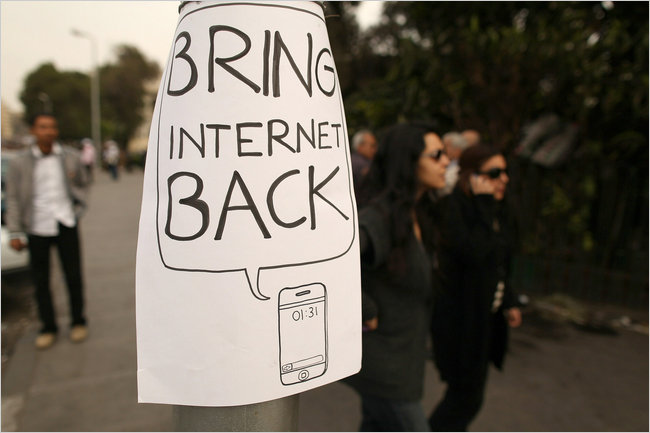
Here is a story I have been looking for. Today’s NYTimes has a page 1 story that puts together the best explanation I have seen yet for the mechanics of Egypt’s suppression of the Internet.

Tip of the hat to tech writer John Markoff.


Leave a comment

Filed under Uncategorized

A real “curveball”

By Chris Daly

This story was, I suppose, inevitable. But it is important to establish the historical record of the Bush years.

Here’s the nub of what the Iraqi source known by his nickname “Curveball” told the Guardian this week:

Everything he had said about the inner workings of Saddam Hussein’s biological weapons programme was a flight of fantasy – one that, he now claims was aimed at ousting the Iraqi dictator. Janabi, a chemical engineering graduate who had worked in the Iraqi industry, says he looked on in shock as Powell’s presentation revealed that the Bush administration’s hawkish decisionmakers had swallowed the lot. Something else left him even more amazed; until that point he had not met a US official, let alone been interviewed by one.

“I had the chance to fabricate something to topple the regime,” he told the Guardian in a series of interviews carried out in his native Arabic and German. “I and my sons are proud of that, and we are proud that we were the reason to give Iraq the margin of democracy.”


What’s missing are comments from:

President George W. Bush

Secretary of State Colin Powell

National Security Adviser Condoleeza Rice

CIA Director George Tenet

Defense Secretary Donald Rumsfeld.

Journalists should be staking out every one of these people and demanding answers.

Leave a comment

Filed under Uncategorized

NPR budget cuts

By Chris Daly

So, Republicans have proposed cutting the budget for public broadcasting to zero. This is a perennial issue, as I have discussed before.

For my two cents, here goes: the amount of taxpayer funds as a fraction of the total of all PBS and NPR budgets is very small. Public broadcasting would be better off without it. They should send the check back to the Treasury today, and then they can tell Republicans how they really feel about them. That would take a club out of the hands of Republicans (who never liked public broadcasting from its inception late in the Johnson administration), and it would unite public broadcasting with the real source of its strength — the audience.

Rip off that band-aid, and I will double my annual pledge.


1 Comment

Filed under NPR