Terror or Fear? (cont.)

By Chris Daly 

In trying to assess the troubling verdict in the Tarek Mehanna case, I am impressed by the analysis provided by one of the witnesses. Yale political scientist Andrew F. March is on the right track in his analysis, which appears in today’s Times Sunday Review section.

Like Prof. March, I just cannot find any evidence or testimony in Mehanna’s recent trial in U.S. District Court in Boston that unambiguously links him to any actions that  are crimes.

He may have wished to be a terrorist.

He may have sympathized with some terrorists.

He may have thought and spoken and blogged in favor of anti-American causes.

But I do not see where he ever did anything to harm an American. That is what remains so troubling about this case. It appears that the federal prosecutors over-reached in charging him with unpopular thoughts and speech, and — equally troubling — the jury went along with it.

I guess the moral is: watch what you think. . .

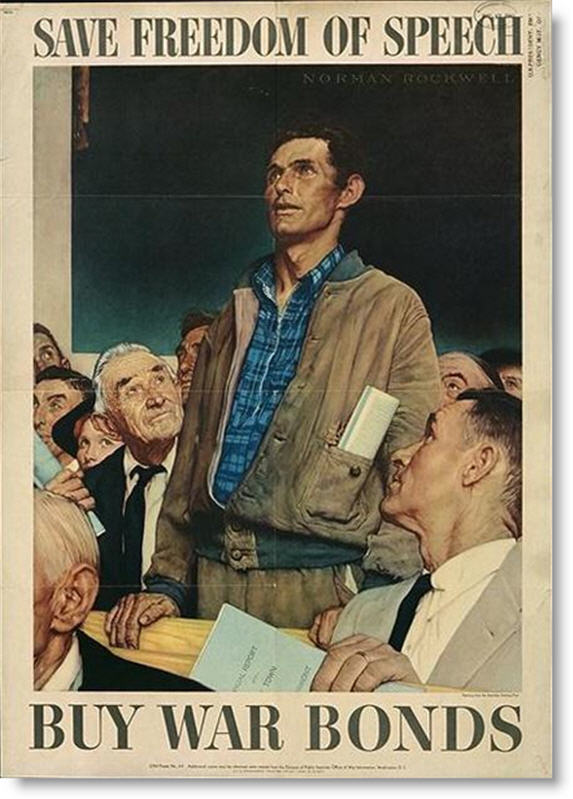
Norman Rockwell


Leave a comment

Filed under Uncategorized

Titanic’s role in journalism

By Chris Daly 

On the eve of the centennial of the sinking of the Titanic, I am posting an excerpt from my new book, Covering America, about the impact of the Titanic on the emerging field of “wireless telegraphy.”

First, here is an image of a wireless distress signal sent that night from the Titanic to the Marconi company.

Telegram from the Titanic: "require assistance. . . struck iceberg"
(Courtesy: Museum of the History of Science, Oxford)

From Covering America: A Narrative History of Nation’s Journalism, chap 7:

In the decades following its invention, the telegraph became a fact of life and an indispensable tool in business, in the military, and in journalism. Still, it had some drawbacks: it could carry a message, but the contents had to be sent in code; messages could be sent only from one point to another, and those two points had to be connected by a copper wire. For these reasons among others, the telegraph was not a popular means of communication but remained a special tool used mainly by businesses.42 In the late nineteenth century, a flurry of scientific and engineering breakthroughs started to overcome those limitations. In 1876 a Boston University professor named Alexander Graham Bell invented a machine, the telephone, which allowed the human voice to be carried over a wire. Nikola Tesla, a Serbian immigrant to America and the inventor of the alternating-current electric motor, contributed the idea that electromagnetic waves could carry messages. Soon it was proven that such waves could pass through walls. They could scale mountains, even cross the ocean. This created the promise of an amazing possibility: a telegraph without wires! A young Italian, Guglielmo Marconi, became a pioneer in the new field, devoting himself to working on a way to use radio waves to transmit signals carrying Morse code.43 Marconi had the resources to tinker with the idea; his mother was an heir to the Jameson family Irish whisky fortune. Rebuffed at home, Marconi went to England, where he formed the Wireless Telegraph Signal Company in 1897, to be followed by an American division of British Marconi a few years later. In 1901, Marconi even managed to send a wireless signal across the Atlantic Ocean, but he struggled to find a business model for his invention. The early applications of the new technology were in the military and in the shipping business, where the ability to send messages without wires had an obvious appeal. At first the technology was referred to as wireless telegraphy, or simply “wireless,” but a new term—radio—first popularized in the U.S. Navy, soon won out. In 1906 an American inventor named Reginald Fessenden demonstrated that radio signals could transmit more than just long and short pulses. They could carry music and even the human voice. In the end, that discovery proved indispensable for making radio a truly popular medium. One of the first big tests of radio, one that made a lasting impact on the public imagination, came in 1912, when the world’s greatest luxury ocean liner, the state-of-the-art Titanic, made its initial voyage from England to New York.44 As the great ship crossed the North Atlantic on April 14, it struck an iceberg, and the crew immediately used the ship’s wireless equipment to call for help. Some of the other ships in the vicinity had wireless equipment that was turned on and monitored at all times; others had turned their sets off for the night. As a result, Copyright 2012 NOT FOR SALE [ 204 ] CHAPTER 7 the closest ship, the Californian, which could have saved all of the Titanic’s 1,522 passengers, lay at anchor just nineteen miles away and never responded. The Carpathia, which was fifty-eight miles away when the Titanic started sinking, took two hours to arrive, and by then, many passengers had drowned in the frigid waters of the North Atlantic. Rescue efforts were also hampered by the many amateur radio operators who filled the airwaves that night with rumors, questions, and interference from their overlapping signals. In the aftermath of the Titanic disaster, the U.S. Congress quickly adopted legislation requiring that all American oceangoing ships and all those entering U.S. ports be equipped with radios, and that the radios be kept on and staffed at all times. Congress also required radio operators to get a license from the U.S. Department of Commerce, and it relegated amateur operators to the bottom of the radio spectrum (the shortwave end) while giving priority to the navy and to commercial companies like Marconi’s.45 Significantly, Congress chose not to follow the European model, in which new technologies including telegraph, telephone, and radio were successively grafted onto a government monopoly such as the postal service, resulting in public communication monopolies like the BBC. In the United States, Congress operated on the principle that radio would be a private enterprise—regulated, to be sure, but private nonetheless. In retrospect, this was one of the constitutive moments shaping the eventual architecture of broadcasting in America, combining elements of technology, law, and economics into a new model.46 On the night of the Titanic disaster, one of the radio operators in New York handling reports of the sinking was a young man named David Sarnoff. (He was not the only one, as he often claimed.) A Russian immigrant who never made it past the eighth grade, Sarnoff would become one of the titans of broadcasting in the twentieth century as president of RCA, the Radio Corporation of America.47 While working for Marconi, Sarnoff demonstrated great foresight. In 1915, when he was just twenty-four years old, Sarnoff wrote a memo to his boss, giving his thoughts on the business. He envisioned a future for radio that went far beyond transmitting coded messages from point to point. “I have in mind,” he wrote, “a plan of development which would make radio a ‘household utility’ in the same sense as the piano or the phonograph. The idea is to bring music into the home by wireless. . . . The same principle can be extended to numerous other fields as, for example, receiving lectures at home which can be made perfectly audible; also, events of national importance can be simultaneously announced and received.”48 Sarnoff projected a market of 15 million American families. The Marconi company did not think much of Sarnoff’s scheme, but Sarnoff clung to the idea that radios could be a popular mass commodity, provided they became easier to use. Never much of engineer, Sarnoff was already showing his true talent: marketing. He switched to management. While Sarnoff and others were pondering the future of radio, most Americans Copyright 2012 NOT FOR SALE Jazz Age Journa lism, 1920–1929 [ 205 ] still had never heard a radio broadcast. A few license-holders were beginning to transmit signals through the airwaves (or into “the ether,” as it was called), where they could be heard by anyone with a receiving set. But hardly anyone had one yet. A few corporations, such as United Fruit, were using radio to coordinate their shipping fleets. And of course the army and navy remained deeply involved in radio. But before about 1920, radio remained largely in the hands of the amateurs— most of them young men who were inclined to tinker. Those early adapters usually built their own radio sets. They set up friendly competitions to see who could pull in the faintest or most distant signal (which they called “DXing”). They often traded information and parts in a wave of enthusiasm that had nothing to do with patents, profits, or licenses. Participants in the new movement sometimes referred to what they were doing as “citizen radio.”49 An editorial in one of the first radio journals put it this way: “Do you realize that our radio provides about the only way by which an individual can communicate intelligence to another beyond the sound of his own voice without paying tribute to a government or a commercial interest?”50 Soon others joined in—women as well as men, universities, stores, even the famous Dr. Brinkley of Kansas, who used radio to promote his theory that implanting goat glands would cure “male trouble.” Radio was wide open— diverse, local, nonprofit, and utterly unpredictable. But not for long. World War I transformed radio, as it did so many other institutions.

Leave a comment

Filed under broadcasting, Journalism, journalism history

Newspaper jobs

By Chris Daly 

This just in: The number of jobs for reporters in U.S. newspapers has probably bottomed out. That’s one takeaway from the latest survey of the country’s newsrooms released by the American Society of Newspaper Editors. The ASNE, which has been meeting in Washington and played host to both Obama and Romney (on different days!), conducts an annual survey of who is working in the newsroom.

Here’s a key passage (imho):

Despite this year’s loss in newsroom positions, the decline in jobs that began in 2006-07 appears to be stabilizing. The loss this year is not as drastic as the losses between 2007 and 2010.

So, if things are no longer getting worse, does that mean that they are getting better?

Leave a comment

Filed under Journalism

“Covering America” reviewed

By Chris Daly

Delighted to see this review just out from Publisher’s Weekly.

Covering America: A Narrative History of a Nation’s Journalism.
Christopher B. Daly. Univ. of Massachusetts, $49.95 (544 p) ISBN 978-1-55849-911-9

In this scholarly yet readable volume, Daly (Like a Family: The Making of a Southern Cotton Mill World), a professor of history and journalism at Boston University, presents a surprisingly spirited and detailed account of American journalism and the many ways in which the press has impacted the trajectory of American history, and vice versa. Beginning in the early 1700s with the institution of a postal service and continuing through the advent of the Internet and its implications for the “dinosaurs” of big media, the book is full of colorful portraits of American media icons such as Benjamin Franklin and late New York Times reporter David Halberstam. Any history book runs the risk of being bland, but Daly peppers the text with amusing anecdotes and intriguing facts (e.g., the idea for the first journalism courses, offered at Washington & Lee University, came from defeated Confederate General Robert E. Lee). Daly divides the major time periods in American journalism into five categories: politicization (1704-1832), commercialization (1833-1900), professionalization (1900-1974), conglomeration (1965-1995), and digitization (1995-present). These divisions make the narrative easy to follow for both students of journalism and casual enthusiasts. In addition to the interesting stories, Daly makes many cogent arguments about what the press has meant to the country’s shared history and identity. Illus.

Reviewed on: 04/09/2012
If you’ve read it, please leave a comment of your own. If you haven’t, get off-line, pick it up, and read!


Leave a comment

Filed under history, Journalism

Shameless promotion

By Chris Daly

Just back from a talk I gave at the Columbia Journalism School on Tuesday. The dean, Nick Lemann, is an old friend who graciously hosted a discussion of my new book, Covering America

The video should be shown on C-Span’s Book TV in a few days. (I will post the link when it’s definite.)

Here’s proof that I was there, standing in front of Joseph Pulitzer himself.

Photo by Anne Fishel

Photo by Anne Fishel

Leave a comment

Filed under Journalism, journalism history

The bear facts

By Chris Daly 

For the past week or so, I have been puzzling over my reactions to a new multimedia project from the Canadian National Film Board. It’s called “Bear 71,” by Jeremy Mendes and Leanne Allison.

It is described as “an interactive multimedia project” that tells “the true story of a grizzly bear.” It is fascinating. It is absorbing. It is beautiful. It is a high-tech, multi-layered way of spending time with an individual bear. As far as I can tell, nothing is made up. All of the information comes from radio tracking, video, and other sources.

The weird thing about it is that it is narrated from the bear’s point of view.

Does that mean it is still non-fiction?

I’d love to know what other people think, so please watch it, then leave a comment.

Leave a comment

Filed under Uncategorized

Narrative in journalism’s history

NARRATIVE 

IN THE HISTORY OF

AMERICAN JOURNALISM

BY CHRIS DALY

[Narrative Arc conference, Boston University, March 24, 2012]

I am delighted to speak briefly today about my new book, which is a narrative itself that focuses on the history of journalism in America. It’s called Covering America, and I conceived of it as a narrative from the get-go. That is, the book is a 300-year history of a major institution with a through-story that follows a thread of innovation.

Before writing this book, I had spent 20+ years in the news business, at the AP and at the Washington Post — most of that time banging out bulletins or day stories or updates. So I was ready to try a different mode.

Funny thing: this book took so long to write that there is something of a narrative about the writing process. When I started working on it eight years ago, the news media were still fat and happy and arrogant.  And I thought my narrative arc would end in a critical denunciation of Big Media.

Then, the bottom fell out. For years, Romenesko brought us nothing but news of layoffs and bankruptcies. So, I needed a new ending. For a while, it looked like I might be writing journalism’s obituary.

But then, things started to shift again, in really interesting new ways – all kinds of experiments, new models, new heroes– well, let me just say that it’s covered in the last chapter.

So what did I learn about narrative?

I learned that narrative in American journalism is not a johnny-come-lately, and not a fad. In fact, narrative was right there at the founding.

Here’s an image from the Boston News-Letter of 1704 – the first edition of the first successful newspaper in the New World.

It contains – a narrative! It is a narrative about a certain Captain Toungrello, a pirate who was marauding off Curacao in the Caribbean, then made his way as far north as Rhode Island.  It’s a great story, told in my book.

And narrative remained a persistent feature. For many, many decades, American newspapers were more likely to carry what we might call an account than a report. By account I mean – usually – a first-person narrative: I went here and saw this.

It’s only well into the 19th century that we start to see the emergence of the report (or the reported story) – the dispassionate, impersonal organized by importance rather than chronology – usually devoid of  personality, wit, attitude and drama.

But all along, narrative persisted. In newspapers, magazines, and books.

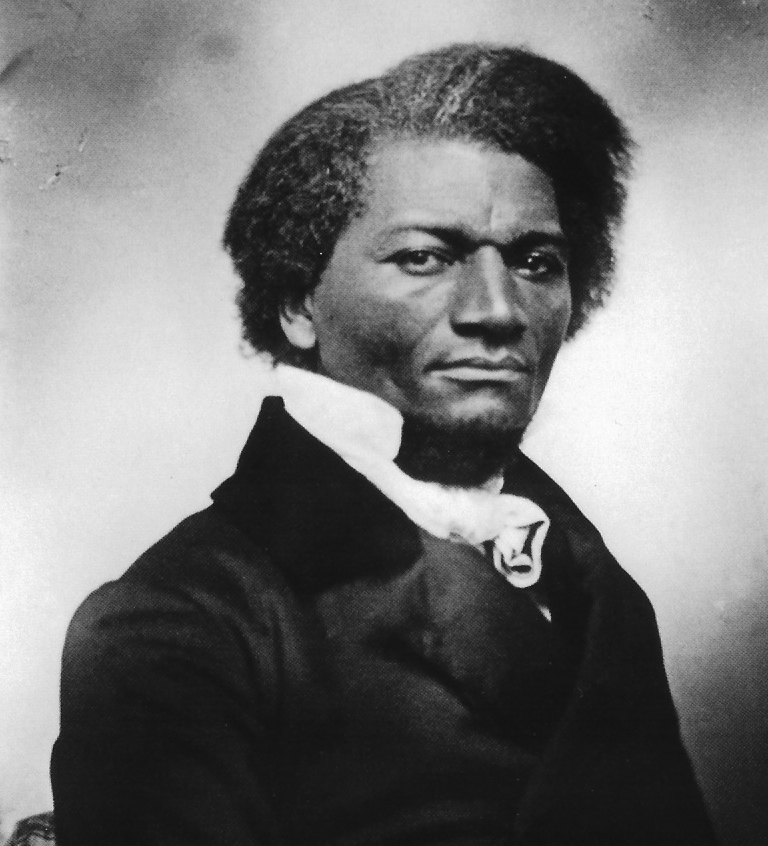
You can see it in Frederick Douglass’ great narrative and in other slave narratives.

Here is his opening, published in 1845.

I was born in Tuckahoe, near Hillsborough, and about twelve miles from Easton, in Talbot county, Maryland. I have no accurate knowledge of my age, never having seen any authentic record containing it. By far the larger part of the slaves know as little of their ages as horses know of theirs, and it is the wish of most masters within my knowledge to keep their slaves thus ignorant. I do not remember to have ever met a slave who could tell of his birthday. They seldom come nearer to it than planting-time, harvest- time, cherry-time, spring-time, or fall-time. . .

My mother was named Harriet Bailey. She was the daughter of Isaac and Betsey Bailey, both colored, and quite dark. My mother was of a darker complexion than either my grandmother or grandfather. . . .

I never saw my mother, to know her as such, more than four or five times in my life; and each of these times was very short in duration, and at night. She was hired by a Mr. Stewart, who lived about twelve miles from my home.

Right there, you can see Douglass grabbing narrative as his tool to tell the world about himself: I was born. . . Then, we can see him link his own story to his people’s story. All in the first three sentences.

You can see narrative again  in Nellie Bly’s great work in the 1880s – her  “Ten Days in a Madhouse”  One of the first undercover exposes.

Or her “Around the World in 72 Days.”
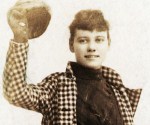
Here’s her very shrewd opening to “72 Days”, published in 1890:

WHAT gave me the idea?

It is sometimes difficult to tell exactly what gives birth to an idea. Ideas are the chief stock in trade of newspaper writers and generally they are the scarcest stock in market, but they do come occasionally,

This idea came to me one Sunday. I had spent a greater part of the day and half the night vainly trying to fasten on some idea for a newspaper article. It was my custom to think up ideas on Sunday and lay them before my editor for his approval or disapproval on Monday. But ideas did not come that day and three o’clock in the morning found me weary and with an aching head tossing about in my bed. At last tired and provoked at my slowness in finding a subject, something for the week’s work, I thought fretfully:

“I wish I was at the other end of the earth!”

“And why not?” the thought came: “I need a vacation; why not take a trip around the world?”

It is easy to see how one thought followed another. The idea of a trip around the world pleased me and I added: “If I could do it as quickly as Phileas Fogg did, I should go.”

There, she is setting the hook. Most readers – most people in America – would have known how this story turns out. The fact that she made the trip was covered obsessively by her own paper, Pulitzer’s New York World. So, what’s left? The narrative that focuses on how. Yes, we know the ending, but this narrative is going to give us something else.

You can see narrative again and again. There it is in the rise of photojournalism: in

LIFE (founded, 1936), which pioneered the photo  essay. Many of those photo essays were often conceived and executed in a narrative mode.


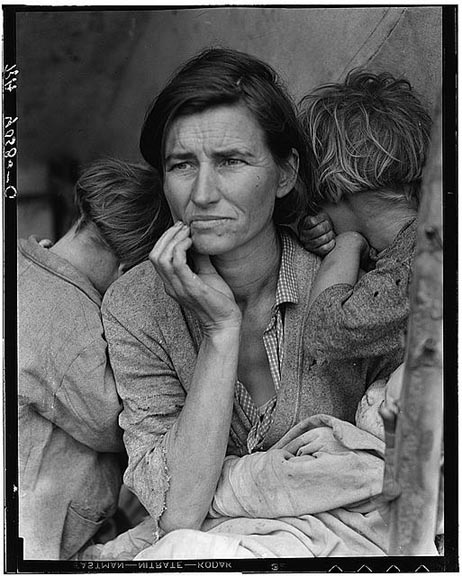
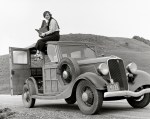
We see narrative again in the FSA photos, telling a narrative about desolation and dislocation. Here’s a rare photo: it shows the photojournalist Dorothea Lange – looking jaunty in her sneakers atop her old woody.


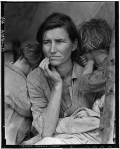
And here’s her classic photo titled Migrant Mother. Although it’s a still image, it certainly tells a story. A tale of dislocation, of loss, of movement.


DURING WORLD WAR II , narrative came roaring back. Journalists, in search of powerful storytelling modes for the unbearable stories they had to tell. Just to take a few examples:

–Ernie Pyle’s “The Death of Captain Waskow

–Marguerite Higgins on the liberation of the Dachau concentration camp in April 1945.

–William Laurence on the dropping of the A-bomb on Nagasaki.

And of course, the master: John Hersey.

His Hiroshima, considered a masterpiece of 20th C journalism, has an extraordinarily tight narrative focus:

At exactly fifteen minutes past eight in the morning, on August 6, 1945, Japanese time, at the moment when the atomic bomb flashed above Hiroshima, Miss Toshiki Sasaki, a clerk in the personnel department of the East Asia Tin Works, had just sat down and her place in the plant office and was turning her head to speak to the girl at the next desk. . .

I would argue that Hersey is the key figure here, the one who connects this great tradition to the New Journalists, who in turn have a lot to do with the current resurgence of narrative.


So, today, as we talk about narrative, as we create our own new narratives, as we think about the future of narrative, I would say we are seeing a rebirth. We are seeing the explosion of narrative as a storytelling mode across all platforms.

I would argue that we are even beginning to see the classic news report – the inverted pyramid, the “news from nowhere” — with its flattening of affect and its shattering of time – we are starting to see that as a historical artifact. It is not inevitable, it is not superior, it is not even adequate for so many purposes.

So, here’s my bias: I want all of us to know this history, to claim this legacy. Many of us here today are exploring the outer limits of narrative – across different platforms, lengths, and topics.

And even as we do that work, we should know that we are heirs to a great tradition. That is the legacy that I tried to find, open up, and share in my book, “Covering America.” As I wrote it, I felt so proud of that long line of journalists who had done such wonderful work and so humble in their presence.

–30–

2 Comments

Filed under Journalism, journalism history

A St. Patrick’s Day tribute (part 2)

By Chris Daly 

One of the greatest Irish-Americans in the history of U.S. journalism is one who is not often remembered today: S.S. McClure.

After making money in the syndication business, McClure sent on to found one of the most important magazines in American history, the eponymous McClure’s Magazine. More than any other magazine, his was at the heart of the Muckraking movement at the start of the 20th Century. He hired or published Ida Tarbell, Lincoln Steffens, Ray Stannard Baker, and other pioneers of investigative journalism. The January 1903 issue of McClure’s Magazine was one of the greatest single issues ever published. 

Here is an excerpt from my new book (on sale now!), called Covering America, which is a narrative history of 300+ years in journalism.


As a coherent national movement, muckraking can be traced to the year 1902. The setting was a monthly magazine called McClure’s, which had been founded by S. S. McClure, an Irish-born journalist, in 1893 in New York City. Sam McClure was a pioneer in a new kind of publication then sweeping the country. Although magazines had been published in America for more than a century, they generally steered clear of journalism and focused instead on literature, fiction, ladies’ fashion, or housekeeping hints. Traditional magazines like the Atlantic Monthly, Scribner’s, or Harper’s were also typically quite expensive in price and conservative in outlook. But starting in the 1880s, a new kind of magazine appeared. Thanks to dramatic drops in the cost of paper, magazines could now be priced to reach middle- and working-class audiences. And thanks to the halftone engraving process, they could print extensive displays of photographs. It is also important to note that, unlike even the biggest daily newspapers, which were rarely distributed far beyond their home base, these magazines circulated around the country. The emergence of cheap, well-illustrated monthly magazines created the possibility, for the first time, of a mass national audience focused on news and public affairs. Until the advent of radio networks in the 1920s, such magazines were the only truly national outlet for journalism.

Still, it took some initiative to capitalize on this new possibility and to turn it in a politically progressive direction. That was precisely where Sam McClure, after making a fortune in syndication, led the way. One of McClure’s first hires for his magazine was a young woman named Ida Tarbell, who spent most of the 1890s working on lengthy serialized biographical sketches—first of Napoleon, then of Lincoln. Two other key additions were a contributing editor, veteran Chicago reporter Ray Stannard Baker, and a managing editor, Lincoln Steffens, hired in 1900. In January 1903, McClure’s Magazine assembled an issue that has been called the most famous in American magazine history. It contained three articles that became recognized as classics of modern muckraking: part three of Tarbell’s history of John D. Rockefeller’s Standard Oil trust, Steffens’s exposé of municipal corruption in Minneapolis, and an article by Baker on a brutal coal-mining strike in Pennsylvania—all accompanied by an editorial written by McClure that attempted to frame the entire issue as one that raised serious questions about American society. “Capitalists, workingmen, politicians, citizens—all breaking the law, or letting it be broken. Who is left to uphold it?” he asked. “There is no one left; none but all of us.”

Tarbell’s nineteen-part series on Standard Oil became a sensation and set the standard for the techniques of exposé. Tarbell, who had grown up in the oil fields of western Pennsylvania, where Rockefeller built his business, was a scrupulous researcher, and she relied heavily on official government documents and court records to build the case against him. Rockefeller’s companies had been sued and investigated for many years, and there was an extensive paper record dispersed across dozens of courthouses and state agencies, but no one had committed the time and expense (McClure sank an astonishing $50,000 into the project) to pull it all together in a dramatic narrative for a national audience. Tarbell’s account was quickly published in book form, and two years later, the administration of Theodore Roosevelt filed a federal antitrust suit against Rockefeller’s Standard Oil. For McClure’s Magazine, the impact was also great. From a circulation of about 370,000 in 1900, the magazine shot past half a million after it began running exposés.

Soon, others joined in. Journalists began looking into child labor, race relations, lynching, prostitution, and an array of other social ills. . .


Leave a comment

Filed under history, Journalism, journalism history

A St. Patrick’s Day tribute (part 1)

By Chris Daly

Irish immigrants to the United States, of course, had a large impact on American journalism. Usually landless, they crowded into the growing cities of America in the 19th century, at precisely the same time as the ascendancy of the big-city daily newspapers. Often literate in English, the Irish immigrants found a way to make something (a paycheck) out of nothing (a facility with the language).

One of the greatest was Finley Peter Dunne. (His timeless observation about the purpose of journalism appears on pg. 128 of my new book, Covering America).


Here is the quote:

“The job of a newspaper is to comfort the afflicted and afflict the comfortable.”

Dunne wrote in the guise of “Mr. Dooley,” a thickly accented immigrant, as a columnist for a series of papers in Chicago during the 1890s and early 20th Century.

Finley Peter Dunne (from Wikipedia)


Leave a comment

Filed under history, Journalism, journalism history

Cameras in court

By Chris Daly 

Praise for the Supreme Judicial Court of Massachusetts for recognizing the right of the people to know what goes on in their courts.

In a recent ruling, the state’s highest court ruled in favor of the OpenCourt initiative, which seeks to post court proceedings online.

From my experience in covering trials, arraignments and other court proceedings in several states, I would say that far too many judges, clerks, guards and others consider the judiciary branch their own territory and resent the intrusions of the mere public (not to mention journalists) in what they consider “their” courthouses.

And a hat-tip to WBUR, a Boston NPR affiliate, for pushing this project. (And thanks to the Knight News Challenge, too.)


Leave a comment

Filed under Uncategorized