Keeping up with the Murdochs By Chris –

Keeping up with the Murdochs By Chris – Keeping up with the Murdochs By Chris Keeping up with the Murdochs By Chris… http://ow.ly/1j8HN8

Leave a comment

Filed under Uncategorized

Murdoch scandal (cont.)

By Chris Daly 

Gee, I guess I have been wrong about Rupert Murdoch all along. Turns out he’s just a simple publisher striving always to do the right thing.

Here’s the latest from London.

Rupert Murdoch / pool photo

Leave a comment

Filed under Journalism

Keeping up with the Murdochs By Chris –

Keeping up with the Murdochs By Chris – Keeping up with the Murdochs By Chris Daly It’s not easy keeping track of … http://ow.ly/1j7o8K

Leave a comment

Filed under Uncategorized

Copy, right? By Chris Daly Our wacky l –

Copy, right? By Chris Daly Our wacky l – Copy, right? By Chris Daly Our wacky legal system at work. Here is what o… http://ow.ly/1j7o8P

Leave a comment

Filed under Uncategorized

Keeping up with the Murdochs – By Chris

Keeping up with the Murdochs – By Chris Daly It’s not easy keeping track of the unfolding Murdoch scandal(s), with d… http://ow.ly/1j6wm2

Leave a comment

Filed under Uncategorized

Copy, right? – By Chris Daly Our wacky l

Copy, right? – By Chris Daly Our wacky legal system at work. Here is what our founders wrote in the Constitution (A http://ow.ly/1j6wm7

Leave a comment

Filed under Uncategorized

Keeping up with the Murdochs

By Chris Daly

It’s not easy keeping track of the unfolding Murdoch scandal(s), with developments multiple times a day on both sides of the Atlantic.

Here is

The New York Times has assigned two-time Pulitzer Prize winner John F. Burns, which is a sign of the paper’s institutional commitment to the story, which is of course meant to torment the Times‘ chief antagonist, Rupert M. Here’s the lastest from Burns (and his co-author, Alan Cowell):

In Testimony, Murdoch Plays Down His Political Pull

By  and 
Published: April 25, 2012

LONDON — With a political firestorm cascading over the British government’s ties to his media empire, Rupert Murdoch faced rare public scrutiny about his relationships with elected officials on Wednesday, and sought to deflect suggestions that he tried to use his links to powerful public figures to further corporate commercial interests.. . .

Here is the latest from the Guardian, which is live-blogging from the Leveson inquiry:

  • Wednesday 25 April 2012

  • Rupert Murdoch at the Leveson inquiryRupert Murdoch at the Leveson inquiry: ‘Do I have an aura or charisma? I don?t think so.’ Photograph: Reuters

    Join us as News Corp’s Rupert Murdoch gives evidence to the inquiry set up in the wake of the phone-hacking scandal. By Josh Halliday andJohn Plunkett

    Continue reading…213 comments

    Posted by

    10.19 EDT

  • Tuesday 24 April 2012

  • James Murdoch gives evidence at the Levenson inquiry at the High Court in LondonJames Murdoch gives evidence at the Leveson inquiry today

    Full coverage of James Murdoch’s evidence to the Leveson inquiry. ByJosh Halliday and John Plunkett

    Continue reading…

    Posted by

    18.59 EDT

  •  And here is the latest from the Wall Street Journal, which is of course, owned by Murdoch, which makes this a miserable assignment for the three Journal staffers who share the byline today:

    News Corp. Chief Faces Inquiry

    LONDON—With a fresh political scandal swirling around his global media conglomerate here, News Corp. NWSA +0.62% Chairman and Chief Executive Rupert Murdoch faced questioning Wednesday before a public press-ethics inquiry about whether he used the company to call in political favors and push his commercial interests.

    The media mogul repeatedly said he hadn’t asked prime ministers, and would-be prime ministers, for favors, and said that his commercial interests didn’t influence where his newspapers stood on issues or political parties.

    Rupert Murdoch, News Corp. chairman and chief executive, appeared before the Leveson Inquiry, a judge-led examination into British media practices. WSJ’s Bruce Orwall discusses this and the fallout from James Murdoch’s testimony yesterday.

    At the same time, he conceded “abuses” have occurred at his own company—which has been battered by a long-running scandal over illicit reporting tactics—though he added: “I would say there are many other abuses, but we can go into that in time.” Mr. Murdoch also distanced himself from some of the activities: “”We have a very large company and I do run that company with a great deal of decentralization.”

Leave a comment

Filed under Journalism

Copy, right?

By Chris Daly

Our wacky legal system at work.

Here is what our founders wrote in the Constitution (Article 1, Sec. 8):

The Congress shall have power . . . to promote the Progress of Science and useful Arts, by securing for limited Times to Authors and Inventors the exclusive Right to their respective Writings and Discoveries.

Here is what it has come to (from a piece by Patricia Cohen in today’s Times):

Art Is Long; Copyrights Can Even Be Longer

 Filmmakers are not the only ones who sometimes run afoul of artists’ copyright law. In recent weeks Google Art Project, which just expanded its online collection of images to more than 30,000 works from 151 museums, agreed, because of copyright challenges, to remove 21 images it had posted.Artists’ copyright is frequently misunderstood. Even if a painting (or drawing or photograph) has been sold to a collector or a museum, in general, the artist or his heirs retain control of the original image for 70 years after the artist’s death.

Can someone explain how locking up these rights for 70 years after the creator has died is supposed to benefit society by spurring new creative efforts? How does it “promote the Progress of Science and the useful Arts”?

As an author, I am all for giving writers a temporary right to earn money from our creations. Without it, I might still write stuff like this, but I would not have written my book. So, a reasonable copyright is a good thing, in my book (and for my book!). But Picasso is not creating any new Demoiselles no matter how long his family gets to dine out on it.


Leave a comment

Filed under publishing

Review of “The Columnist”

By Chris Daly 

A new play about to open on Broadway takes us back, not only to a different era but to a different America. The play is “The Columnist,” by playwright David Auburn, who also wrote the marvelous drama “Proof” in 2000.
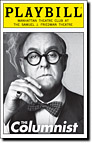
The Columnist, by David Auburn

His latest play tells a version of the story of Joe Alsop, who was one of the mandarins of the Washington pundit class during its heyday. Indeed, one of the remarkable things about “The Columnist” is how deftly it reminds us of what a different media world it was in the 1950s and 1960s from today. It’s not just the period details — Alsop’s smoking or his typing (on a real typewriter!~). What is most telling is the way Alsop thinks of his role and the way he is treated by other powerful figures.

Alsop, who teamed up for periods with his brother, Stewart, knew everyone in Washington, of course. But his most strategic alliance was probably with John F. Kennedy, who, on the night of his inaugural in 1961, said good night to Mrs. Kennedy, then headed over to Joe Alsop’s for a nightcap. This was all very pre-Watergate, in an era when journalists and politicians actually knew each other, spoke off the record, and even drank together.

To his credit, Auburn wastes no time on nostalgia. Yes, his play acknowledges, something has been lost in the distance that now separates journalists from political leaders, but “The Columnist” also makes the point in several ways that something has been gained too.

At the same time, the play makes the point that the Democratic Party was a militaristic, center-right party not much different from the Republican Party of that era. Without saying so, the play hints at how much effort it would take in the 1960s and 1970s to turn the Democratic Party into more of a progressive, inclusive, anti-war party.

As played by the marvelous John Lithgow, this portrayal of Alsop pulls no punches. Yes, he could be witty, perceptive,  and disarmingly charming. At the same time, Alsop was a martinet, a bully, and a war hawk. Lithgow deserves high praise for a smashing portrayal in a role that has him on stage for every scene and that requires him to age about 2o years in two hours. Witty, mannered, polished — Lithgow is the perfect embodiment of Alsop.

In the play, Alsop has several shouting matches (via telephone; Lithgow does all the shouting) with Scotty Reston, the Washington bureau chief and lead political columnist for the New York Times for much of the Cold War. Many of them help to advance the play because they involve Alsop’s fury at Reston’s protege, David Halberstam. So, it is quite natural and historically accurate that Alsop is portrayed teeing off on Reston.

But from the standpoint of the history of journalism, a better foil for Joe Alsop would  have been Walter Lippmann. After all, Lippmann was, like Alsop, a syndicated columnist whose beat was The Big Picture. Like Alsop, Lippmann was a pillar of the American Establishment. In the post-War years, there was no office-holder or opinion-shaper who would not drop everything to take a phone call from Walter Lippmann. Yet unlike Alsop, Lippmann was a critic of Kennedy’s involvement in Vietnam and warned the president repeatedly (and publicly) to get out.

When I was writing my book on the history of journalism, Covering America, I considered including Joe Alsop, and I very nearly did. But in the end, I decided that he did not make the cut because he was not enough of an innovator. I wanted to focus on those men and women who changed the field of journalism or who used journalism to make some kind of broader change. Joe Alsop struck me as one of those who dedicated his life to holding off change. More’s the pity.


Leave a comment

Filed under Journalism, journalism history

E-books

By Chris Daly

In the letters to the Times today about ebooks and the future of publishing, I am struck trying to figure out the answer to this question:

In all this upheaval, who is on the side of writers? (without whom, need it be said, there would be no books, in any format)

It feels kinda lonely here in the writer’s corner.


2 Comments

Filed under publishing