News beyond newspapers

By Chris Daly

I heard a terrific piece today on WBUR, the local NPR affiliate. It was about “Toys for Elephants” — a project by students from the Massachusetts College of Art who took up the challenge of designing play objects for two mature elephants who live at the Buttonwood Park Zoo in New Bedford.

Here’s a link to the story by reporter Vicki Croke and producer George Hicks. (I hope I have that division of labor right, but it’s probably murkier than that.) It presents a really rich blend of multi-media: sound, still photos, video, and words.

Try that with your print newspaper!

[Actually, the Boston Globe did a version of the same story back in April, then posted a video version on the paper’s website. It’s a fine piece, too, but not as rich as the ‘BUR version.)

I don’t know anything about elephants, but these seem like two happy, engaged creatures.

Ruth and Emily /  photo by Susan Hagner for WBUR

Ruth, 54, and Emily, 49. / photo by Susan Hagner for WBUR

Leave a comment

Filed under broadcasting, Journalism

Buffett on newspapers

By Chris Daly

Guess what super-investor Warren Buffett thinks about the future of newspapers?

Hint: he’s buying them. (And not just copies of papers; he’s buying whole newspaper companies.)

 Via Omaha.com

Warren Buffett’s letter to publishers and editors

p. 1

«

AP Photo

AP Photo


Leave a comment

Filed under Journalism, local news, publishing

Glass half full?

By Chris Daly

The latest American newspaper to take a step back from daily print publication is the venerable Times-Picayune of New Orleans. Today’s New York Times reports that the 175-year-old newspaper is scaling back to printing three days a week. By doing so, the managers hope to capture the bulk of the advertising revenue they get from display ads in the print version, while reducing some of the “legacy” costs that go along with printing: the extra salaries for full-time printers and drivers; the cost of the newsprint paper; the overhead, etc.

The good news: the folks at the Times-Picayune have taken the first steps along the narrow, rickety, wobbly, rope bridge to the digital future. The Times-Picayune is not going out of business. Far from it. The cutback in printing is part of a larger strategy to save the paper, not destroy it. Just about every newspaper in the country is somewhere along that same timeline, whether they recognize it or not. They are all groping their way into the future — without a map (such as the map of New Orleans below, which was created by the Times-Picayune).

Bonus question: What does picayune mean? (answer below)


Picayune

From Wikipedia, the free encyclopedia
This article is about the obsolete Spanish coin. For other uses, see Picayune (disambiguation).

picayune was a Spanish coin, worth half a real. Its name derives from the French picaillon, which is itself from the Provençal picaioun, meaning “small coin.” By extension, picayune can mean “trivial” or “of little value.”

Aside from being used in Spanish territories, the picayune and other Spanish currency was used throughout colonial AmericaSpanish dollars were made legal tender in the United States by an act on February 9, 1793 until it was demonetized on February 21, 1857.[1] The coin’s name first appeared in Florida and Louisiana where its value was worth approximately six and a quarter cents, and whose name was sometimes used in place of the U.S. nickel.[2][3]

A daily newspaper published in the New Orleans market, the Times-Picayune, is named after the picayune.[4]

[edit]References

Wikisource has the text of the1911 Encyclopædia Britannicaarticle Picayune.
Look up picayune in Wiktionary, the free dictionary.
  1. ^ Spanish Silver: General Introduction Coin and Currency Collections – University of Notre Dame, Retrieved on April 7, 2008
  2. ^ Picayune, Probert Encyclopedia, Retrieved on April 10, 2008
  3. ^ Picayune, World Wide Words, Retrieved on April 8, 2008
  4. ^ McLeary, Paul (2005-09-12). “The Times-Picayune: How They Did It.”Columbia Journalism Review. Retrieved 2010-07-27.

2 Comments

Filed under Journalism, journalism history

Should anonymous comments be banned?

By Chris Daly 

According to TIME, legislation has been proposed in the New York Assembly that would ban the widespread (but often annoying) practice of posting online comments anonymously. I like comments: I like to read them, and I allow them on this site. 

But here’s the thing: 

–Signed comments are sometimes good and sometimes bad.

–Unsigned comments are sometimes good and sometimes bad.

–All of the worst comments seem to be anonymous.

Let’s discuss. Feel free to comment. But let’s try this: if you insist on commenting anonymously, you must follow the guidelines that journalists use for granting anonymity for sources. That is, you have to have a reason for your anonymity, and you have to disclose as much information as possible about that reason.

Leave a comment

Filed under Uncategorized

Covering Romney

By Chris Daly

Here’s the text of a letter I submitted to the New York Times for publication yesterday. Since they have had 24 hours to act on it and have not contacted me, I am assuming that they are not going to use it. (Everyone makes mistakes.) So, I am posting it here:

TO THE EDITOR: 

Re: “Tall Tales about Private Equity” (Op-ed, May 23): 
Steven Rattner makes a valid point about Republican presidential candidate Mitt Romney’s track record of job creation while Mr. Romney was the head of Bain Capital. Mr. Rattner argues that Bain’s primary goal was to make money and that job creation was secondary. He notes that in the case of Bain’s involvement with Staples, Mr. Romney claims credit for all of the 89,000 jobs Staples had by 2010, rather than the 42,000 employees it had when Mr. Romney left Bain in 1998.
From another point of view, even the 42,000 figure may be too high, because it is not a net figure. Staples is a big-box office supply chain whose success led indirectly to the closing of some uncounted number of small stationery shops, all of which once had employees too. When the loss of those jobs is reckoned against the gains at Staples, the net number of jobs gained in that retail field is probably much lower.
–CHRISTOPHER B. DALY
Boston, May 23, 2012

Leave a comment

Filed under Uncategorized

Do college students study enough?

By Chris Daly

Recent news reports about college life focus on the findings of the latest National Survey of Student Engagement, which is run by Indiana University with funding from Pew and Carnegie. The upshot seems to be that college students don’t study enough — or at least, they don’t study as much as college students used to study.

I don’t know if that’s true, and I don’t think the NSSE has been around long enough to provide meaningful data about study habits during the Baby Boomers’ college days (a vague metric that seems to underlie a lot of the news coverage).

But as a college professor myself (at a large, selective, private university), I would venture to offer two reasons why today’s college students might study less than their counterparts from the 1970s, when I was in college:

1. Many of today’s students are working during the school year to help their families meet the exorbitant cost of college education. Whenever I propose an out-of-class assignment, the hands immediately go up, and students tell me that they can’t do it because they are working.

2. Many of today’s students are caught up in the expansion of NCAA sports. For one thing, under Title IX, the number of female athletes has exploded in recent decades. Not only that, but many NCAA teams require their “student-athletes” to train year round. I had a student last semester on the B.U. swim team who had to miss a few classes due to travel to swim meets during the winter season. When the season ended, I mentioned that she must be finding it easier to keep up. She said: no, the coach expects them to keep showing up for practice. This is a common fact of life for college athletes — they are competing or training continuously throughout the school year. There goes 3-4 hours a day.

Both of these trends really impinge on the time students could possibly devote to studying. Assuming they want to.


Leave a comment

Filed under Uncategorized

A news blog evolves

By Chris Daly 

In my recent book, Covering America, I ended my 300+ year narrative of journalism in America on an optimistic note. One reason for that optimism is the success of Josh Marshall and his Talking Points Memo.


I admire Marshall, and I wish him well. So I was pleased to see this item in the Nieman

Josh Marshall (I would credit this photo, but I can’t find the source.)

Journalism Lab website, which suggests that Marshall is trying to figure out what a blog looks like when it grows up. After 12 years in business, TPM has expanded in several stages, reaching 28 full-time employees recently. That makes it a medium-sized newsroom, based entirely on the Web. TPM has no legacy in traditional media; it was born on-line and grew up there.


Now, the growing seems to mean branching out into all kinds of media, especially video, as well as mobile apps. Here’s the take-away, from Marshall himself:

“If someone were to ask me a year ago, I would have said, ‘Well, yeah, we’re not just a website — it’s this, and we have that, and the other.’ But I think it was when I saw mobile growing as fast as it was that it just sort of hit me at a different level,” Marshall told me. “Inevitably, as long as mobile was something like five percent of traffic, it was just something you made available on the side. But you start to see,this is going to be half of our audience. We can’t be approaching it in a way that the website is the thing, and we’re making imitations of it — because this thing is losing its primacy. In a lot of ways, it wasn’t until late last year that it hit me at a different level. It hit me as more than a concept. It was really true.”

 Keep up the good work. (But I must say I don’t care for pre-roll ads and usually bail out when I encounter one.)

Leave a comment

Filed under blogging, Journalism, journalism history

Is Google a publisher? Are you?

By Chris Daly 

What is Google?

Of course, it’s a search engine. But is it also a “common carrier” type of utility like the phone company or a bus company?

Or, is it a publisher like the old Yellow Pages or Consumer Reports? Does it organize, rank, and highlight certain information?

That’s a question that many folks are wrestling with. One, highlighted in today’s Times (as a result of an editorial decision, to be sure), is Eugene Volokh, the UCLA law professor behind the popular blog, the Volokh Conspiracy. According to the Times, Volokh took money from Google to write an “article” that argued — surprise! — just what Google wanted him to argue, which is that Google deserves just as much First Amendment protection as it wants.

BTW, if you blog, you are definitely considered a “publisher” in the eyes of the law, and you are just as responsible for the contents of your blog as a traditional publisher or broadcaster.

Leave a comment

Filed under broadcasting

A new series: Money in politics

By Chris Daly 

I am launching a new series of posts (like the “Math for Journalists” series) to focus on the impact of money in politics.

I first started paying attention to this issue in the 1980s, when I was covering politics full-time for The Associated Press. My perch was the Massachusetts Statehouse. As the chief of a small bureau there, I lead a team of four who covered government and politics — including elections. Most of those elections were for state office (including the U.S. Senate and House races), but they also included a presidential race in 1987-88 when former Gov. Mike Dukakis took it into his head to run for president. That race, just six election cycles ago, now seems quaint in light of the Supreme Court rulings that have since unleashed spending of a type and scale unknown before. We are in uncharted waters here.

Today’s Times brings a story about a hidden reality of the new Super PACs. For the top guns in political consulting, the Super PACs are, in many ways, more desirable as clients than are actual candidates. When you work for a candidate, you have to travel, you have to deal with volatile spouses and staffers, you have to obey campaign-finance laws that force you to raise money in small amounts from large numbers of individuals.

What the Times story doesn’t say but seems equally important is this: if you work for a candidate, there is a good chance your candidate will lose. The voters can reject the campaign or the campaigner, and the whole staff — including consultants — is, in effect, fired, by the people. Not so with the Super PACs. They don’t ever “lose” in the same sense that a candidate does. They can just hang around forever, banging away at the donors’ pet priorities. In political terms, they are immortal.

Consider “Americans for Rick Perry.” This was a Super PAC that was run by a Republican strategist named Bob Schuman. When Perry dropped out of the Republican presidential primary, Schuman — to use a Texas metaphor — had his horse shot out from under him. No matter. Schuman just got a fresh mount and reorganized as the Restoring Prosperity Fund, pushing the same agenda on behalf of many of the same donors.

One way to look at all this: money is, in effect, dis-enfranchising voters. If you don’t agree with a particular office-holder or candidate, you can vote against him or her. If enough of your fellow citizens agree, then that candidate is done.

But not so with the Super PACs. You can never vote to get rid of them.

Your view? Leave a comment.

(To be continued. . .)


Leave a comment

Filed under Politics

Horst Faas, great news photographer, dies at 79

By Chris Daly

One of the most important photographers and photo editors of the last century has died. Horst Faas, a two-time Pulitzer Prize-winner during his long career at The Associated Press, was 79.

Obits are here and here and here.

Horst Faas in a heroic pose / AP Photo

Faas really made his mark in Vietnam, where he was stationed from 1962 through 1973. There, he planned the coverage, trained new photographers and photo stringers, edited many of the most memorable images of the war, and shot photos himself. From the tiny darkroom in the bathroom of the AP’s Saigon bureau, he was responsible for much of the “look” of the war.

Two photos are always associated with Faas and his constant efforts to disseminate photos that would show the reality of war:

–in 1968, during the Tet Offensive, the AP photographer Eddie Adams snapped a photo of a South Vietnamese officer executing a Vietcong prisoner. The photo caught the very moment when the bullet entered the prisoner’s head and captured something about the offhand violence of the war.

Eddie Adams / AP Photo

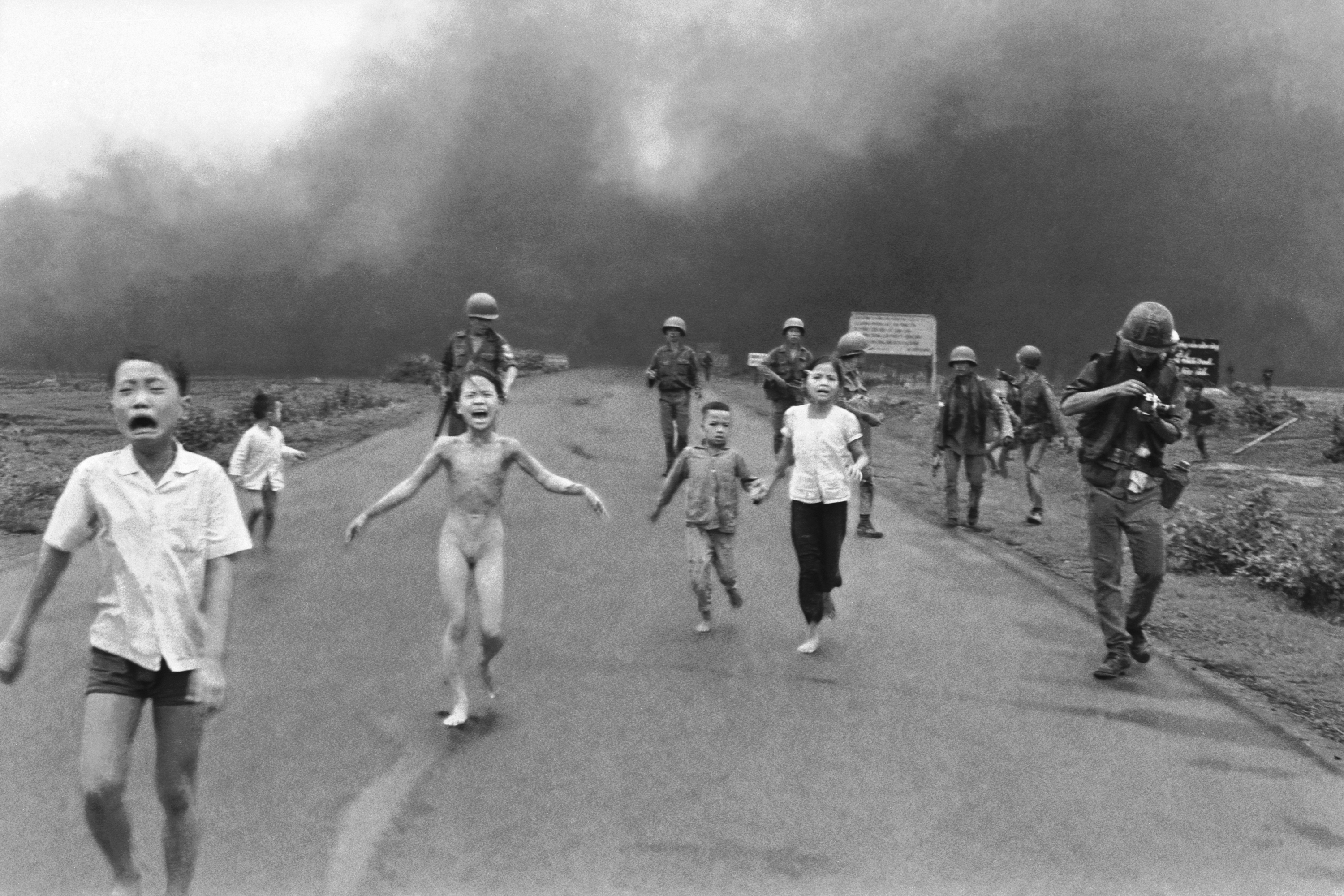
–in 1972, he fought to transmit the unforgettable image of a young girl fleeing naked and screaming from a napalm attack. The picture was shot by Nick Ut, a Vietnamese photographer trained by Faas, and the decision to send it out was one that Faas fought hard for. I remember seeing it on the front page of the Boston Globe on the day it was published in 1972 and never could forget it.

Nick Ut / AP Photo

As I discovered in researching my new book on the history of journalism, Covering America, Faas was also responsible for another of the most emblematic photos of the Vietnam War, the photo from 1962 of a monk burning himself to death in protest against the government of South Vietnam. The photo was taken by AP correspondent Malcolm Browne. But Browne was a reporter/writer, not a photographer. The only reason he was carrying a camera that day was that Faas insisted that all AP correspondents learn to take photos and carry cameras with them. Back at home, union rules forbade AP correspondents from shooting photos, but in Vietnam, those rules didn’t apply, and Faas wisely turned everyone into a photographer.

Recently, while researching the photos for my book, I came across Faas photo. This is a photo that I knew I wanted for my book, but I had a devil of a time figuring out who owned the rights to it. I had seen it variously credited to TIME and the New York Times (both wrong) and to the AP (not quite right either). It is a photo that shows three of the key U.S. correspondents stationed in Saigon during the early years of the war: David Halberstam of the Times, Mal Browne of the AP, and Neil Sheehan of UPI (later of the Times). They are standing around in front of a helicopter. Browne is smoking and Sheehan holds a big map.


According to Faas, he took the photo himself. And he told me that he took it with his own personal camera and that it never belonged to AP. But rather than rile the AP and its lawyers, he sent me the image directly via email and said to go ahead and use it with his blessing. Here’s what he wrote late last year:

I took the photo at the time as a personal picture and should have it in my personal computer files. I will look for it beginning next week: No time now – I am off for a quick trip (without my computer). Since all my material at the time was officially AP material I don”t want to get in conflict with AP and would give you the photo “courtesy of..” i.e. free of charge, In return I would be interested in a copy of your book once it is published. OK?

Best regards, Horst Faas

Thanks again, Horst.

I also want to share another photo that Faas sent me (“courtesy of” the photographer). It shows the press corps in Saigon in 1963:

2 Comments

Filed under Journalism, journalism history