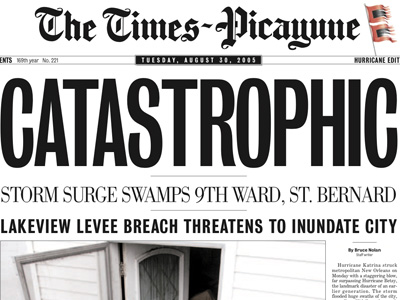
Newsroom half empty?

By Christopher B. Daly 

No one said this would be easy. The threatened layoffs have hit the newsroom of the New Orleans Times-Picayune (and other papers owned by the Advance Publications chain).

Things to keep in mind:

–Not all the layoffs are in the newsroom.

–Some of these folks will be replaced.

–The alternative could well be bankruptcy.


1 Comment

Filed under Journalism, media

Media hypocrisy check

By Christopher B. Daly 

With gasoline prices dropping, here’s my question:

If conservative media personalities really love this country and if they are really rooting for America, then why don’t they hail the good news of lower gas prices if those prices drop under a Democrat?

Hmmm. . .


Leave a comment

Filed under Journalism, Politics

Journalism on film

By Christopher B. Daly

Fun piece by columnist Dan Barry in the Times about the portrayal of journalists in U.S. feature films.

Two questions:

–How did he do this whole piece without ever mentioning the essential resource in this field: the Image of the Journalist in Popular Culture program at USC? Either he didn’t do a whole lot of research, or he didn’t want to steer readers to a more authoritative source?

–The Times piece is illustrated by a still b+w photo from the iconic film comedy “His Girl Friday.” So far, so good. But the photo is credited to “New York Public Library.” Now, the paper may have found the photo there, but that doesn’t mean the Library has the rights to it. In researching the illustrations for my book, Covering America, I found (to my regret) that the rights are owned by Sony Pictures Entertainment, which does not give away the right to reprint those images for free. For use of a different still from “His Girl Friday” in my book, Sony charged me $75.

[Note to Sony lawyers: I consider it “fair use” to post a copy of the version I paid for in this non-profit context for the purpose of illustrating my point.]

Still from the film classic “His Girl Friday,” set in a newsroom.

Leave a comment

Filed under Journalism, journalism history

Abolish the NCAA (cont.)

By Christopher B. Daly

The battle over intercollegiate athletics rages on. (Actually, it is just a few folks crying in the wilderness.)

Recently, the reformist Joe Nocera of the NYTimes weighed in with an op-ed. Like many reformers, he seems to really believe in the need for more radical solutions, but he pulls his punches in the name of being realistic. Enh!

Earlier, the Chronicle of Higher Ed shared this story about a football player at the University of Memphis, which makes a powerful case for eliminating college athletics. It’s a thoroughly reported piece on the Chronicle’s handsome, lucid, well-designed website. ( Actually, the home page is not that brilliant, but the Memphis piece is beautifully laid out and includes relevant multimedia. The audio clips are really something.)

And Buzz Bissinger, never one to mince his fuckin’ words, had this to say: Ban College Football.

AP photo / Football at my alma mater, UNC

AP photo / Football at my alma mater, UNC

(Which would be a start. What educational purpose does college football serve? It really amounts to a farm system for the NFL in which the pro teams don’t have to pay player salaries.)

For that matter, what educational purpose does any intercollegiate athletics serve? If you are in college and you want to get some exercise, start a pick-up game and challenge the kids in the next dorm. Then, get back to reading long books.)

I say, ban the NCAA.

Leave a comment

Filed under Uncategorized

Leaks investigation

By Christopher B. Daly

The Times editors probably should have slapped an “Analysis” label on this piece (which it carries online, but not in today’s print version) or put in the Sunday Review section. In any case, Charlie Savage has an intelligent analysis of why “leaks” investigations so often come to nought.

He makes a key legal point here:

Many people are surprised to learn that there is no law against disclosing classified information, in and of itself. The classification system was established for the executive branch by presidential order, not by statute, to control access to information and how it must be handled. While officials who break those rules may be admonished or fired, the system covers far more information than it is a crime to leak.

Instead, leak prosecutions rely on a 1917 espionage statute whose principal provision makes it a crime to disclose, to persons not authorized to receive it, national defense information with knowledge that its dissemination could harm the United States or help a foreign power.

And he goes on to make the point that prosecutors have a difficult showing the harm that flows from disclosures of classified information. It is almost never the case that a news media participant in a leak will divulge real, active military secrets. Instead, the practice of leaking is usually someone’s way of trying to win or shape a policy debate. It is the pursuit of politics by other means.


Leave a comment

Filed under First Amendment, Journalism, journalism history, leaks, New York Times, President Obama

Update on leaks

At his press conference later in the day (June 8), Obama had this comment on the issue:

“The notion that my White House would purposely release classified national security information is offensive,” he said. “It’s wrong. And people, I think, need to have a better sense of how I approach this office.”

Without confirming the accuracy of the information — which was revealed in two articles in The New York Times last week — Mr. Obama said the such leaks deal with the safety of the American people, its military and its allies.

“We don’t play with that,” he said, vowing to investigate the leaks. “We consistently, whenever there is classified information that is put out into the public, we try to find out where that came from.”


Of course, what else would he (or any president) say?

Leave a comment

Filed under Journalism, leaks, Politics, President Obama

On national security leaks

By Christopher B. Daly

Here we go again.

According to today’s Times, members of Congress (especially Republicans?) are outraged at the leaks on national security matters that they believe the administration is committing. Not only that, they are shocked (shocked, I tell ya) that such leaks might be carried out to advance the president’s political fortunes. Reading between the lines, it appears that they are upset that Obama officials go off the record and whisper disclosures to the Times and other news media informing the media and thus, the public as well, of their successes in the secret drone campaign and in the secret cyberwarfare we are apparently waging against Iran.

Imagine that: Could it really be that the Obama administration has invented a tactic that no other president (such as his immediate predecessor) ever thought of? Hmmm… Ever since the passage of the Espionage Act in 1917 and especially since the rise of the National Security state after WWII, this issue has been a chronic point of friction at the intersection of law, military operations, spying, and politics.

In all these situations, I believe the first question that any honest citizen should ask is this: Where is the harm?

Who, exactly, is harmed by knowing what the government is doing in our name around the world? There is no indication that any operational details have been compromised. (Surely, the remnants of al Qaeda know that we are gunning for them; just as surely, the Iranians know that we are trying to mess up the computers that run their nuclear program. So what?)

Look at it this way: with the leaks, the American people know enough to debate whether these are good ideas or not (and whether we want to re-hire the guy who is ordering them).

Without the leaks, we would be ignorant.

Leave a comment

Filed under Journalism, journalism history, media, New York Times, Wikileaks

News about the News

By Christopher B. Daly

As so often happens, the Monday business section of the New York Times delivers an array of stories about journalism and media worth reading. (Why doesn’t the paper have a “media” tab on its homepage?)

1. David Carr reports on talks between CNN, the ratings-challenged cable news pioneer, and Anthony Bourdain, the macho chef/traveler of Travel Channel fame. CNN execs are trying to address a problem I discuss in my new book (Covering America), which is much easier to formulate than to solve: what can a news-oriented cable channel do to fill all those hours when all hell is not breaking loose?

Bourdain could be part of the answer.

What else might help CNN? You comment; you decide!


2. Following up on the recent cutback in printing by the New Orleans Times-Picayune, comes a look at the broader trend, including some pros and cons.

3. From London, word that Rupert Murdoch’s troubles extend into an area he really cares about: the circulation figures of his newspapers.

4. From Shantou, a piece about how tricky it can be for Westerners to teach journalism to Chinese students in China. As a Westerner who teaches journalism to Chinese students in Boston, I can certainly sympathize. This piece also includes a bonus: an answer to the question of what Peter Arnett has been up to since he was forced out of CNN (in a failed attempt to pump up CNN’s prime-time audience ratings — see item #1 above).

So, there you go. (Just a typical Monday at the Times: four original, reported stories from across the globe that other people will be talking about for a week. )

Leave a comment

Filed under CNN, Journalism, publishing

The glass is half-empty AND half-full

By Christopher B. Daly 

In light of the recent announcement that the New Orleans Times-Picayune will scale back the frequency of its print editions, the following chart bears studying:

This chart was part of a recent presentation by Mary Meeker of Kleiner Perkins. (I got hold of it through Poynter.)

So, what’s the takeaway? If you extend those trend lines any further, you can see that the revenue won’t be there in the future to support a printed newspaper. If newspapers want to stay in the news business, they better have a plan to get out of the paper business.

2 Comments

Filed under Journalism, journalism history

The Warren-Brown Senate Race: “Organized Hatred”?

By Christopher B. Daly

The 19th Century historian Henry Adams – who was no dope – once shrewdly described Massachusetts politics as “the systematic organization of hatreds.” That was certainly true in his day. A question raised by the current U.S. Senate campaign is whether it is still true today.

Here’s why I say that. The presumptive Democrat, Elizabeth Warren, has had to spend weeks defending herself from the revelation by the Boston Herald that she once, long ago, gave the impression that she was part Cherokee.  The resulting brouhaha has changed the subject in the campaign and presumably worked to the advantage of the presumptive Republican candidate, Scott Brown.

Where did the original disclosure come from?

Let me emphasize that I don’t know what happened.

In fact, it is probably unknowable at present, due to the code of omerta that prevails among political operatives and political reporters. That code is something I do know a little about, having spent a few years as a political reporter covering Massachusetts politics.

In that role, I was the recipient of calls from parties unknown who, for reasons best known to them, decided to “drop a dime” into an untraceable payphone (I am dating myself here, I realize) and share some precious intelligence. I was sometimes invited to “take a walk” by a gimlet-eyed young operative; we would end up on a bench on the Common, and the guy would lean in close and give me the phone number of a divorce lawyer representing some disgruntled ex-spouse of a politician or cabinet member. I was invited to lunch at restaurants in the vicinity of Beacon Hill and slipped manila envelopes with documents inside, detailing the names of political donors whose relationships to each other were not obvious but turned out to be quite interesting once the tipster connected the dots. I got to know the system, thanks to these then-young political operatives.

So, here is what I surmise happened in the Senate race.

The Brown campaign did what all well-financed modern campaigns do: the candidate took a sliver of the millions he has raised and hired a team tasked with conducting “opposition research.” That is, you get a bunch of brainy young people together and you tell them to research everything about the political opposition.

And when they say everything, they mean everything: every indiscretion and every discrepancy. Every tax or mechanic’s lien. Every divorce, adoption, or inheritance. Every real estate transaction, including mortgage notes. Every arrest and every traffic violation. Every grade in school, every bad date, every expensive hairdo – EVERYthing.

The fruits of all that research are then handed over to the campaign’s senior aides and advisers, who stockpile them like ammunition. When they see an opportunity to use the information to their tactical advantage, they fire away. The campaign has some options. In one scenario, they can use the material directly and have their own candidate make a public accusation.

Or, they can play it “cute” and aim for a bank shot. They might decide to “leak” the information to the news media. That approach has several advantages. One is that the damaging material has the added credibility of reaching the public in the form of a news story. Another advantage of the leak is that the campaign can deny involvement or feign ignorance, safe in the knowledge that the reporter they went to will never rat them out.

           This can be especially effective if the campaign aides don’t even tell the candidate. Then, when the “news” breaks in the media, the candidate can act sincerely shocked and outraged and call for further investigations into the “troubling questions” raised by the news reports. That way, the story gains what we call “legs” – that is, it has the capacity to sustain itself as a continuing “story” involving denials, “fresh details,” and so on.

Did that happen in the case of the disclosure about Warren’s heritage? As I said, I don’t know. But it has all the hallmarks.

And what’s troubling about it is this: somebody knows. Quite likely, somebody in the campaign knows. If that’s the case, then there’s your real scandal right there. I say that because it points a finger at someone on Brown’s staff who must have gone through a thought process something like this:

            Oh, boy! This is great. We can leak this baby to the Herald, which we can depend on to slap it on Page 1. It will look on the surface like a “gotcha” story about a candidate’s hypocrisy. But as an added bonus, this story comes with a dog whistle: For those who can hear it, this is really a story about affirmative action. It’s a smear, intended to leave the impression that Elizabeth Warren is some kind of race whore, who gamed the system that so many white ethnics still hate.

            In their view, affirmative action is a big con game designed to put unqualified blacks, Hispanics and other minorities in line ahead of qualified white ethnics for the few good things in life. If we can get Warren associated with affirmative action, we can stir up those resentments, organize those hatreds, and peel off a couple thousand white ethnics who are independents or even some who are still Democrats. If we’re lucky, the “story” will get picked up by the echo chamber of right-wing talk radio. The eight ball drops into the corner pocket.


Did all that happen? I don’t know.

But someone does.

Leave a comment

Filed under Journalism, Politics, Uncategorized