Memo to Obama: Hands off the news media!

By Christopher B. Daly

Today brings more disappointing news about the Obama administration. As they spend more years in office, they are starting to revert to the mean and resemble a very ordinary power-grabbing, rights-trampling, self-serving operation. Alas.

NYT coverage / WaPo coverage.

Image_FreeSpeechWhile they have been busy not closing Guantanamo, this administration has been busy setting the all-time record for leaks investigations. The latest misguided attempt to stop leaks is the disclosure that the Obama Justice Dept. “secretly seized two months of phone records for reporters and editors of The Associated Press.” The rationale was that the AP had received a “leak” from someone in the government about a CIA operation to disrupt a plot unfolding in Yemen that was aimed at taking down an airliner. If true, that was a fine thing for the CIA to do. If true, then the folks in the CIA running the operation should have kept their mouths shut. If someone in the government who had knowledge of it spilled the beans, that’s not the fault of journalists. The Obama administration, like every other administration, needs to get its own house in order. You don’t stop leaks by trampling the First Amendment.

Instead, we get this (from NYT):

The A.P. said that the Justice Department informed it on Friday that law enforcement officials had obtained the records for more than 20 telephone lines of its offices and journalists, including their home phones and cellphones. It said the records were seized without notice sometime this year. The organization was not told the reason for the seizure.

The First Amendment exists to safeguard the right of the American people to be informed. The only known means to provide the kind of information we need to govern ourselves comes from a free and independent press, which is protected in its new-gathering every bit as much as it is protected in its news-telling. If the executive branch investigates the news media every time its own employees leak information, that cannot help but have a “chilling effect” on the news business.

This is ancient truth, going back at least as far as the Pentagon Papers and Watergate. If Obama does not want to go down in history in the same chapter with Richard Nixon, he has got to cut this stuff out. He could start by firing Attorney General Eric Holder.

Memo to the AP: The government got all those phone records from your telephone company. I would suggest you cancel your account and try a different carrier. 

Hat-tip: to NYT’s Charlie Savage, who seems to have staked out a new beat: reporting on the constitutional infringements and other abuses of power committed by the Obama administration.

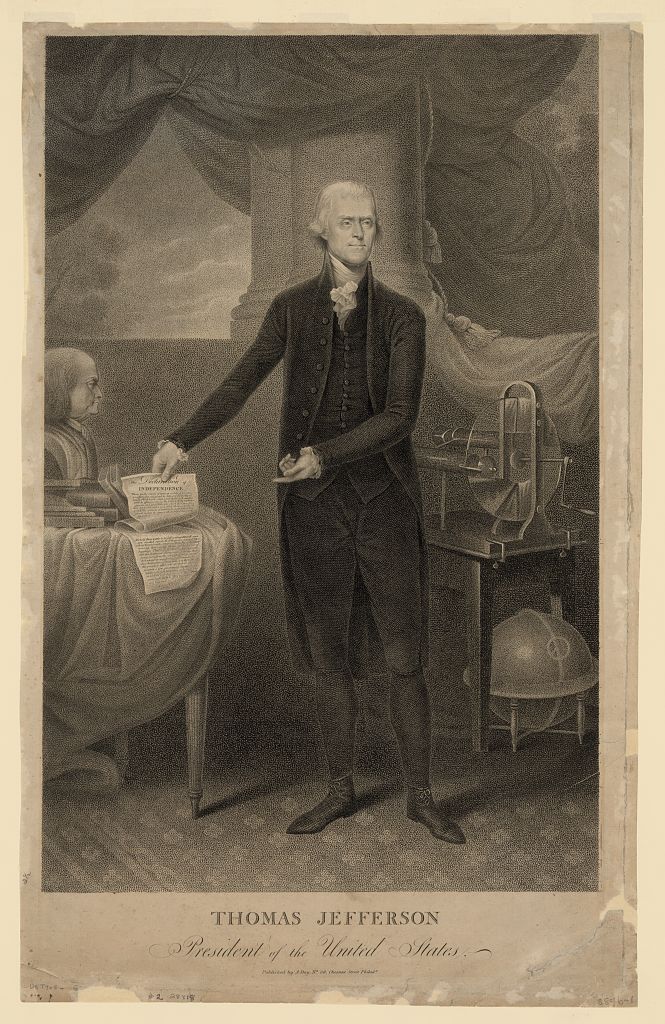
Obligatory quote: Here’s Thomas Jefferson on the dangers of executive power:

"Aware of the tendency of power to degenerate into abuse, the
worthies of our country have secured its independence by the15715v
establishment of a Constitution and form of government for our
nation, calculated to prevent as well as to correct abuse." 
--Thomas Jefferson to Washington Tammany Society, 1809.
Clarification: Of course, what the administration objects to are unauthorized leaks. The leaks they plan and execute for their own purposes are, naturally, quite alright.


 

Leave a comment

Filed under First Amendment, Journalism, leaks, Obama, Uncategorized

History keeps happening: Southern textile factory gets new uses

By Christopher B. Daly

The Loray Mill in its heyday, when it made fabric for the Firestone tire company.

The Loray Mill in its heyday, when it made fabric for the Firestone tire company.

The huge brick textile factory complex in Gastonia, North Carolina, once considered the largest in the world, is about to find a new life as an apartment complex, complete with amenities like restaurants and shops. From the description in today’s New York Times, it looks like the old factory has come a long way from the original life of the Loray Mill, built in stages starting in 1902.

That earlier story is the one told in the book that I co-authored with five fellow historians, Like a Family: The Making of a Southern Cotton Mill World. Published in 1987 and reissued in 2000,51gBhqv0KTL._BO2,204,203,200_PIsitb-sticker-arrow-click,TopRight,35,-76_SX225_SY300_CR,0,0,225,300_SH20_OU01_ Like a Family puts the Loray Mill (see chap. 4), located near Charlotte, into the broader context of Southern industrialization, told largely from the workers’ point of view, based on their own testimony in hundreds of oral history interviews. That work was made possible through the Southern Oral History Program at UNC-Chapel Hill, which continues to do fine work in oral history. The SOHP interviews are mostly on deposit at UNC’s Wilson Library, where they are open to scholars. You can even search for a term like “Gastonia” in the search tool.

That should keep you busy for a while!

banner5

Leave a comment

Filed under history, Uncategorized

Abolish the NCAA (cont.)

By Christopher B. Daly

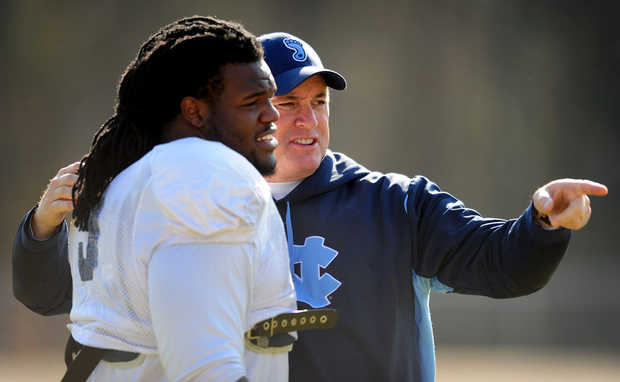
Former North Carolina head football coach Butch Davis talks with former defensive tackle Marvin Austin in a file photo. Austin is a key player in investigations involving improper contact with sports agents. JEFF SINER — JEFF SINER - jsiner@charlotteobserver.com

Former North Carolina head football coach Butch Davis talks with former defensive tackle Marvin Austin, who is a key player in investigations involving improper contact with sports agents.
JEFF SINER — JEFF SINER – jsiner@charlotteobserver.com

The latest episode of stupid, destructive results stemming from collegiate involvement in big-time athletics involves the University of North Carolina-Chapel Hill. This one is particularly painful to me, since I got my master’s degree at UNC in 1982. (Yes, that was the height of the Michael Jordan era in Tarheels hoops, and yes, I was a fan. I had not yet figured out how deeply corrupting the NCAA is.)

In today’s column, the NYT’s Joe Nocera lays out some of the low-lights from the downfall of UNC Chancellor Holden Thorp (what a name!).

Here’s a link to some of the coverage of the UNC mess by the estimable N&O, the News & Observer of nearby Raleigh. You know you’re in trouble when the biggest paper that covers you has to create a standing headline like “UNC Scandal.” The N&O has a story about a recent talk given by Mary Willingham, who once labored in the belly of the athletic beast, helping unprepared athletes navigate their ways to remaining eligible while working nearly full-time as minor-league players for pro sports.

Willingham, who worked as a learning and reading specialist inside UNC’s academic support program for athletes, talked Thursday about her struggle to combat the system. She spoke of NCAA paperwork that arrived annually that required a signature and promise that she hadn’t seen cheating, or been a part of it.

“I’ve got to tell you that most of the time, I scribbled my initials on it,” Willingham said. “So yeah, I lied. I saw it – I saw cheating. I saw it, I knew about it, I was an accomplice to it, I witnessed it. And I was afraid, and silent, for so long.”

Willingham still works at UNC, though not with athletes. She’s an assistant director in the center for student services and academic counseling. Of the 750 to 800 athletes at UNC, she described 150 to 200 of them on Thursday as “seriously underprepared” for the academic rigors of college life at UNC.

During her 20-minute speech, she lambasted the NCAA – calling the organization a “cartel” and describing its academic entrance standards for athletes “a farce.”

And she should know.
What more is there to say? Abolish the NCAA, before it corrupts another fine school. 


2 Comments

Filed under Journalism

What is “strategic communications”?

By Christopher B. Daly

images-1While not wanting to sound holier than anybody, I have to ask:

What is a school of Journalism (not to mention the oldest one in the country) doing with a search for a new professor of something called “strategic communications”?

The once-proud University of Missouri School of Journalism, founded in 1908, recently posted this job advertisement:

The Missouri School of Journalism is seeking a colleague who will teach at the graduate and undergraduate levels in strategic communication in the areas of marketing research, data analysis, and consumer insights.  We invite applications for a full-time 9-month tenure track assistant professor beginning in August 2013.

Why are they teaching “marketing research, data analysis, and consumer insights”? What do those things have to do with journalism? Journalism is simple to define: try to find out the truth and tell it. I don’t know what those other activities are. They sound suspiciously like figuring out how to sell stuff (and maybe candidates or ideologies) to people who may or may not be better off after being researched and analyzed.

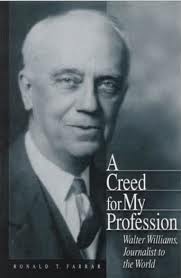
Obviously, the answer is that Mizzou has strayed from its original founding mission. That mission was spelled out by the school’s first dean, Walter Williams. It is worth recalling:

images

The creed

I believe in the profession of Journalism.
I believe that the public journal is a public trust; that all connected with it are, to the full measure of responsibility, trustees for the public; that all acceptance of lesser service than the public service is a betrayal of this trust.
I believe that clear thinking, clear statement, accuracy and fairness are fundamental to good journalism.
I believe that a journalist should write only what he holds in his heart to be true.
I believe that suppression of the news, for any consideration other than the welfare of society, is indefensible.
I believe that no one should write as a journalist what he would not say as a gentleman; that bribery by one’s own pocket book is as much to be avoided as bribery by the pocketbook of another; that individual responsibility may not be escaped by pleading another’s instructions or another’s dividends.
I believe that advertising, news and editorial columns should alike serve the best interests of readers; that a single standard of helpful truth and cleanness should prevail for all; that supreme test of good journalism is the measure of its public service.
I believe that the journalism which succeeds the best-and best deserves success-fears God and honors man; is stoutly independent; unmoved by pride of opinion or greed of power; constructive, tolerant but never careless, self-controlled, patient, always respectful of its readers but always unafraid, is quickly indignant at injustice; is unswayed by the appeal of the privilege or the clamor of the mob; seeks to give every man a chance, and as far as law, an honest wage and recognition of human brotherhood can make it so, an equal chance; is profoundly patriotic while sincerely promoting international good will and cementing world-comradeship, is a journalism of humanity, of and for today’s world.


Leave a comment

Filed under Uncategorized

End cell-phone thefts

By Christopher B. Daly 

Here’s my idea for a solution to the growing problem of cellphone thefts: build in the equivalent of the exploding re-dye packs that banks put in the bags of cash they give to bank-robbers. That way, robbers will figure out pretty quickly that it’s not worth stealing phones. It also makes the bad guys pretty easy to spot.

Besides, how satisfying would it be to know that the rotten bastard who stole your phone had a face full of red dye?

19776942_BG1-1


Leave a comment

Filed under Uncategorized

Can journalism get by without advertisers?

By Christopher B. Daly 

Why should journalism depend on advertising? There is nothing logical, necessary or inevitable about it.

Originally, advertising was a trivial source of income for 18th Century newspapers. Instead, readers supported those newspapers by subscribing for fixed (and pretty lengthy) periods. there were few if any newsstand sales. That model worked for more than a century.

It was only in the 19th Century that newspaper publishers began seeking and relying on advertising revenues. This coincided with an explosion of spending on ads, so there was plenty of money sloshing around to allow newspapers to expand. By the end of the 19th Century, many newspapers derived half or more of all their revenues from ads.

When broadcasting came along in the 20th Century, most radio and television operations could not find a way to get their audience to pay, so they became almost completely dependent on advertising income. (NPR and PBS are exceptions; they depend on a shifting mix of foundation grants, “sponsors,” a shrinking direct government subsidy, and the direct financial support of “viewers (and listeners) like you.”)

There, in broad strokes, is a big part of the current existential crisis facing all the “legacy” media with a foot in the pre-digital past. They arose under a set of conditions that no longer exist. Advertisers have reduced their spending overall, and they have reallocated the remaining ad buy so that they can buy a growing amount of space online. They are not coming back to print or broadcasting.

So, if advertisers cannot be depended on to fund journalism, who’s left?

One answer is pointed to by David Carr in his column today. Ostensibly, his column is about HBO and the success of such tv “auteurs” as the creators of The Sopranos and The Wire. Carr observes that HBO never depended on ads, so HBO’s executives never had to worry about what kind of programming advertisers would accept. Instead, the only constituency they had to please was viewers, who flocked to the better (if violent) programs. It was a case of “viewers to the rescue.”

From Carr’s column:

As it turned out, what had been holding television back was not the audiences, but the advertisers. HBO, freed of those bonds as a pay TV service, bet on a show about a fat, conflicted gangster who spent time in a shrink’s office when he wasn’t ordering up murders from the back of a strip club called the Bada Bing.

HBO had figured out that the strategy followed by broadcast networks — trying to please all of the people at least part of the time — was a losing formula for a pay service. Instead it began producing remarkable programming for a discrete audience that would pay a premium for quality. That audience has ballooned to some 30 million viewers and turned HBO into an A.T.M. for Time Warner, a lesson that was not lost on other cable channels. This revolution will continue to be televised.

In cable TV, unlike traditional broadcasting, money comes from “subscribers” — i.e., you and me and everyone else who overpays Comcast or Verizon or some other cable provider. All our monthly bills go into a giant pot, and cable providers turn around and dole it out to the suppliers of programming — X for ESPN, Y for all the NBC properties, Z for Fox, and so on. The details are the result of negotiations based mainly on who’s hot and who is bringing in the biggest audience.

HBO is just one example of a model that could be used to pay for all sorts of creative and valuable original materials. Consider: if I buy a song on iTunes, there is no jingle that I have to listen to first (or in the middle!). If I buy a book, there’s no ad on page 178. In those markets, I expect to pay the full amount, without a  subsidy from advertisers.

Can the journalism that has been brought to us by newspapers, magazines, and television be funded without advertising?

Stay tuned.


Leave a comment

Filed under broadcasting, business, CNN

Terror suspects’ parents

By Christopher B. Daly

Is it just me? Or does something about the body language of the people in this photograph seem wildly inauthentic?

DAGESTAN-articleLarge

(Photo: Dmitry Kostyukov for The New York Times)

I ask myself: If my wife and I had to conduct a press conference under similar circumstances (which, granted, is a big stretch), would we carry on like that? What is really up with these folks? This looks like a scene from a “Borat” film. It looks like a parody of two distraught parents. They seem to be saying “Up yours!”

Does anyone else find this odd?

4 Comments

Filed under Uncategorized

Readers to the rescue! NYTimes gains in circulation

By Christopher B. Daly 

Yes, the New York Times company reported a sharp drop in earnings this week.

Yes, the figures for advertising revenue were wretched and getting worse.

BUT, buried in the financial details, there is some potentially important good news: Money coming in from circulation is rising. In fact, it rose 6.5% in the first quarter of this year compared to the same quarter a year ago. Therein may lie the salvation of the most important news organization in the country.

The reason is that “circulation revenue” is all the money coming in from the subscriptions to the traditional print edition, the dollars paid by folks picking up a copy of the Times at newsstands, and — most important of all — the money coming in from digital subscribers who bumped into the Times “paywall” and decided to pony up and pay for full access to the Times online. They are important because they are the future. In the digital era, the key metric is whether you can make money online. Historically, newspapers depended on a “dual revenue stream” of money coming from both circulation and advertising. For more than a century, both sources increased, and they fluctuated around a ratio of 50/50 in terms of total revenues.

If the Times can continue to gain readers who will pay, then there is no reason it could not sustain itself mainly on the basis of its own readers — who are, ultimately, a better base for journalism than advertisers. Thank you, Tiffany and Bloomingdales, and may your ad spending continue. But ultimately, the Times might be better off if it were funded like the old PM newspaper, or I.F. Stone’s Weekly, or NPR, or the AP or other news organizations that do not depend on advertising.

According to the latest figures, readers now account for a majority of the Times revenues.

Here’s a chart from the company’s press release.


First Quarter
2013 2012 % Change
Revenues
Circulation $ 241,789 $ 226,994 6.5 %
Advertising 191,167 215,234 -11.2 %
Other(a) 32,977 33,204 -0.7 %
Total revenues 465,933 475,432 -2.0 %

When I looked at the numbers more closely, here’s what I found on a percentage basis:

First quarter

[                                 2013               2012

Revenues

Circulation             51.8%          47.7%

Advertising            41.0%          45.2%

Other                          7.1%             6.9%

So, it appears that “the people formerly known as the audience” are pointing the ( or a?) way forward.

Readers to the rescue!

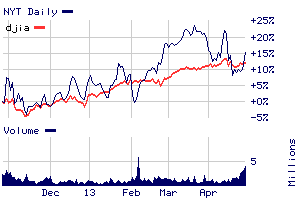
chart

This chart (which I customized using a tool on the NYTCo corporate site) shows how the NYTCo stock has performed in the last six months, compared to the Dow Jones average, which has been on a tear. 

Leave a comment

Filed under business, Journalism, journalism history, New York Times, Uncategorized

“Historians Still Despite George W. Bush”

By Christopher B. Daly 

“Now, there are some who would like to rewrite history - revisionist historians is what I like to call them.” -- George W. Bush

“Now, there are some who would like to rewrite history – revisionist historians is what I like to call them.” — George W. Bush

That’s the headline on a piece in the latest History News Network website, reporting the results of a flash poll of elite historians timed to coincide with this week’s opening of the new George W. Bush presidential library.

(Actually, it’s the George W. Bush Presidential Library and Museum, dedicated Thursday on the campus of the private religious school Southern Methodist University in Dallas. Like all 13 U.S. presidential library+museum complexes, it is administered by the National Archives and Records Administration. At all these operations, there is an inherent tension between the desire of the families and supporters to lionize our ex-presidents and the professional obligation of the NARA to preserve everything and make it all available to the public and to scholars.)

Back to the historians: they really can’t stand Bush, and they grade him about as harshly as possible. (Memo to future presidents: Invading the wrong country is never good for your reputation.)

The History News Network conducted an informal poll on Thursday asking American historians from the nation’s top research universities and liberal arts colleges to grade the presidency of George W. Bush on an A-F scale, based on fourteen different metrics, ranging from foreign policy to the economy to transparency and accountability.

Sixty-four historians responded. Thirty-five — over half — rated his presidency an outright failure.

“Thank you, God, for this opportunity,” one professor, a faculty member at one of the service academies, wrote in a comment. “He was not qualified to be president and it showed for eight long years.”

But Bush, famously unreflective, professes nonchalance. He spoke this week to CNN national correspondent John King (yes, the same John King who mis-reported a key part of the Boston Marathon bombing case).

An excerpt:

GEORGE BUSH: History will ultimately judge the decisions that were made for Iraq. And I’m just not going to be around to see the final verdict.

KING: Not going to be around. That’s an interesting way to put it. You…

GEORGE BUSH (laughing): In other words, I’ll be dead….

Bush said something similar when he was asked a similar question by Bob Woodward in late 2003. Asked by Woodward about how history would judge Bush’s decision to invade Iraq, Bush said: “History. We don’t know. We’ll all be dead.”

True that.

Here’s the Bush report card from the top historians:

HNN contacted faculty members who list American history as a research interest at the top twenty-five graduate programs in history and the top twenty-five liberal arts colleges in the United States, as ranked by the U.S. News and World Report in 2013.

Respondents were asked to grade President Bush on the following metrics (the average letter grade accompanies each metric) and provide justifications for their marks:

Overall (not a composite):  F 0.70
Communication ability D- 0.94
Relationship with Congress C 2.06
Supreme Court appointments D 1.09
Handling of the economy F 0.57
Executive appointments D 1.26
Diplomacy & foreign policy F 0.57
National security D- 0.82
Civil rights & civil liberties D- 0.90
Innovation and initiative D 1.14
General leadership D 1.04
Vision D 1.06
Transparency & accountability F 0.70
Integrity D+ 1.45
Crisis management D 1.00
Ability to learn from mistakes D- 0.82

1 Comment

Filed under Uncategorized

Should corporations enjoy free speech?

By Christopher B. Daly

For no good reason, our laws (both legislative and the common-law, judge-made type) have been moving in a while in the direction of recognizing corporations as “persons” and granting them most of the benefits of being a person, while sparing them most of the downsides (like dying, paying taxes, and feeling inadequate).

The latest flash point in this development involves a petition campaign to try to use the power of government to force corporations to divulge how much the spend on political campaigns and who gets it. Such a move would limit the free-speech rights of corporations — but only to the limit already imposed on us actual living persons. As matters stand, a real live human being who donates to a political campaign has to do so knowing that the donation will be a matter of public record, available for inspection in the records of the Federal Election Commission.

But not corporations. (They’re so sensitive!) No, they are enjoying the “right” to free speech without the responsibility of disclosure. That’s why they were able to spend hundreds of millions of dollars in the last election cycle to influence our politics (translation: to elect Republicans) without having to inform anyone. That includes two very important groups:

1. The shareholders. In theory, the management of every publicly traded corporation has a legal responsibility to maximize shareholder value. Some shareholders may believe that such a duty does not extend to dropping millions of their dollars into the campaign treasuries of political candidates.

2. The customers. In theory, consumers have power that they can exercise over companies who do things they don’t like, but only if they can find out what’s going on. One reason that corporations like to exercise their free-speech “rights” in secret is so that they don’t have to face backlash and boycotts from angry consumers.

All of this can be remedied with a simple change: The Securities & Exchange Commission, the federal agency that oversees U.S. corporations, could simply require corporations to publicly disclose their political donations. That is no more onerous than what is required of you or I as an individual. In fact, the five SEC commissioners have a petition pending before them asking them to do just that. I hope that the three Democrats on the panel will find the gumption to do just that. (I have no hope that either of the two Republicans will do so).

I’m not familiar with SEC rule-making. I found this page that records comments that have already been received. I don’t see any way to comment on-line. So, I would urge you to scroll over the phrase “Type A,” print that out, and send it by snail mail to the SEC. I’m sure that if I were a corporation, I could figure this out.

For the record: I am not convinced that a corporation (a legal fiction created by the state to serve social purposes) has any rights, but I am certain that they do not have more rights than you or I.

Sheesh.

Here’s the text of the comment in support of the petition:


bannerSeal

The following Letter Type A, or variations thereof, was submitted by individuals or entities.

Letter Type A:

I am deeply concerned about the influence of corporate money on our electoral process.

In particular, I am appalled that, because of the Supreme Court’s ruling in Citizens United v. Federal Election Commission, publicly traded corporations can spend investor’s money on political activity in secret.

I am writing to urge the Securities and Exchange Commission to issue a rule requiring publicly traded corporations to publicly disclose all their political spending.

Both shareholders and the public must be fully informed as to how much the corporation spends on politics and which candidates are being promoted or attacked. Disclosures should be posted promptly on the SEC’s web site.

Thank you for considering my comment.


http://www.sec.gov/comments/4-637/4637-26.htm


Home | Previous Page
Modified: 01/19/2012


Leave a comment

Filed under First Amendment