It’s raining leaks!

By Christopher B. Daly 

imgres3Today’s news brings a very curious twist on the theme of national-security leaks. This time, the suspected leaker is not a low-level functionary like Bradley Manning or Edward Snowden but a high-ranking military official — in fact, the former No. 2 in the entire military command structure. According to a report first broken by NBC News, retired Marine Gen. James E. “Hoss” Cartwright is under investigation in connection with the leak of classified information about American cyberattacks against Iran, intended to disable or slow down Iran’s program to build a nuclear weapon. (The coverage in today’s NYTimes is rather circumspect, which makes sense, considering that the Times was the recipient of the leak. The paper quotes NYT executive editor Jill Abramson saying she doesn’t discuss such things.)

I wonder if Cartwright’s rank will make any difference here. After all, he’s not some some “29-year-old hacker,” — as President Obama pooh-poohed Snowden on Thursday, while adroitly trying to keep the Snowden/NSA leak from screwing up great-power relations with China and Russia. (Funny thing: at other times, Obama is quite willing to characterize Snowden as a threat to our very existence. Also, an update: Snowden turned 30 last week.)

Back to Cartwright. Far from being a hacker, Cartwright, who was named vice chairman of the Joint Chiefs by President28stuxnet1-img-articleInline Bush and who served under Obama as well, was at the epicenter of the military/national security power structure. I wonder how the top brass and the national-security establishment feel about leaks now, when one apparently came from one of their own. Where’s the outrage? Will we be seeing Sens. McCain and Graham or former veep Cheney going on Sunday TV talk shows demanding his head?

We might also ask: Why would Hoss Cartwright do such a thing? He’s not commenting, but we can just imagine. Maybe he wanted to see the U.S. get credit for “doing something” about the Iranian threat. Maybe he wanted to let Americans know that we had the technical means to mess up their weapons program without having to attack or invade Iran by conventional means. Maybe he was ordered to make the leak by someone who out-ranked him (perhaps the Chair of the Joint Chiefs, or the National Security Adviser, or the Secretary of Defense, or the President himself?)

The Washington Post, after pointing out that the cyberattack on Iran included a computer virus named Stuxnet and was part of a broader program code-named “Olympic Games,” adds this tantalizing hint:

Cartwright, who helped launch that campaign under President Bush and pushed for its escalation under Obama. . .

Maybe Cartwright thought his favored program was threatened in some way by someone else in the national security apparatus.

As I have long maintained, the reaction to leaking is very much in the eye of the beholder. If the leaker is powerful enough, the act of leaking is not a crime but just politics by another means.

For the record: As far as we know, Cartwright would be the eighth target of an Espionage Act investigation undertaken in the Obama administration’s record-breaking campaign to punish leakers.

Speaking of cyberattacks, U.S. officials seems to be scrambling to find a path through this 28cyber1-img-popuppolicy thicket. On the one hand, Joint Chiefs Chairman Martin Dempsey is hurrying to write new rules for warfare in cyberspace, according to another article in today’s NYTimes. (Don’t hold your breath waiting to participate in this process yourself: any such rules are classified. So there!) Here’s the takeaway:

[Dempsey] said that, globally, new regulations were needed to govern actions by the world community in cyberspace. He said that the Chinese did not believe that hacking American systems violated any rules, since no rules existed.

And, finally, for an example of what’s at stake in terms of commerce, today’s Boston Globe has an eye-popping story about how the Chinese allegedly steal commercial secrets. If you thought they just stole plans for making plastic tschotschkes, think again. This one involved the design for wind turbines, which the Chinese had the nerve to sell back to us!

It’s enough to make the head spin. How am I supposed to keep up with the Whitey Bulger trial, the Hernandez case, or the trade of both Paul Pierce and Kevin Garnett to the Brooklyn Nets????

p.s. For a fun and puzzling exercise in mind-games, go to the NYT homepage and enter the term “stuxnet” in the search box. If you can figure out the results, please explain in a comment below. 

1 Comment

Filed under Journalism, journalism history, leaks, media, New York Times, Obama, Politics, President Obama, Wikileaks

Monday morning roundup

Odds & Ends:

–Here’s David Carr on the “British invasion” of the high end of American media. (Why don’t they ever try to take our unpaid internships and crummy starting jobs?)

–Here’s the Times’ attempt to keep with Edward Snowden. What I found remarkable about this story — which was, after all, quite inconclusive — was the combined throw-weight of the team of reporters. In addition to the triple byline, I count seven more bylines in the credit line at the bottom. That’s 10 reporters on three continents, not to mention interns, news aides, editors, photographers, and photo editors. Take that, HuffPo!

–Here’s a Times feature on the antiquated ways of SCOTUS. These are not merely quaint. I believe they are snubbing their noses at all the rest of us, because they can. They are among the most unaccountable holders of power in the country. Perhaps an occasional impeachment (yes, it can be done and has been) would get their attention.


2 Comments

Filed under Uncategorized

Why I hate fishing

By Christopher B. Daly

Actually, this is just one reason: Many people who fish (not all, granted) leave a lot of junk behind.

I recently found this attractive nuisance on the ground near Crystal Lake in Newton, Mass. — just seconds before my puppy found it and did what she does with everything, which is to say, tried to eat it. 

IMG_2658

Leave a comment

Filed under Uncategorized

Who will own the Boston Globe?

By Christopher B. Daly 

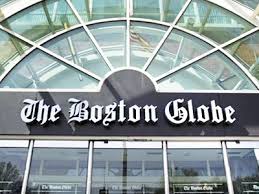
The New York Times Co. has declared its intention (again) to sell the Boston Globe and has solicited bids. They are due on June 27. Since the Globe employs the largest team of journalists in New England, the outcome of that process is of interest to every resident of the region.

So, as a public service, here is a handicapping of the field of bidders. (the Globe itself identified eight potential buyers — both individuals and groups — but reported today that the “Kraft group” has dropped out. Perhaps Robert Kraft is too busy overseeing his wayward football players or squiring his babe/girlfriend to charity events?)

Note: As the estimable blogger/professor Dan Kennedy has pointed out, the Globe sale includes not just the business but some pretty significant tangible assets, including a big chunk of property in Dorchester that is ripe for development into something more attractive than the uber-utilitarian Globe building, plus what is probably the biggest array of printing presses in New England, not to mention a fleet of boxy green trucks.

The field:

LOCAL

–The Comeback Kids: Two members of the Taylor family, which founded the Globe in 1873 and ran it until 1993, are interested. Cousins Ben and Steve Taylor have teamed up with former magazine executive Jack Griffin. For the Taylors, this would be a way to recycle some of the vast pile of money they took from the Sulzberger family when the Times Co. overpaid for bought the Globe from the Taylors for $1.1 billion. It would fascinating to know what the Taylors have done with that $1.1 billion over the last 20 years. If they had invested it in the Dow Jones Industrials, their haul would be worth about $4.5 billion today. So, they could easily afford to buy back the Globe at its steeply discounted current value. Estimates vary wildly, but it’s hard to imagine it could bring in $200 million. FYI, Griffin was a heavy-hitter in the magazine business: he was a top exec at Conde Nast, Meredith, and TIME Inc. until he set up a magazine consulting company, Empirical Media. He made an earlier play for the Globe with Aaron Kushner, but Kushner appears to have no role in this round of bidding.

–Rick Daniels, is a former president of the Boston Globe Co. (2001-2006). A Cohasset resident and B.U. alum, Daniels was an executive with GateHouse Media, which publishes the Patriot Ledger, the Brockton Enterprise, and the MetroWest newspaper, from 2007 to 2012. He is teamed with Heb Ryan of Boston Post Partners LLC, a private equity firm with an insanely discreet website. (Eds: Heb is cq; his full name is Heberden.)

John J. Gormally Jr., president of Gormally Broadcasting LLC in Springfield. Gormally owns an ABC affiliate WGGB-TV and a Fox affiliate, and it publishes BusinessWest , which calls itself “The Business Journal of Western Massachusetts.”

–Shannon Liss-Riordan, a Boston labor attorney at Lichten & Liss-Riordan, who call themselves “The Labor, Employment & Class Action Specialists” — which should serve Liss-Riordan in sorting out the Globe’s famously contentious and expensive labor agreements. A 1996 Harvard Law School grad, she has made a career of sticking up for the little guy, representing thousands of waiters and waitresses in forcing their employers to fork over their  tips — including a big 2006 jury verdict in a case against Hilltop Steak House. Unclear where she would round up the necessary millions.


NOT LOCAL

–Robert Loring, founder and managing partner of Revolution Capital Group, which is based in Los Angeles. Loring, 48, a B.C. grad, was involved in the deal in which Revolution Capital bought the Tampa Tribune last year and bought the Clearwater (Fla.) Gazette two months ago. Since they are in the money business and sometimes in the newspaper-buying business, this seems like a plausible bidder.

–Jahm Najafi, another founder of another private equity firm, this one based in Phoenix. Nafafi, a Harvard Business School grad, is an owner of the Phoenix Suns but no newspapers. The closest thing to a newspaper is a publication we have all looked at: SkyMall.

–Douglas F. Manchester, a conservative businessman from Southern California, was a key donor in the campaign to ban gay marriage in California. “Papa Doug” has had a long career of running lots of companies, including the merged daily newspapers serving San Diego, the Union and the Tribune, which he inelegantly re-named the “U-T.” This is small, but I gotta say, he seems very un-Boston.

0   0   0   0   0   0

Overall, it’s disappointing that there aren’t more local bidders and that there are zero minority applicants. 


2 Comments

Filed under Uncategorized

Abolish the NCAA (Cont.)

By Christopher B. Daly

Here we go again. More evidence that the NCAA lacks a meaningful educational purpose and really operates as a professional sports league for the big sports. A federal judge is weighing whether to let all former NCAA athletes to join together to file a class-action lawsuit against the NCAA, demanding a share of the Association’s “profits.”

Here’s Fortune’s story.

Here’s Deadspin.


1 Comment

Filed under Uncategorized

Maine’s governor to press: Drop dead!

By Christopher B. Daly

The Republican governor of Maine, Paul LePage, has decided not to speak to three of the largest media outlets in his

Tight-lipped governor.

Tight-lipped governor.

state — which means, of course, that he is refusing to speak to all of their readers (who are also voters). Fair enough. That’s his call. He is a partisan (by definition), and he believes the papers are out to get him, so he’s going to try to win the argument by not engaging.

Hmmm… let’s see how that works out.

My guess that is that the Portland Press Herald, the Kennebec Journal (Augusta), and the Morning Sentinel (Waterville) will all be in business long after LePage has been retired by the readers/voters.


Thanks to the AP’s David Sharp for staying on top of this. Here’s the Press Herald’s own account.

imgres

Leave a comment

Filed under Journalism, Politics

Bulger trial coverage

By Christopher B. Daly

Whitey Bulger, courtesy of Boston PD. One of the greatest mugshots in the history of the genre.

Whitey Bulger, courtesy of Boston PD. One of the greatest mugshots in the history of the genre.

The long-awaited trial of gangster/murderer Whitey Bulger is in full swing in a federal courthouse in Boston (named for the longtime congressman from the district of South Boston, the late Joe Moakley).

Some of the journalists and news institutions covering the trial are doing excellent work. Here’s a guide:

The Boston Globe, the biggest news organization in New England, is all-in. Here’s a link to their special expanded coverage for “Globe Insiders” (which just means non-freeloaders — i.e., those who have a digital subscription, as we all should).

WBUR, the longtime news leader among NPR stations in the region, has a smart-looking special section as well, led by veteran reporter David Boeri.

2013_Bulger-Banner_940x125

Both sites are rich with background, photos, timelines, who’s-who’s, and (my favorite) maps.

Also meritorious: the reporting of the ubiquitous Adam Reilly, who reports for the city’s other major NPR station, WGBH.

bulgerbanner3

And, if that’s not enough, you can always follow the Twitter feeds (#bulger), which are emerging as a pretty good workaround for the continuing silliness of banning TV cameras from federal trial courts.

Oh, and for deep background, read the Whitey biography written by my friend and BU colleague Dick Lehr.

2 Comments

Filed under Boston, Journalism, Uncategorized

Mass. Senate race: another private equity guy gives it a try

By Christopher B. Daly

In Massachusetts, we are having a special Senate race to fill the seat vacated by veteran Democrat John Kerry when he became president Obama’s Secretary of State. The race features two finalists, each of whom has a classic profile for his party:

Ed Markey, a Democrat who is a career politician, versus Gabriel Gomez, a Republican who was a Navy SEAL and was a millionaire executive of a private equity fund until he resigned in February to run for Senate.

Last night, the two candidates faced off in the final debate of the campaign, ably moderated by my B.U. colleague and veteran television news anchor, R.D. Sahl. Voting is next Tuesday.

In the debate, it appeared as though Markey was trying to do to Gomez what Ted Kennedy famously did to Mitt Romney in the 1994 U.S. Senate race in Massachusetts. The career-pol Democrat accused the private-equity guy of buying up companies, firing their workers, and profiting the difference. It worked, and Ted Kennedy returned to Washington.

This time, Gomez has steadfastly declined to talk about his major post-military career. He has spent more than a decade at Advent International, making deals. It’s a bit odd that Gomez, who is also a Harvard Business School grad, does not want to talk about business.  Instead, he spends most of his time talking about his service to country (he was an aircraft carrier pilot as well as a SEAL, which is a major big deal) and about how Washington is broken because of partisanship.

Fair enough, but what about his career?

As a public service, here are some articles about Gomez as a businessman — from CNN Money, from Daily Kos, and the Boston Globe. I think the best coverage of this issue has come from Dan Primack, who (unlike political reporters) actually covers business in his work at CNN Monday/Fortune. Here’s his latest. Everyone in Massachusetts should get up to speed on this issue before next Tuesday. Thanks, Dan Primack.


Leave a comment

Filed under Boston, Journalism, Politics

Who will buy the Boston Globe?

By Christopher B. Daly 

imgresThe Boston Globe carries a story today about the impending sale of the newspaper by its owner of the past two decades — the NYTimes Co. Bids are due by June 27. As a regular reader, I hope, of course, that the new owners will be very, very rich people with very, very high standards of journalistic integrity. I hope they will be innovators who have a clue about how to make a business out of quality journalism. I also hope they really care about Boston and New England. I hope they have the nerve to stand up to people like Whitey Bulger (and Billy Bulger, for that matter) and an appreciation for why this is a special place. (Yes, every place is special, but I am looking for someone who gets the particular special-ness of this particular place; in other words, no Sam Zells, please.) I hope they have wit, and style, and grace.

Know anyone?

2 Comments

Filed under Journalism, New York Times, Uncategorized

NSA Leak: Why not the Times?

By Christopher B. Daly

Since the disclosure of the NSA leaks story, a fair amount of media commentary has focused on the thinking of the self-identified leaker, Edward Snowden, who got access to secrets by working for a government contractor. Many have compared him to Daniel Ellsberg, who got access to secrets by working for a government contractor, then divulged the Pentagon Papers in 1971 to the New York Times. 

Some wonder why Snowden chose to cooperate with Glenn Greenwald (who is a lawyer/activist/blogger/freelancer) rather than a traditional media heavyweight such as the New York Times. Some of the concern is misplaced, I believe, since Snowden also shared his NSA leak with the estimable Barton Gellman of the Washington Post.

As far as the Times goes, the newspaper’s own Public Editor, Margaret Sullivan, aired out the question in her most recent posting.

I think it is worth recalling some of the history of the Pentagon Papers case (which you can read at greater length in chapter 11 of my book, Covering America.) By his own CA cover finalaccount, Ellsberg had a political goal — ending the U.S. war in Vietnam. To that end, he first tried to leak the classified documents to members of Congress, on the theory that they could use their congressional immunity to read the papers aloud on the floor of the House or Senate. Because of their immunity, they could not be prosecuted for anything said as part of the proceedings of Congress and their remarks would be on the public record.

When the office-holders balked, Ellsberg turned his thoughts to the media. There I think it is indicative that he did not approach the Times as an institution. Indeed, the Times — in 1971 — was not well known for challenging the federal government. Instead, Ellsberg was targeting an individual journalist whom he thought he could trust: Neil Sheehan.

Ellsberg and Sheehan had a bit of history. They had met when Ellsberg was serving in the Marines in Vietnam and Sheehan was working for United Press in its Saigon bureau. Ellsberg had a sense that Sheehan was a skeptic about the war. Later, Sheehanimgres-1 joined the Times, and he was working as a reporter in the Times Washington bureau in 1971. Under the terms of employment for Times reporters, he was supposed to keep his political views to himself. On March 28, 1971, Sheehan wrote a lengthy multi-book review for the Times Sunday Book Review in which took seriously the idea that there should be war-crimes trials for the U.S. policy-makers who kept us in Vietnam. When Ellsberg read that review, he knew he had found the right journalist.

Three months later, Sheehan wrote the first front-page article in the series that became known as the Pentagon Papers.

imgres

4 Comments

Filed under Journalism, journalism history, leaks, New York Times, Uncategorized