Surveillance State: An old-school leak of FBI docs

By Christopher B. Daly

History keeps happening.

Thanks to a new book by former Washington Post journalist Betty Medsger called The Burglary, 51HydAvzamL._AA160_Americans can now see another example of principled, patriotic, non-violent dissenters who made America a better place by risking jail to bring important truths to light. The New York Times has a good story today about it, including a terrific video. More is at NPR.

To set the scene:

–It was a time in American history when we were fighting an undeclared war halfway around the world.

–We were fighting against people whose history, culture, and language we did not understand.

–We could not tell friend from foe.

–With each passing year, the insurgency grew stronger and we never managed to “pacify” any territory.

–American citizens tried to stop the war and were castigated as disloyal, unpatriotic.

–The government engaged in a secret, illegal campaign to find and crush people it considered terrorists.

The year was 1971, at the height of the American war in Vietnam, not 2003 or 2004, at the height of the U.S. “war on terror.” (Instead of al Qaeda, the FBI was targeting domestic “terrorists” like the Weathermen and the Black Panthers) After years of peaceful protests, a small group of anti-war activists decided to try a new tactic: break into an FBI office, remove the files, and divulge the secret contents to the news media.

Here is a template for national security leakers. The break-in described in the new book took place in the Philadelphia suburb of Media, Pa., on March 8, 1971. That very same week, Daniel Ellsberg made his first contact with New York Times reporter Neil Sheehan to discuss divulging the massive secret files that became known as the Pentagon Papers. In both cases, people who found that they could not change policy through normal politics and who could not legally blow the whistle on wrongdoing decided to go outside the law — risking prosecution and jail — in the hope that disclosing secrets would lead to a desirable change.

The comparisons to Edward Snowden are obvious. As a contract employee for the NSA, Snowden learned that the government has built a vast spying operation since 9/11/01 that includes secret top-secret-stampsurveillance of millions of law-abiding Americans in peacetime and that officials hid and lied about.

The anti-war burglars in the Media FBI break-in hurt no one and did almost no property damage (they had to jimmy a lock to get in). As a result of their disclosures, no one died and the sky did not fall. Instead, the disclosures added fuel to the anti-war movement and provided vital clues to the wider disclosures that led to the Church Committee investigation and reforms.

In the Media break-in, the only apparent crime was simple burglary, and the statute of limitations expired long ago. So, there is no question of penalties as these American heroes emerge from the shadows.


Leave a comment

Filed under Journalism, journalism history, leaks, media, surveillance

Surveillance state: The rationale for secrecy is, of course, SECRET

By Christopher B. Daly

top-secret-stampYou may think you are a sovereign citizen of a free country. You may think that “we, the people” rule through elected representatives who are accountable to us. But that would be wrong.

The latest affront to self-government is a ruling issued by a federal appeals court on Friday (beware of Friday rulings). Here’s the background:

Thanks to accused leaker Edward Snowden, we know that the U.S. government runs a secret program in which the government calls on the telephone companies to hand over information about you without a court order or subpoena, even if you are not suspected of any wrongdoing. You were not supposed to know about it, but that cat is now out of the bag.

So, you might want to know where the government gets off concocting such a scheme and how it could possibly square such massive, secret, peacetime spying on law-abiding citizens with the Constitution. Well, too bad. The Obama administration’s lawyers, who wrote a memo in 2010 attempting to justify the whole thing, decided that the memo itself should be kept secret, and President Obama agrees.

The Electronic Frontier Foundation and others filed suit seeking to get access to the memo. The government refused. On Friday, Judge Harry T. Edwards said no. EFF can’t see it and neither can we, the people. According to a link-rich story in today’s Times by the redoubtable Charlie Savage, the ruling seems likely to stand.

This is just the latest cause for disappointment in President Obama when it comes to transparency and press freedom. If he wanted to really serve those great causes, he could:

–stop prosecuting and issuing subpoenas to reporters at an unprecedented pace

–stop over-classifying new material as “secret”

–begin reducing the backlog of classified materials that can be de-classified with no harm

–adopt the common-sense reforms recommended by his own task force on surveillance issues.

There are many things to admire about Barack Obama, but his record in this area is not one of them Perhaps it confirms that the Founders were right to be suspicious of executive power per se, regardless of the individual wielding that power. They saw, rightly, that power is by its very nature aggressive, always seeking to expand and never yielding unless forced to do so.

Leave a comment

Filed under First Amendment, history, Journalism, journalism history, leaks, New York Times, Politics, President Obama, Uncategorized

Abolish the NCAA: Shame on UNC, too

By Christopher B. Daly 

Today’s NYTimes greets the new year with a dismaying (though hardly surprising) story about the ways in which the NCAA extends its corrupting reach into college classrooms. It’s an extreme version of a common imagespractice — providing fluff courses for intercollegiate athletes so that they can maintain their student status even while they are spending all their time in training for their schools’ teams (which are nothing more than farm teams for professional leagues).

This story is particularly dismaying because it involves charges of academic abuse that are so egregious that they caught the attention of a criminal prosecutor. Not only that, but the case involves UNC-Chapel Hill, where I went to graduate school in history, which is actually a images-1fine, serious, and improving university. Yes, it is also an NCAA powerhouse in football, basketball, lacrosse, and other sports that fill stadia and attract national TV distribution.


Again, I ask: What educational purpose does the NCAA serve?

In my experience, the practice of intercollegiate athletics not only contributes nothing to students who participate, it also detracts from educating young people. The only educational purpose I can imagine is to serve as an object lesson in what not to do in economics, law, and ethics.


2 Comments

Filed under Uncategorized

When the “ball drop” building housed the NY Times

By Christopher B. Daly 

Many eyes will be focused on the ludicrous famous “ball drop” tonight in Times Square to mark the arrival of the new year in the eastern United States. Many TV cameras and uncounted phone cameras will be aimed southward toward a narrow building. Here is an earlier view of the exact same building, taken in 1908. That’s when the building served as the recently finished headquarters of the New York Times newspaper. The paper’s owner, Adolph Ochs, was proud of the landmark building as a reflection of the Times‘ growing profits and prestige. He was so proud that he prevailed on the New York city government to rename the spacious intersection of Broadway and 7th Ave. from Longacre Square to Times Square.

The Times soon outgrew this slender masterpiece and moved about a block away to a much larger, stouter French-style building for most of the 20th Century. (The paper, now published by Och’s great-grandson, is currently located a few blocks away on 8th Ave.)

So, as the ball drops tonight, show this picture to your guests and raise a glass to Adolph Ochs.

Oh, and happy new year!

NYT Bldg 1908


Leave a comment

Filed under Uncategorized

Surveillance state: NSA reforms driven by Snowden (and Greenwald)

By Christopher B. Daly 

This may be obvious, but I think it bears repeating:

Absent journalists (and their sources, of course), President Obama would not have appointed a task force on the NSA, he would not have welcomed a debate over surveillance, and he would not be forced to consider reforms. From today’s Times:

While few in the White House want to admit as much in public, none of this would have happened without the revelations by Edward J. Snowden, the former N.S.A. contractor now in asylum in Russia. While Mr. Obama has said he welcomes the debate about the top-secret-stampproper limits on the N.S.A., it is not one he engaged in publicly until the Snowden revelations began. Now the president has little choice — this week alone a constellation of forces is pushing for change: A federal judge called the bulk-collection program “almost Orwellian,” while some in Congress, many of his allies and Silicon Valley executives demanded change.

So, let’s give thanks to Edward Snowden and Glenn Greenwald for enabling us to act as citizens of a free country. In the end, Americans may decide that they like being spied on. If they do, I will still disagree, but I will say, So be it. What I cannot abide is the grasping for power that goes beyond the constitution, American laws, and common sense.


1 Comment

Filed under New York Times, President Obama, surveillance

No cheering in the pressbox, please.

By Christopher B. Daly 

Boston Globe sports columnist Dan Shaughnessy had a remarkable column on the front page of the paper today. It was remarkable for several reasons.

First, it was on page 1, which suggests to me that it was a newsroom decision to put this on the front page. I wonder why? That means, for one thing, that the Globe’s editors wanted this message to reach readers beyond those who read the sports pages.

Second, it makes a point about the methodology of writing columns, which is more “meta” than Dan usually gets. So, I wonder if this column was prompted by something specific. (Maybe the new Ted Williams biography by Dan’s former colleague, Ben Bradlee Jr., which reminds us of the feud Williams had with Boston sports columnists who were not sufficiently admiring.)

Perhaps it has to do with the Globe’s new owner, John Henry, who also happens to be the major owner of the Boston Red Sox. Was Dan declaring his independence from both the team and the new owner? Was the newsroom supporting him in this? Were they trying to tell Henry (who is new to the role of newspaper-owner) that he should not expect Shaughnessy — and, by extension, the whole Globe staff — to use their words and images to support the boss’s causes and interests? Does that extend to Henry’s business interests? To his politics?

Boston Globe image

Boston Globe image

Dan (full disclosure: he’s a friend, and our boys are friends) is making a case that should be self-evident. Years ago, the principle was established among the guild of sports writers that they attended sporting events not to root for the teams they were covering. This attitude was expressed quite well in the classic formulation: “No cheering in the pressbox.”

That goes for the hometown team, too. I believe the job of a sportswriter is to call them as he/she sees them. If my team stinks, I want to know why. I don’t want to be told that they don’t stink when they do.

Dan’s column got a lot of comments, many of which were the kind of harsh put-down that fills sports radio, the internet, and many a comments section. Turns out, a lot of guys want a columnist like Dan to agree with them. That, too, is not his job. As I understand the calling of columnist, the job is to be interesting, plain and simple. A columnist should write about things that are true in an interesting way and write about things that are interesting in a true way.

It’s not the same job as being a reporter or a beat writer. That is a more factual task, trying to answer the basic question: what happened? The columnist is trying to answer a different question: of the things that just happened, which ones are not obvious but would amuse, inform, challenge, provoke, or beguile my readers?

This has been true since the early days of column writing in the early 20th century and can be seen in the work of

Red Smith

Red Smith

the great Red Smith or in the tremendous columns churned out by the likes of Walter Lippmann, Dorothy Thompson, Langston Hughes, and Ernie Pyle (see Covering America).

Keep ’em coming, Dan. And don’t pull any punches.

2 Comments

Filed under Journalism

Surveillance State: Don’t Spy on Me!

By Christopher B. Daly     top-secret-stamp

[Update: here’s the report. More later. ]

As the White House moves to speed up its response to overreach by the NSA, it is worth reviewing exactly what the issue is. I write a lot on this blog about the First Amendment, because press freedom is one of my big themes. But press freedom is all of a piece with our other freedoms — freedoms which, by the way, we have as citizens. We don’t get them from the government; we don’t even get them from the Constitution. (We assert or articulate them in the Constitution, but that’s all). We have rights because we were endowed with them by our Creator, or because they are our birthright as free citizens of a free country.

One part of the Constitution that we need to keep in mind during the revelations about the NSA spying is the Fourth Amendment. Here is the text (as maintained by the National Archives):

The right of the people to be secure in their persons, houses, papers, and effects, against unreasonable searches and seizures, shall not be violated, and no Warrants shall issue, but upon probable cause, supported by Oath or affirmation, and particularly describing the place to be searched, and the persons or things to be seized.

At a minimum, that begins to define my relationship with the government by saying, Hands off. I have the right to be secure (not just to feel secure, but to actually BE secure) in my body, my house, and all my paper and electronic records. We start, then, with the premise that the government should LEAVE ME ALONE. If the need should arise to search me, or my place, or my stuff, then the government must first go to court and secure a warrant from a judge. To get such a warrant, some government agent must swear that there is “probable cause” to believe that it would be fruitful to search a particular person, place, or thing.

In my view, that single sentence should have kept me (and the rest of us) secure from surveillance and record-keeping about my activities, movements, affiliations, and all the rest. Instead, the Bush and Obama administrations embarked on a peacetime program of data-gathering about every U.S. citizen without so much as a by-your-leave — no warrants, no subpoena, no notice. If the president and Congress think this is a great idea, then they need to come to us, the people, the sovereign rulers of this country, and ASK US. They need to say, “Hey, would it be OK with you if we collect data about your every phone call and email and keep it indefinitely?And we won’t tell you when it starts or ends, and the legal rationale for it will be a secret, and we will get approval from a secret court that only hears from the government. Would that be OK with you?”

I would say, NO. I would say, LEAVE ME ALONE. I would say, DON’T SPY ON ME.

Thanks again to Judge Leon for his recent decision knocking the legal legs out from under the government’s position. And here is a fine analysis of that ruling by TNR’s Jeffrey Rosen.

1 Comment

Filed under President Obama

Million+ historic photos put online

By Christopher B. Daly 

Don’t miss: if you are a historian, researcher, or dedicated browser, visit the new flickr site of The British Library. The library recently made news by posting more than 1 million historic images — all digitized, all in the public domain, and all available for use now. Plus, there’s metadata for each one. The site is not as easy to navigate (it’s actually a bit overwhelming) as the U.S. Library of Congress site for the Prints & Photographs Division, but I’m hardly complaining.

It’s also based on flickr, so you need to have an account to take full advantage. (I tried to re-activate my old Yahoo account — Yahoo bought flickr a few years ago — but it was so cumbersome and annoying that I gave up, for now. I got these images by dragging them in from news sites.)

British Library Flickr


blflickr5_0

Leave a comment

Filed under history, journalism history, Photography, Photojournalism, Uncategorized

Read the judge’s ruling in the NSA case!

By Christopher B. Daly 

OK, my fellow Americans, here’s the chance to empower yourself for the coming debates over secrecy and surveillance and security. READ the judge’s ruling in the NSA case

After you’ve read it, leave comments and let others know what you think.

That, it seems to me, is the least we can all do as free citizens of a free country.

Now, I gotta get back to reading it.

Leave a comment

Filed under Uncategorized

Alternatives to leaf-blowing

By Christopher B. Daly

In an earlier post, I laid out some of the case against getting rid of all the leaves that may fall on your land in the fall. This time, I want to explore some alternatives.

1. Do nothing. This is pretty extreme, I will grant you, especially in certain suburbs. It is the first step in a process that would logically culminate in turning your yard into a forest (at least here in New England). The trees on your land not only want to live, they want to pass on their DNA. To do that, they will produce thousands of seeds, and they will also try to shape the environment to favor their own kind. Thus, white pines will drop needles in profusion, changing the chemistry of the soil and physically blocking many of the pine’s rivals. So, if you really do nothing about your yard in this part of the world, it will soon look like the nearest patch of forest near where you live. This would not be the worst thing, but it will attract some notice, especially from neighbors who think the neighborhood should look like a golf course or a corner of Versailles. (Plus: you should probably not do absolutely nothing, or else you could end up with a forest of Norway maples, which would not be a really great outcome. See: alien invasives.) Still, if you’re up for it, go ahead to do nothing. Please let me know how that works out.

2. Fire your landscaper. Most landscapers are really not on your side. The ones I observe here in the New England suburbs are profit-maximizing businesses like any other. They want to sell you services and materials. So, they are not really interested in cutting back on the number of visits or applications of stuff like pesticides, herbicides, and fertilizers. If you decide to keep your landscaper around, then at least take charge of the relationship. Tell your landscaper exactly what you want (and do not want). You can begin by telling your landscaper not to use leaf-blowers on your place any more. Tell him (or her?) that you request the use of rakes and brooms instead. Your guy may grumble, but remember: the customer is always right.

3. Mulch your lawn. This may sound technical, but it is about as easy as falling out of bed. All mulching means is that you shred your leaves (somehow) and keep them on your own property. First, the shredding. This can be accomplished in a pretty good fashion with a regular lawn mower. You will need to mow pretty often in the fall to stay ahead of the accumulating leaves, but this is better than nothing. You can even tell your landscaper to do this. Better is to get a “mulching mower,” which is specially adapted to shredding imagesleaves into a nice small size, which encourages them to rot, which is just another term for recycling. Rotting is a great thing for your yard — both lawn and gardens. In fact, without rotting, we would be buried in stuff that never got properly recycled. So, you shred the leaves, and if the pieces are small enough and there are not too many leaves, you can just let them drop. They will drop down to the base of your grass. There, the mulch will retain water in the soil (thus sparing you from another racket — irrigation systems. If you live in New England, you do not need an irrigation system, certainly not for the typical lawn and gardens. We get plenty of rain here.) The mulch will also rot into the soil, thus enriching it. There you go: no need to water, no need to fertilize.
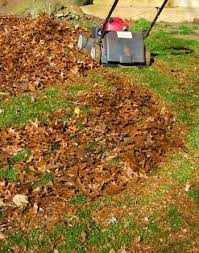
4. Mulch your gardens. As the leaves pile up in the fall, you may find that they outrun your capacity to mulch them right into the lawn. That’s OK. You can run your mulching mower with the bag attachment andimgres collect the shredded leaves. When the bag is full, you walk over to a nearby garden bed and just shake the contents into the garden. Let them pile up two to three inches deep. Here, they are your friends. They will rot and enrich the soil; they will limit evaporation and help retain rainwater; they will also help to suppress certain weeds. Depending on the ratio of garden beds to lawn at your place, you might be able to use all your shredded leaves on your own property. Never buy any more mulch from the nursery. You don’t need it.

5. Compost. This too may sound arcane or just daunting. It’s not. Composting is just a fancy name for a program of deliberately encouraging organic material to rot. When you compost, you accomplish several good things at once: you create your own free, natural fertilizer; you reduce your flow of garbage and other waste that has to be dealt with; and you will capture more and more of your own organic material. Composting can be ridiculously simple. You can just start a pile on the ground behind your garage. Toss grass clippings and shredded leaves on the pile, in alternating layers. From time to time, mix them up. Come back a few months later, and — voila! — there will be a load of dark, rich material that looks like a composting-how-tocross between plain old dirt and peat moss. Help yourself to a shovel-ful. Take it to a flower or vegetable bed, pour it on, and mix it in. Or, you can shake it lightly over your lawn. Anything you want to grow will grow better with compost. Once you get the hang of it, you can add kitchen scraps to your compost pile (but no meat or fish, please, or you will get every raccoon and skunk in the neighborhood spending the night behind your garage having a real hooey!). You can also buy a composter, which is a container for all this stuff, or make your own. Oh, yes, one more thing: it will all go better if you can divert some rainwater from your garage roof and keep your compost pile nice and moist.

6. Start a hedgerow. Huh? This too is easy. Here’s the idea: in many parts of the world (Ireland, England, France and elsewhere), farmers traditionally divided their fields by allowing or encouraging certain shrubs to grow up along the borders. Think of it as a living fence. The hedgerow not only marks boundaries, it was also used to control livestock in the centuries before barbed wire. But there’s one more benefit, too: the hedgerow is a patch of land on your property that you can essentially leave alone forever. The leaves that fall on it can just be left alone. Oh, and there’s a super bonus, too: a healthy, established hedgerow is also a home for lots of beneficial wildlife, which will appreciate the leaf litter on the ground, the cover provided by the shrubbery, the possibilities for making homes, and the food provided by any fruit or seeds yielded by the plants in your hedgerow. Here’s a way to start: go out to the back boundary on your land. Pace off 10-12 feet. Mark that line. Then, just stop mowing or weeding that zone. In a few years, you will find all kinds of “volunteers” — plants that show up all on their own, thanks to the wind or animals that disperse the seeds, and set about growing. You might want to do a bit of sorting, so that you get a good mix of native plants about the right size. Evergreens like yews and holly will get you through the winter. Fruiting shrubs like viburnums provide color and fruit. Now, if you back neighbor would do the same thing, the two of you would have a hedgerow more than 20 feet wide, which will really transform your neighborhood.

img_4468


So, there you go. These are all cheap, low-tech, proven techniques. Try them all. And see if you don’t find yourself running a more natural landscape.


6 Comments

Filed under Environment