Category Archives: Uncategorized

Eastwood follow-up

OK, so it turns out that a few journalists have (sort of) raised some of those questions.

1. Here’s the NYT’s Media Blog: The Clint Eastwood clip is really painful viewing… http://bit.ly/OBnSCd  …who thought that was a good idea?


2. Here’s a sane column in Forbes. Excerpt:

Commentators are lashing out this morning at the convention’s organizers. But where does the buck stop? For Romney, this was the most important hour of the campaign so far. It was what everything so far had been leading up to. He had to pay more attention to what happened then than to any other hour in his campaign. And he allowed it to be wasted.

3.  ??


If you find others, send links.


Leave a comment

Filed under Uncategorized

Not to be forgotten

Karl Fleming was a heroic reporter. He speaks for himself in a wonderful video called “Dateline Freedom,” which is hard to find but worth looking for.

Leave a comment

Filed under Uncategorized

Review of Covering America

Here’s a new review of my book, Covering America, that appeared in the Martha’s Vineyard Gazette. It was written by veteran journalist John Kennedy (once of the Boston Globe), who also interviewed me at the Gazette’s offices in Edgartown.

THE FUTURE OF JOURNALISM IS BRIGHT IN LIGHT OFTHE PAST

By JOHN H. KENNEDY

Daily newspapers shuttered. Radio and TV networks swimming in red ink. Reporters and editors enduring widespread buyouts and layoffs.

This was the landscape of the news business that Boston University professor Christopher B. Daly confronted as he began researching the history of American journalism about eight years ago. It occurred to him that he just might end up having to write the obituary of American journalism.

“The dark days seemed so dark,” Mr. Daly, a summer Aquinnah resident, said in a recent interview. “But actually . . . I stayed at it long enough to emerge with a feeling of great optimism. I actually feel we are on the verge . . . of a great period of journalism.”

A former Associated Press reporter and Washington Post correspondent for New England, Mr. Daly begins his new book, Covering America: A Narrative History of a Nation’s Journalism (University of Massachusetts Press), with a simple instruction: to understand the news business, one must understand news as a business.

And so the current economic tumult in news can be placed in historical context, in which journalism has had to periodically adapt to social, economic and technological change. As he writes in the book, “Each new phase of journalism history contains within itself the seeds of its own destruction and renewal.”

Both journalist and scholar, Mr. Daly writes that he combines “an insider’s knowledge with an outsider’s skepticism.” He left daily journalism for teaching in 1997 amid the tectonic changes rattling the industry; his job at the Post has since been eliminated.

“There is always a shakeout, yes,” he said last week. “And there are winners and losers. There have been terrible times recently in our field. I think we’ve reached the bottom — I sure hope so. But what I think is easy to lose sight of . . . are those brand-new, online-only ventures that are both doing good journalism and making money, which is no small thing.”


covering america

Mr. Daly has had one foot in journalism and the other in history for much of his adult life. As an undergraduate American history major at Harvard, he wrote for the college newspaper. He then worked for several years as a journalist, returned to academia to get a master’s degree in American history from the University of North Carolina and came back to daily journalism. But when he started teaching full-time at B.U., the journalism history course was an orphan, a course no one else wanted to teach.


“I did a really quick immersion in the history of journalism,” he said. “And it turned out I loved teaching the courses.” Now there are anywhere from 60 to 120 students in the classes each semester.

He eventually saw a place for a book that would blend the best examples of journalism and the industry’s changes over the centuries into a sweeping narrative. Mr. Daly has largely succeeded: The book is a welcome addition to the journalism history shelf, with crossover appeal to general audiences due to its narrative power and elegant writing.

As a result of his research, he has come to advocate for the importance of journalism history among other genres — political, military and social histories — that attempt to explain America. You can’t begin to understand the American revolution, for example, without appreciating the power of Thomas Paine’s argument for independence. A history of the Civil War is incomplete without an explanation of the role newspapers played in helping divide the country, he says.

“And again, and again, and again, you see it down through the generations, the newspapers, then radio, TV, photography, the Web, all of these things are really central to how this country came to be,” Mr. Daly said.

Along the way are stories of pivotal figures, including Benjamin Franklin and his business acumen and World War II columnist Ernie Pyle and his evocative prose about the G.I. (The late Katharine Graham, John Hersey, Art Buchwald and Mike Wallace, all summer Vineyard residents, also merited entries.)

Mr. Daly underscores the point that journalism is essential to the health of the country. What gives him hope are the better and cheaper tools available to journalists, as well as the lowest barriers to new publishers since Franklin’s time. You don’t need a printing press, barrels of ink and rolls of newsprint. Power up the laptop, and type in your blog’s web address.

“A journalist today, with the things you can put in a briefcase or a handbag, can go further, see more, record more, more accurately, more vividly than at any time in history,” the author said.

“When I was starting out in my own career in the seventies, to produce a multimedia package — it wasn’t even a concept we had — you would have needed a truck full of gear and specialists,” he said. “You would have needed Disney Studios, basically, to follow you around on assignment.”


What remain as challenges for the future, he added, are a press whose independence is linked to its economic health and a commitment to originally-reported news that transcends the celebrity gossip, public relations fluff and partisan bloviating that often passes for journalism today.


» SHARE YOUR FEEDBACK


Leave a comment

Filed under Uncategorized

New review of “Covering America”

By Christopher B. Daly 

I was delighted to see this smart, informed review of Covering America on the Nieman site. It was written by Dan Kennedy, a professor of journalism at Northeastern who is also widely known for his blogging, his columns in the Guardian (UK), and his regular weekly appearances on the PBS media-criticism program “Beat the Press.” As an author, I must say it is seriously gratifying to have a book reviewed by someone who really knows the field.

[Full disclosure: Dan is, as he put it in his review, a “friendly acquaintance” of mine, but I had no idea he had a review in the works. This came as a pleasant surprise.]

I was glad to see Dan pick up on the theme of the changing business model for journalism. That’s what makes me so optimistic about the future of news.


Leave a comment

Filed under Uncategorized

Can the president execute U.S. citizens?

By Christopher B. Daly 

A hat-tip to Charlie Savage of the Times for sticking with the story of one of the major constitutional, diplomatic, and military issues of our times:

Does the president of the United States have the constitutional authority to order the killings of U.S. citizens without so much as a trial?

That is the issue at heart of a lawsuit going forward in U.S. District Court in Washington. The suit was filed by survivors of Anwar al-Awlaki, the notorious America-hater who did so much to help al Qaeda before he was taken out last September in a drone attack in Yemen.

Things to keep in mind:

–al-Awlaki (although a rotten bastard for sure) was a U.S. citizen, born in New Mexico.

–al-Alawki was not bearing arms against the U.S. at the time.

–the president ordered his execution.

–al-Awlaki was never tried, convicted or sentenced in a U.S. court.

He was treated like a foreign enemy wearing a military uniform, only he wasn’t. This is the most troubling issue in the developing, high-tech, long-distance war on terror.


Leave a comment

Filed under Uncategorized

News Corp: Divide and conquer?

By Christopher B. Daly 

No doubt, Rupert Murdoch has something up his sleeve. His News Corp. has announced plans to divide into two new companies — one involved in print activities (mainly publishing the more than 100 newspapers in Australia, Great Britain, and the US) and another one involved in the far more lucrative activity of broadcasting.

Like many people, I suspect that Murdoch is seeking to protect the value of the broadcasting companies by separating them from his troubled print operations, which are the target of the phone-hacking scandal in the U.K. (and which threaten to drag the company into a parallel scandal here in the U.S. before too long).

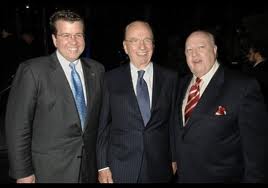
In an interview with the pompous windbag Neil Cavuto on Fox News yesterday, the inscrutably inarticulate Murdoch said he had no goal other than to improve both companies by letting their talented managers do their best. Yeah, right.

Stay tuned (but not to Cavuto).

From right to far right: Cavuto, Murdoch, Ailes   (AP photo)

From right to far right: Cavuto, Murdoch, Ailes (AP photo)

2 Comments

Filed under Uncategorized

Another view on the Times-Picayune layoffs

Here’ s an analysis by Rick Edmonds (via Poynter).

Worth considering.

Leave a comment

Filed under Journalism, publishing, Uncategorized

Abolish the NCAA (cont.)

By Christopher B. Daly

The battle over intercollegiate athletics rages on. (Actually, it is just a few folks crying in the wilderness.)

Recently, the reformist Joe Nocera of the NYTimes weighed in with an op-ed. Like many reformers, he seems to really believe in the need for more radical solutions, but he pulls his punches in the name of being realistic. Enh!

Earlier, the Chronicle of Higher Ed shared this story about a football player at the University of Memphis, which makes a powerful case for eliminating college athletics. It’s a thoroughly reported piece on the Chronicle’s handsome, lucid, well-designed website. ( Actually, the home page is not that brilliant, but the Memphis piece is beautifully laid out and includes relevant multimedia. The audio clips are really something.)

And Buzz Bissinger, never one to mince his fuckin’ words, had this to say: Ban College Football.

AP photo / Football at my alma mater, UNC

AP photo / Football at my alma mater, UNC

(Which would be a start. What educational purpose does college football serve? It really amounts to a farm system for the NFL in which the pro teams don’t have to pay player salaries.)

For that matter, what educational purpose does any intercollegiate athletics serve? If you are in college and you want to get some exercise, start a pick-up game and challenge the kids in the next dorm. Then, get back to reading long books.)

I say, ban the NCAA.

Leave a comment

Filed under Uncategorized

The Warren-Brown Senate Race: “Organized Hatred”?

By Christopher B. Daly

The 19th Century historian Henry Adams – who was no dope – once shrewdly described Massachusetts politics as “the systematic organization of hatreds.” That was certainly true in his day. A question raised by the current U.S. Senate campaign is whether it is still true today.

Here’s why I say that. The presumptive Democrat, Elizabeth Warren, has had to spend weeks defending herself from the revelation by the Boston Herald that she once, long ago, gave the impression that she was part Cherokee.  The resulting brouhaha has changed the subject in the campaign and presumably worked to the advantage of the presumptive Republican candidate, Scott Brown.

Where did the original disclosure come from?

Let me emphasize that I don’t know what happened.

In fact, it is probably unknowable at present, due to the code of omerta that prevails among political operatives and political reporters. That code is something I do know a little about, having spent a few years as a political reporter covering Massachusetts politics.

In that role, I was the recipient of calls from parties unknown who, for reasons best known to them, decided to “drop a dime” into an untraceable payphone (I am dating myself here, I realize) and share some precious intelligence. I was sometimes invited to “take a walk” by a gimlet-eyed young operative; we would end up on a bench on the Common, and the guy would lean in close and give me the phone number of a divorce lawyer representing some disgruntled ex-spouse of a politician or cabinet member. I was invited to lunch at restaurants in the vicinity of Beacon Hill and slipped manila envelopes with documents inside, detailing the names of political donors whose relationships to each other were not obvious but turned out to be quite interesting once the tipster connected the dots. I got to know the system, thanks to these then-young political operatives.

So, here is what I surmise happened in the Senate race.

The Brown campaign did what all well-financed modern campaigns do: the candidate took a sliver of the millions he has raised and hired a team tasked with conducting “opposition research.” That is, you get a bunch of brainy young people together and you tell them to research everything about the political opposition.

And when they say everything, they mean everything: every indiscretion and every discrepancy. Every tax or mechanic’s lien. Every divorce, adoption, or inheritance. Every real estate transaction, including mortgage notes. Every arrest and every traffic violation. Every grade in school, every bad date, every expensive hairdo – EVERYthing.

The fruits of all that research are then handed over to the campaign’s senior aides and advisers, who stockpile them like ammunition. When they see an opportunity to use the information to their tactical advantage, they fire away. The campaign has some options. In one scenario, they can use the material directly and have their own candidate make a public accusation.

Or, they can play it “cute” and aim for a bank shot. They might decide to “leak” the information to the news media. That approach has several advantages. One is that the damaging material has the added credibility of reaching the public in the form of a news story. Another advantage of the leak is that the campaign can deny involvement or feign ignorance, safe in the knowledge that the reporter they went to will never rat them out.

           This can be especially effective if the campaign aides don’t even tell the candidate. Then, when the “news” breaks in the media, the candidate can act sincerely shocked and outraged and call for further investigations into the “troubling questions” raised by the news reports. That way, the story gains what we call “legs” – that is, it has the capacity to sustain itself as a continuing “story” involving denials, “fresh details,” and so on.

Did that happen in the case of the disclosure about Warren’s heritage? As I said, I don’t know. But it has all the hallmarks.

And what’s troubling about it is this: somebody knows. Quite likely, somebody in the campaign knows. If that’s the case, then there’s your real scandal right there. I say that because it points a finger at someone on Brown’s staff who must have gone through a thought process something like this:

            Oh, boy! This is great. We can leak this baby to the Herald, which we can depend on to slap it on Page 1. It will look on the surface like a “gotcha” story about a candidate’s hypocrisy. But as an added bonus, this story comes with a dog whistle: For those who can hear it, this is really a story about affirmative action. It’s a smear, intended to leave the impression that Elizabeth Warren is some kind of race whore, who gamed the system that so many white ethnics still hate.

            In their view, affirmative action is a big con game designed to put unqualified blacks, Hispanics and other minorities in line ahead of qualified white ethnics for the few good things in life. If we can get Warren associated with affirmative action, we can stir up those resentments, organize those hatreds, and peel off a couple thousand white ethnics who are independents or even some who are still Democrats. If we’re lucky, the “story” will get picked up by the echo chamber of right-wing talk radio. The eight ball drops into the corner pocket.


Did all that happen? I don’t know.

But someone does.

Leave a comment

Filed under Journalism, Politics, Uncategorized

Should anonymous comments be banned?

By Chris Daly 

According to TIME, legislation has been proposed in the New York Assembly that would ban the widespread (but often annoying) practice of posting online comments anonymously. I like comments: I like to read them, and I allow them on this site. 

But here’s the thing: 

–Signed comments are sometimes good and sometimes bad.

–Unsigned comments are sometimes good and sometimes bad.

–All of the worst comments seem to be anonymous.

Let’s discuss. Feel free to comment. But let’s try this: if you insist on commenting anonymously, you must follow the guidelines that journalists use for granting anonymity for sources. That is, you have to have a reason for your anonymity, and you have to disclose as much information as possible about that reason.

Leave a comment

Filed under Uncategorized