Category Archives: New York Times

Jill Abramson on narratives, multimedia

By Chris Daly 

Since the announcement of her appointment as the next top editor of The New York Times, Jill Abramson has received a lot of attention. At the same time, the newly designated leader of the most important institution in U.S. journalism has been fairly circumspect. It’s fair to say that more has been said about her than by her.

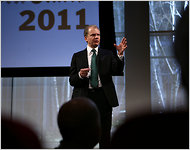
But she did speak at length recently in a public forum: the annual conference on narrative non-fiction, hosted at Boston University. Abramson was one of the keynote speakers, sharing the honors with Gay Talese, Susan Orlean, Ken Auletta and other distinguished practitioners, and she went into some detail about her views on long-form storytelling as well as multimedia storytelling. All in all, her presentation gave some powerful signals about where she might lead the Times.

[Full disclosure time: I have known Jill for 30-something years; I admire her and consider her a friend. I also had a tiny role in organizing the conference at BU. So, there you go.]

Abramson was introduced by the main conference organizer, Isabel Wilkerson, who won a Pulitzer Prize while working as a reporter for the Times, then left to pursue her epic narrative of black migration within the United States, the much-acclaimed (and definitely long-form) book The Warmth of Other Suns.

In her talk, Abramson gave the crowd a good sense of what she took away from the six months she spent in late 2010 immersing herself in the world of social media, multimedia, and the like. But first she reaffirmed her enthusiasm for the kind of long-form journalism known as “narrative non-fiction.” As Gay Talese beamed a few rows away, Abramson described how she uses Talese’s landmark profile “Frank Sinatra Has a Cold” in her teaching. For about five years, Abramson has been teaching a course each spring in journalism at Yale. (Since Yale does not have a full-blown Journalism department, the course is offered under the auspices of the English Department — or, as Abramson calls it, the “House of Hersey,” in honor of another hero, the journalist and novelist John Hersey, who taught at Yale.)

Here’s what she had to say about journalism and multimedia:

Abramson sees a “very robust future” for narrative non-fiction. She said her intention was to explore the roots of narrative non-fiction and to trace its relationship to today’s “dizzying” 24/7 news cycle.

In her teaching, she tries to spread her “viral enthusiasm” for long-form journalism, citing Hersey’s classic “Hiroshima” as a canonical text. She said her students, despite their youth, quickly become engrossed in Hersey’s meticulous recreation of the impact of the atomic bomb on his six chosen subjects. “Imagine how may clicks you would need today to read it on your iPad.”

And she cited Talese’s Sinatra piece as another canonical work, one that she uses as the first reading every semester; she likes it because, among other reasons, it points up the need for obsessive reporting, which she said is even more important than access.

This kind of reporting, according to Abramson, can now be found only at the Times, the New Yorker, and “precious few other places.”

Calling narrative non-fiction “a distinct American art form,” she said that the doomsayers were wrong when they predicted that the coming of the Web would destroy the love of reading. As evidence, she pointed to the “most read” and “most emailed” features in the Times, which often include lengthy pieces from the magazine. One recent example was the profile of Obama’s mother by Janny Scott (although Abramson acknowledged that the piece may have received a boost from the insanely cute photo of Obama in a pirate costume).

Abramson said that after holding out for a while, she recently got an iPad and quickly became “slavishly addicted” to it. “It could make me a hermit.” In her view, the iPad (and presumably, other tablets as well) give narrative non-fiction new life by expanding its reach to a new audience — and it’s an audience that is getting used to the idea of paying for content.

“The long-form article is not only alive, it is actually dancing to new music.”

She described her 2010 sabbatical from her daily m.e. duties as a “deep digital dive” during which she spent considerable time looking at sites like Politco and HuffPO. Their readers, she decided, are mainly “snackers,” looking for  what she calls “scoop-lets” – short , gossipy items.

Abramson acknowledged that HuffPo founder Arrianna Huffington says she wants to feature longer articles. Problem is, according to Abramson, those pieces are time-consuming and therefore expensive. “You really can’t do original reporting by scraping the Internet.” You also need a cadre of reporters with experience. It is “a source of worry” that news outlets are continuing to cut back on their investigative teams and foreign bureaus — two notorious cost centers inside news organizations.

Abramson also took a swipe at the Times‘ nemesis, Rupert Murdoch. She reiterated the point she made in a recent piece by Ken Auletta in the New Yorker, in which she was quoted as lamenting the demise of the old page 1 features, which Murdoch did away with after acquiring the Wall Street Journal, where Abramson cut her teeth as an investigative reporter. Those feature stories gave readers “the story behind the story.”

“The current Journal… rarely has these pieces. The new Journal, at its core, is a quick-delivery system. It’s excellent . . . but those long distinctive pieces are mostly gone, and that makes me very sad indeed.”

So, where is narrative non-fiction still flourishing?

It’s still around some of the old familiar places — the New Yorker and the Atlantic, to name two. But Abramson said readers can also find great reporting in new venues.

One place that she touted is ProPublica — the prize-winning, online-only investigative organization — which Abramson said has about 30 investigative reporters, who work exclusively on long narratives. She said she was impressed by the reporting done by Dr. Sheri Fink for ProPublica on the medical decisions made during Hurricane Katrina, which turned into a joint project with the Times. (Abramson called the work “essentially a co-production.”

“There are new flowers blooming all over the place. That keeps me optimistic. . . .We are told that younger people don’t read. But…”

She touted several other Websites, including The Atavist, Byliner and Longreads, as well as Kindle’s “Singles” program, which sells pieces in the 10,000- to 30,000-word range.

“I’d like to reassert the Times’s deep and enduring commitment to long-form narratives and the sometimes crazy, obsessed, manic-depresseive  work cycles they require from the people who create them.”

Why?

“Impact. These articles really do change the world.”

She presented two examples from the Times:

1) Alan Schwarz’s series on concussion in football and other sports.

Abramson said Schwarz was a stringer when he started this series and then brought on staff specifically so he could pursue the topic. He was also “plucked” out of the Sports department and assigned to work with a special editor. “He was a math major who never studied journalism. He relies on the mathematical idea of the “golden ratio” — which he uses as his organizing principle when outlining longer pieces.

2) The paper’s multimedia series “A Year at War.”

“Finally, I’d like to talk about the new face of long-form journalism at the Times.”

Abramson shared a vision of “integrated story-telling” where audio, video and photos are “not simply offshoots of written pieces but are integral to the journalism from the inception of a project.”

The example she chose was “A Year at War.”

(Note: this is not easy to find on the Times’s densely packed homepage, but is well worth pursuing; the packages like this are ghettoized and can only be found by using the search function. This is the something that the Times needs to address and, once Abramson takes over, maybe will do. She said she would like to develop a prominent place on the Times site that could be a “library” of great long-form projects. For now, you have to find the tiny link called “Multimedia” in the faint gray lettering on the left-side navbar; it does not appear in the navigation bars at the top or bottom of the page. Once you get to the Multimedia page – actually titled “Multimedia/Photos” – you have to scroll down pretty far. Hang in there. I would link to it, but I want readers to try to find it. Any other newspaper in America would be incredibly proud of all this work and would tout it much more aggressively. Aw, heck, here’s the link to the section:  And here’s the link to the feature that Abramson showed.)

“From the beginning, we saw this series as a way to reengage our readership – depressed and bored by nearly a decade of war coverage.”

“Rather than focusing on fighting or on strategy, we wanted to look intimately at the troops themselves. . . . We wanted to show, in close to real time, how service affects soldiers.”

The who project was conceived as a narrative with looping detours that readers could follow. The project also includes writings and photos done by the soldiers themselves – “which were amazing.”

“This is probably the richest and deepest content we have ever offered readers of a long series.”

Abramson then showed the conference audience the moving segment about Sgt. First Class Brian Eisch and his two adorable sons.

“I leave you with my optimism about the past, the present, and the future of this uniquely American art form that we all treasure.”

–30–

P.S. Boston University has helpfully posted a video of Jill Abramson’s talk, so you can see the whole thing for yourself.

6 Comments

Filed under Arianna Huffington, Journalism, New York Times, Uncategorized

Who reports?

By Chris Daly

Here is a really worthwhile follow-up to the recent posting about Nate Silver and his study of original reporting. It develops several points that I think are solid and worth further research.

It’s from Nick Baumann of Mother Jones. Like Nate Silver, he is an interested party in all this — trying to make sure that Mother Jones’s original reporting is reckoned properly. Fair enough.

Thanks to my son Gabe for sending it along!


Leave a comment

Filed under Journalism, New York Times

Who reports?

By Chris Daly

The always-interesting Nate Silver, in a recent post, put his finger on a really key issue in journalism: who does the reporting that everyone else fights over, analyzes, re-purposes, aggregates, or just steals?

Silver did some back-of-the-envelope calculations and came up with this chart:

(I must say I am very gratified to see that two of the top 10 — The AP and The Washington Post — are the places were I spent most of my years as a journalist.)

As anyone in the news business could tell you, there are no real surprises here. Silver is trying to identify who does the bulk of the original reporting about national and international affairs for American audiences. (He is not looking here at local news, which is another story.)

Two news organizations in particular stand out, almost in a class by themselves.

First is the AP, the enormous but nearly invisible news organization that still operates in every state in America and most countries around the world. The non-profit cooperative functions as a giant wholesaler of news — gathering, re-writing, shooting, editing, and distributing vast amounts of stories, images, sound, and data every hour of every day. Almost all of AP’s output is delivered to other news organizations, and not directly to the public. So, most people think they “get their news” from whatever retail outlet they happen to frequent, rather than from the ultimate source, which is often the AP.


Number Two on the list is The New York Times. Again, no real surprise. Say what you will about its management, business model, stock price and all the rest, the Times has no real peer among “general news” organizations. (By that, I mean organizations that have a broader sweep than a particular topical niche like business, sports, or celebrities).

The point is worth making again: reporting is expensive (and sometimes dangerous), and the world would be a better place if more people got out, walked around, took notes, made photos, and shared what they found.

‘Nuf said.

2 Comments

Filed under Journalism, New York Times

More news about the news

By Chris Daly

More news today about journalism.

~First, an update from the NYTimes about the harrowing captivity of four of its own journalists (including Tyler Hicks, a BU alum who will be the commencement speaker this spring at BU’s College of Communication — assuming he stays out of any further serious trouble). And thanks to Joe Klein, on today’s “Morning Joe” on MSNBC, for pointing out that when certain people (he mentioned Sarah Palin) whine about the “lame-stream media,” they should realize that they are disrespecting people who deserve better. 


Photo by John Moore/Getty Images


~Whither Glenn Beck? Who the heck knows?


~Thanks to Michael Miller for pointing this out, here are some interesting further thoughts on the NYTimes pay model (including bold assertions about the future) from John Gruber at Daring Fireball. (With a name like Daring Fireball, no wonder he’s so confident about his predictions…)


~A happy prospect: help-wanted from Talking Points Memo, which is seeking to fill a new position, that of associate editor for Washington news. Here’s the take-away:

Crackerjack news judgment, experience as an editor and deep familiarity with politics and political news are each a must. Competitive salary for qualified applicants; health care, three weeks annual vacation and 401k benefits provided.


Glad to see health care benefits being offered. Wonder what is meant by “competitive salary”. . .


Leave a comment

Filed under broadcasting, Fox News, Glenn Beck, Journalism, New York Times

NY Times pay wall

By Chris Daly


So often, the field of media criticism/analysis partakes of the spirit of sports journalism. If you watch ESPN a lot, you realize that most of the people on the screen have a very specific skill set: the ability to make bold, provocative statements about the near future. (There is a similar skill set involved in politics and military analysis, too.)


I will admit that this is an activity I am not very good at, so I will not try. Instead, I take a more agnostic and empirical approach (more in keeping, I think, with the genius of journalism and history, which are essentially backward-looking enterprises). I am applying it now to the NY Times newly announced pay-for-news plan.


To its credit, the paper has started covering the issue a bit better, including a piece today.

Some of those people who are gifted with knowledge of the future are already weighing, as here.

I say: let’s get some data first, then try to figure out what it means.

Until then, I must say I wish the Times good luck in figuring this out.


NYT publisher Arthur Sulzberger Jr. last week.


.

Leave a comment

Filed under media, New York Times, publishing

Whose press freedom?

By Chris Daly

Today’s Times includes a “sidebar” piece (column?) by legal correspondent Adam Liptak. I found it frustrating for a couple of reasons. For one thing, it is a bit of a mystery why it is running now (except for the thin reed of the anniversary of the Citizens United ruling from the Supreme Court). There is no discernible “news peg.” But that’s not really important.

What is more frustrating is that the piece provides so few links to the scholarly literature on this vast subject. That’s where the Times could have really used the Web to help its readers go deeper. I am going to try to find some of this material and post those links here.

Meanwhile, let me throw out a thought: At the time the Founders enshrined the idea of “freedom of the press” in the Bill of Rights, the press of the day was small, local, independent, and opinionated. The typical form of ownership was a “sole proprietorship” — that is, the printer who ran the press owned the business entirely himself. But even then, many “job printers” handled printing chores for all manner of customers, including customers whom they disagreed with. So, in that scenario, who enjoyed press freedom? The owner of the business that facilitated the mass communication? The author of the words? Both?

Keep in mind, the main goal of the founders was to prevent “prior restraint” — the use of government power to prevent certain facts or ideas from ever getting published in the first place. That seems like as worthy a goal as ever. Therefore, the rights of all individual human beings who want to communicate with other individual human beings should be protected from government interference. That, it seems to me, ought to be the operating principle here.

Comments?


Leave a comment

Filed under history, Journalism, media, New York Times, Supreme Court

The “psycho killer” problem

By Chris Daly

Today’s NYTimes has a piece that tries to address an issue that I believe was raised by the Tucson shootings: What are people supposed to do when they think a young man is losing his grip on reality and appears headed toward some violent act.? Turns out, there is not a really good answer — at least in most states, most of the time, with most cases.

This is an issue that I raised last week, shortly after the shootings in an op-ed I wrote in the Boston Globe.

Regrettably, though, the Globe editing process knocked out a key point I was trying to make. Midway through the op-ed, I wrote:

For one thing, the age at which both men are thought to have committed violent acts — their early 20s — is around the time when men tend to experience the onset of schizophrenia, a major mental illness that affects less than 1 percent of the population, most of whom will never commit an act of violence.

The regrettable part is that an editor at the Globe cut the final phrase — “. . . most of whom will never commit an act of violence.” — leaving the impression that some, most, or all schizophrenics are dangerous, which is not true and not my point. The editor who accepted the piece and saw it through most of the editing process agreed that it was an editorial mistake to have cut that phrase.

The major point: A lot more people need to learn a lot more about effective interventions for people suffering major mental illnesses.

Leave a comment

Filed under mental illness, New York Times, schizophrenia, Tucson, Tucson shooting

Watchdog or cheerleader?

By Chris Daly 

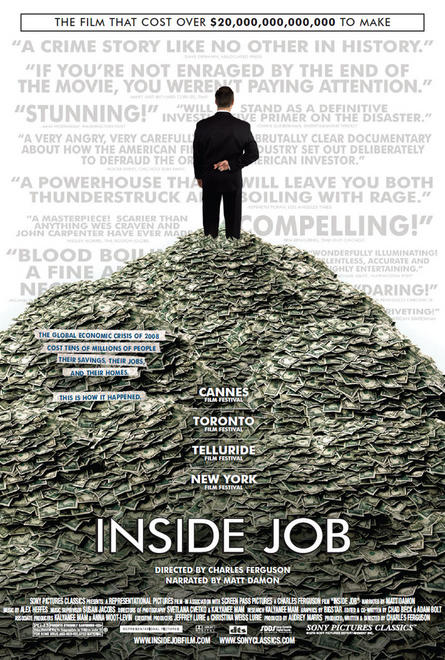
After watching the recent documentary “Inside Job,” about the U.S. economic collapse in 2008, I couldn’t help wondering: Where was the business press during all the run-up to the edge of the cliff?

The film is not shy about pointing fingers at villains: greedy bankers, revolving-door  government officials who go to Washington to look out for Wall Street, academic economists who write “studies” that “show” that whatever Wall Street wants to do is rational, efficient, etc.

But while the film allocates plenty of blame to markets and to feckless regulators, it says nothing about an institution that is supposed to help protect consumers, investors, and the general public: the media that cover business. The well-paid reporters and editors work for newspapers, magazines, television and websites — everybody from the NYT and WSJ to the Economist and Forbes to CNBC. Where were they?

–Did they explain the rotten core of CDO’s before they imploded (i.e., when the information would have been really timely and useful)?

–Did they spot the housing bubble?

–Did they reveal how bogus the standards had become for subprime loans?

Or, did they do what they usually do — admire executives who had a good quarter, cheer for the Dow to rise, and repeat pro-business dogmas about low taxes?

Hmm… If any academics are looking for a topic to study, that might be a good place to start.


Leave a comment

Filed under business, CNBC, media, New York Times

Keller on WikiLeaks

By Chris Daly

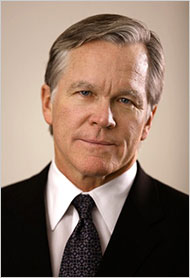
Bill Keller, the top editor of The New York Times, explained his view today of his newspaper’s role in the latest WikiLeaks release of classified government secrets.

Speaking on the Harvard campus, Keller maintained his distance from WikiLeaks founder Julian Assange and said that, so far at least, Obama administration officials have behaved like “grown-ups” – in contrast to the previous administration.

Keller spoke for about an hour Thursday afternoon at the Nieman Foundation for Journalism at Harvard. He was the keynote speaker for the foundation’s day-long conference, “From Watergate to WikiLeaks:  Secrecy and Journalism in the New Media Age.”


Here is most of what he said, including most of the Q+A:


Since he took over the Times in 2003, Keller said no issue has provoked a higher pitch of “indignation” than publishing secrets.

And at least until this year, nothing done by the Times has ever caused so much consternation. That includes the paper’s story about the secret NSA wiretapping program and the 2006 revelations about the Treasury Department’s international program of surveillance of financial transaction.

Both those programs, Keller noted, were designed to catch terrorists – “and, by the way, I am in favor of that.”

Both programs were secret. In both cases, government officials requested that the Times withhold publication.

How rough did they play?

Keller said Bush told him that if the Times went ahead, the editor should “be prepared to be responsible for the next terror attack on America.”
Keller took issue with Bush’s description of the same events, which appears in Bush’s recently released memoir, “Decision Points.”

When the Times went ahead and published anyway, the White House reaction was “predictably fierce.” On the Treasury story, for example, Cheney and others denounced the Times and hinted at criminal charges. Members of Congress piled on, and one right-wing radio talk host suggested that the world would be a better place without Keller.

Reactions like these, Keller said, “may be hysterical but they are heartfelt.” He said there is “real confusion” as to why a newspaper editor should be allowed to disagree with the president in matters of national security.

Then the talk turned to WikiLeaks.

[Humor alert: “When I first heard of it, I thought it sounded like a brand of adult diaper!” Keller said to polite chuckles from about 100 journalists, academics and others in a conference room at Lippmann House, the home of the Nieman program.]

This time around, Keller said the administration’s reaction was quite different from what he had gotten used to under Bush. The Obama officials they consulted in advance of publication were “sober, responsible and grown up.” There was “no orgy of press-bashing.” Except for Joe Lieberman, no one has hinted at prosecution of the newspaper.

Still, he said there are critics. The criticism falls along three main lines:

1.            The documents are of dubious value.

2.            The disclosures put lives at risk.

3.            By dealing with WikiLeaks, the Times has compromised its impartiality.


Addressing each, Keller went on.

1. He is puzzled by the complaint that the documents do not do more to rock our world. “The fact is, 99 percent of the news does not profoundly change our understanding.” The value of these documents is that they provide nuance, texture and drama. He said that if the stories about the diplomatic cables gets people more interested in foreign affairs, “then I believe we have performed a public service.

2.            As for the risks of collaboration with WikiLeaks, Kelle said, “They are real.” Earlier, in the disclosures of the Iraq and Afghan war documents, WikiLeak named many names. With the diplo-cables, he said Wiki did a better job. It’s beyond Keller’s power to influence Wiki. “I can only answer for the Times.”

3.            Does it complicate diplomacy? “I’m skeptical,” Keller said. He cited recent comments by Defense Secretary Gates to the effect that other countries cooperate with the U.S, “because they need us.” [Keller’s implication was that since they still need us, they will continue to talk to us, even in confidential cables.]


As for Julian Assange, founder of WikiLeaks, Keller did not seem ready to grant him the status of a full-fledged journalist and partner:


“We regard Julian Assange as a source. I will not say a source pure and simple, because sources are rarely pure or simple.”

“You don’t always agree with them.

“Your obligation is to verify, to supply context, and to make sense of it. That is what we attempted to do, as we would do with any documents that came into our possession.”


Currently, Keller noted, the Times has 9 staffers assigned to Iraq and Afghanistan – not including freelancers and support staff.

“There are few places you can go to find honest, on-the-scene reporting about what is happening.”

He also noted that the Times has suffered two deaths and four kidnappings. Most recently, a contract photographer, Joao Silva, lost both legs when an IED exploded while he was photographing U.S. troops on patrol in Afghanistan.

Consequently, he said, “We are invested in the struggle against murderous extremism.” He said the Times is struggling against it directly (in terms of threats to journalists’s safety) and indirectly (in terms of threats to free expression).


In recent years, Keller said journalists have revealed lots of things – about Abu Gharib, “black sites,” eavesdropping, extreme rendition, etc. Quoting his colleague Bob Kaiser of The Washington Post, Keller asked if anyone seriously would rather not know these things.

“Government wants it both ways: keep their secrets, but trumpet their successes.”


Keller also invoked the Pentagon Papers case of 1971, referring to the affidavit filed in the case by Max Frankel, then the Times’ bureau chief in Washington. Frankel observed that presidents create secrets in order to use them. Same with cabinet members, military service chiefs, even mid-level bureaucrats. Almost no one plans to keep a secret forever. They are used tactically.

“One man’s security breach is another man’s public realations campaign.”

Recently, Frankel commented on WikiLeaks for the Guardian (which was given the diplo-cables directly from WikiLeaks and shared them with the NYTimes). In that piece, Frankel said that any time 3 million people have access to a “secret,” it’s not much of a secret.


Keller then asked how editors reconcile the urge to inform people with the need to protect legitimate secrets.

“Sometimes it’s easy. Our reporters in Iraq and Afghanistan take care not to divulge operational intelligence.”

“In handling the WikiLeak documents, we excised names.”


Often, though, he said it’s not easy. “There is no neat metric. We make our best considered judgment.”


The Times does not always decide to publish.

“When we come down in favor of publishing, of course, everyone hears about it.”

But sometimes, the paper withholds information. Then, of course, no one knows what they don’t know.


Looking ahead, Keller said editors will continue to have to decide on a case-by-case basis.

“Frankly, I don’t see a way to alter journalistic practices unless we just defer to the government. Our responsibility is to publish information of interest to the public.

“We have a duty to be careful.”

“There is one thing we can do: we can be a little more judicious in our use of anonymous sources.”


Eliminating them is “high-minded foolishness” that would result in “press-conference stenography.” But cutting back on anonymous sources would improve credibility. Overuse adds to the suspicion that journalists make things up.


In legal terms, Keller said some people (he mentioned Gabriel Schoenfeld, who wrote in the WSJ.) want to use the Espionage Act of 1917 to punish the Times and other news organizations. Keller said the Espionage Act has never been applied that way.

“The main practical legal threat facing journalists these days is.. the subpoena.”

In the decades after the 1972 Branzburg case left journalists vulnerable, there were relatively few cases. Since 2000, according to the Minnesota Law Review, it has risen to hundreds a year.”

He said many journalists hope for a federal “shield law” – comparable to those that provide testimonial privilege for lawyers, ministers, and doctors. But Keller said passage does not seem imminent and, in any case, is likely to deny reporters any protection when their reporting involves national security.


Keller acknowledged that “the Internet has transformed landscape of journalism” – by bringing new levels of speed and openness.

He said this is “healthy change,” bringing new voices and new audiences.

But, he said, it has “blurred the definition of who is a journalist.”

“Personally I would urge a fairly expansive definition.” But he would not include everyone.

A real journalist (he did not use that term) is someone who spends a lot of time and energy checking things out. On those rare occasions when the Times gets sensitive secrets, the paper’s reporters spend a lot of effort verifying them – without security clearances, subpoena power, wiretaps or any other special power. He suggested that WikiLeaks is not that kind of outfit – at least not yet.


“The mainstream press may not enjoy the hegemony it had before the Internet.”


He said the current administration has been reacting calmly and professionally. “The previous administration? Not so much.”

“I’d like to turn the telescope around and ask: what are the security implications if we became MORE secretive? Would we be safer?”


Independent news coverage is “not just something to defend, it’s something to be celebrated.”


*     *      *    *    *    *    *

Q & A:


Q. What is the vetting process?

A. We put them into a database. We conducted keyword searches. Could be a country, a leader, a phrase. We searched. Consulted reporters who were experts. They gave us search terms.

That produced clumps of cables. Someone was assigned to go through them for stories. . .


The vetting had to establish, is this stuff ereal?

A number of reporters had seen the real thing before. They could confirm. No one has yet come forward (to dispute authenticity of these cables)

We went to government agencies. Let them raise any objections.  Obviously, we did not offer them the right ro decide. We heard them out  respectfully. I describe it as professional and grown-up. A lot of times, they wanted us to omit things that were just embaraassing. We said, ‘Sorry.’


Q.  What is the schedule for publishing the other 99 percent?

A:  There’s no schedule. The first two dumps (Iraq and afg war logs), WikiLeaks posted, after we had time. Essentially, it was an embargo. (a familiar if loathed practice)

The embassy cables were more complicated. The range was so broad, the volume so enormous. The different interests of different news organizations were large.

He said the Times held discussion with the European partners – The Guardian in the U.K. and Der Spiegel in Germany. Among them, they agreed on a calendar by which they would all write on the same topic on the same day.

“We agreed: day 1 would be ‘Pakistan day.’ Day 2 would be ‘Russia day.’ We agreed to give WikiLeaks the documents we planned to post with each day’s stories. (with redactions)

We have basically done the major stories that we plan do do.

I expect we will post future documents as we think of more stories that we want  to do.

I have no idea what WikiLeaks intends to do.

We don’t  intend to post the whole batch. Most of them are not very interesting.

Many of them are the diplomatic equivalent of  “laundry lists”


Q. Relation with Assange?


A: Assange never said explicitly why he cut the New York Times off. But he has said some things.

Keller said Assange has said or implied that he is miffed because the Times did not link to WikiLeaks online. He said Assange was also unhappy about two Times stories: the reporting about suspected leaker Bradley Manning and the Times’s profile of Assange himself.


Q. Would you work with them again?

A. “They were a source, not a partner.

“I have no idea whether WikiLeaks will offer us anything again. I would accept it on the same terms – raw material that we would take a look at and publish if its interesting.”


Q. This is all about government information. What about private or corporate information, like banking?

A. Keller said he is not sure that would change anything.

“One thing I omitted is that we had lawyers involved along the way – very good lawyers, the kind who see it is their responsibility to see how we can get things INTO the paper.

“We discussed possible jeopardy. Reviewed British law. We ascertained that what we were doing was legal.

“I’m not sure it would be with a private entity.

In that case, Keller said, the charge to the lawyers would be to find a way.

“Beyond that, I don’t see a qualitative difference between government information and information from other powerful institutions.

“I might feel qualms about a private individual. But in the case of a major American bank. . .  I’d be very interested in that.”

[Keller made clear that he would not be interested in just dumping bank account numbers online but he would be interested in secret memo that showed, for example, a particular bank’s role in the financial crisis and bailout.]


Q. Would you be troubled by a prosecution of Assange?  How is the Times different from him?

A.

I’m not a lawyer.  I think our lawyers would  kill me if I offered an answer.

Is WikiLeaks a journalistic organization? I am humble about who gets to be called a journalist.

There are two things I would say: I don’t regard Julian Assange as a kindred spirit. If he’s a journalist, he is is not the kind of journalist I am.”


But Keller says WikiLeaks has already evolved into something more like a journalistic organization, abandoning its original position of total transparency.

“As an editor I find the Espionage Act a scary thing in the wrong hands. It’s an abuse-able law.”


Leave a comment

Filed under Journalism, journalism history, leaks, media, New York Times, President Obama, Wikileaks

Wiki-flood

Not to be missed among the deluge of “cables” is this statement by Times executive editor Bill Keller.

A Note to Readers: The Decision to Publish Diplomatic Documents

The articles published today and in coming days are based on thousands of United States embassy cables, the daily reports from the field intended for the eyes of senior policy makers in Washington. The New York Times and a number of publications in Europe were given access to the material several weeks ago and agreed to begin publication of articles based on the cables online on Sunday. The Times believes that the documents serve an important public interest, illuminating the goals, successes, compromises and frustrations of American diplomacy in a way that other accounts cannot match.

The Source of the Material

The documents — some 250,000 individual cables, the daily traffic between the State Department and more than 270 American diplomatic outposts around the world — were made available to The Times by a source who insisted on anonymity. They were originally obtained byWikiLeaks, an organization devoted to exposing official secrets, allegedly from a disenchanted, low-level Army intelligence analyst who exploited a security loophole. Beginning Sunday, WikiLeaks intends to publish this archive on its Web site in stages, with each batch of documents related to a particular country or topic. Except for the timing of publication, the material was provided without conditions. Each news organization decided independently what to write about the cables.

Reporting Classified Information

About 11,000 of the cables are marked “secret.” An additional 9,000 or so carry the label “noforn,” meaning the information is not to be shared with representatives of other countries, and 4,000 are marked “secret/noforn.” The rest are either marked with the less restrictive label “confidential” or are unclassified. Most were not intended for public view, at least in the near term.

The Times has taken care to exclude, in its articles and in supplementary material, in print and online, information that would endanger confidential informants or compromise national security. The Times’s redactions were shared with other news organizations and communicated to WikiLeaks, in the hope that they would similarly edit the documents they planned to post online.

After its own redactions, The Times sent Obama administration officials the cables it planned to post and invited them to challenge publication of any information that, in the official view, would harm the national interest. After reviewing the cables, the officials — while making clear they condemn the publication of secret material — suggested additional redactions. The Times agreed to some, but not all. The Times is forwarding the administration’s concerns to other news organizations and, at the suggestion of the State Department, to WikiLeaks itself. In all, The Times plans to post on its Web site the text of about 100 cables — some edited, some in full — that illuminate aspects of American foreign policy.

The question of dealing with classified information is rarely easy, and never to be taken lightly. Editors try to balance the value of the material to public understanding against potential dangers to the national interest. As a general rule we withhold secret information that would expose confidential sources to reprisals or that would reveal operational intelligence that might be useful to adversaries in war. We excise material that might lead terrorists to unsecured weapons material, compromise intelligence-gathering programs aimed at hostile countries, or disclose information about the capabilities of American weapons that could be helpful to an enemy.

On the other hand, we are less likely to censor candid remarks simply because they might cause a diplomatic controversy or embarrass officials.

Government officials sometimes argue — and the administration has argued in the case of these secret cables — that disclosures of confidential conversations between American diplomats and their foreign counterparts could endanger the national interest by making foreign governments more wary of cooperating with the United States in the fight against terrorists or other vital activities.

Providing an Analysis

Of course, most of these documents will be made public regardless of what The Times decides. WikiLeaks has shared the entire archive of secret cables with at least four European publications, has promised country-specific documents to many other news outlets, and has said it plans to ultimately post its trove online. For The Times to ignore this material would be to deny its own readers the careful reporting and thoughtful analysis they expect when this kind of information becomes public.

But the more important reason to publish these articles is that the cables tell the unvarnished story of how the government makes its biggest decisions, the decisions that cost the country most heavily in lives and money. They shed light on the motivations — and, in some cases, duplicity — of allies on the receiving end of American courtship and foreign aid. They illuminate the diplomacy surrounding two current wars and several countries, like Pakistan and Yemen, where American military involvement is growing. As daunting as it is to publish such material over official objections, it would be presumptuous to conclude that Americans have no right to know what is being done in their name.

In the coming days, editors and reporters will respond to readers on the substance of this coverage and the decision to publish. We invite questions at askthetimes@nytimes.com.


Leave a comment

Filed under history, Journalism, leaks, media, New York Times, Politics, Wikileaks