Category Archives: journalism history

Where Obama is dangerously wrong about journalism

imgres3Don’t miss this excellent piece by Glenn Greenwald, which ran recently in The Guardian. In it, Greenwald — a lawyer, journalist, and prize-winning author — carefully builds a case about what the Obama administration is doing. In short, he argues that the DoJ (with Obama’s certain knowledge) is taking steps to make it a crime to do many of the activities that constitute investigative journalism. The focus is the case involving Fox News’ James Rosen, but most of these thoughts apply to many other cases as well.

This is something that all journalists, all political progressives, and all Obama supporters need to grasp. The president is wrong on this, and his people are out of control.

The take-away:

Under US law, it is not illegal to publish classified information. That fact, along with the First Amendment’s guarantee of press freedoms, is what has prevented the US government from ever prosecuting journalists for reporting on what the US government does in secret. This newfound theory of the Obama DOJ – that a journalist can be guilty of crimes for “soliciting” the disclosure of classified information – is a means for circumventing those safeguards and criminalizing the act of investigative journalism itself. These latest revelations show that this is not just a theory but one put into practice, as the Obama DOJ submitted court documents accusing a journalist of committing crimes by doing this.

That same “solicitation” theory, as the New York Times reported back in 2011, is the one the Obama DOJ has been using to justify its ongoing criminal investigation of WikiLeaks and Julian Assange: that because Assange solicited or encouraged Manning to leak classified information, the US government can “charge [Assange] as a conspirator in the leak, not just as a passive recipient of the documents who then published them.”

1 Comment

Filed under broadcasting, First Amendment, Fox News, Journalism, journalism history, leaks, Obama, Politics, President Obama

A shield law for reporters? Thanks, but no thanks!

By Christopher B. Daly

First, the Obama administration antagonized the news media by seizing the phone records of The AP-logoAssociated Press. Now, in an effort to make up, the president has thrown his support behind a Senate bill that would create a federal “shield law” that would allow journalists to legally protect their confidential sources.

A lot of journalists have embraced the idea. But I believe that journalists should say, “Thanks, but no thanks.”

Tempting as it might be, a federal shield law is a bad idea for journalists. We do not need it, and we may ultimately regret it. The relevant part of the First Amendment to the Constitution says: Congress shall make no law abridging the freedom of the press. That powerful simple phrase “no law” means just that – no law, period. It means Congress simply cannot legislate in this area.

As a near-absolutist about the First Amendment, I think that part is clear and simple. Furthermore, I believe that a proper reading of the First Amendment makes a shield law superfluous. We almost got such a reading in 1972, in the Supreme Court case known as Branzburg v. Hayes. In that case, the nation’s highest court said that when prosecutors haul reporters in front of federal grand juries and demand to know the names of their sources, the reporters must reveal their sources or face going to jail for contempt of court. In other words, reporters do not enjoy a legal “privilege” against having to testimony such as those enjoyed by doctors, lawyers, or clergy.

The ruling in Branzburg, while wrong, was nearly right. It was a 5-4 ruling, and one of the majority justices was clearly ambivalent about the issue. Justice Lewis F. Powell, as the New York Times reported in 2007, wrote some handwritten notes while the case was being decided. Powell (no friend of the news media) went right up to the line of agreeing with the minority instead of the majority. He wrote:

I will make clear in an opinion . . . that there is a privilege analogous to an evidentiary one, which courts should recognize and apply on case by case to protect confidential information. . . . My vote turned on my conclusion . . . that we should not establish a constitutional privilege.

Those notes are fairly opaque, but they do suggest that reporters very nearly got the recognition they deserve. [Brief digression: Powell’s notes were written on a court form captioned U.S. vs. Caldwell. That’s not a mistake. The Branzburg case was combined with two others in 1972, including a federal subpoena ordering NYTimes reporter Earl Caldwell to testify before a federal grand jury and name his confidential sources among the Black Panthers. For more, see chap XX of my book, Covering America.] The reasoning for granting reporters a “testimonial privilege” is pretty straightforward. Through the First Amendment, the Constitution gives the practice of journalism a 1007LIPTAK.1100.1065special status that recognizes the vital role that a free and independent press plays in the ability of the American people to govern themselves. If the people are to make informed votes and policy choices, they need good sources of information — especially about the performance of the government itself. But like many powerful institutions (corporations, the clergy, and others), government officials like to control the flow of news and information. So, they regularly try to intimidate and chill the practices of journalism.

The practice of journalism includes both a news-gathering function and a news-disseminating function. Neither one is of much use without the other. That is, if journalists are free to disseminate news but not to gather it, they will have nothing of value to share with the people. Conversely, if they are free to gather news but not to disseminate it, the people will again be thwarted in their ability to learn the things they need to know to govern themselves. Thus, journalists must be free to gather news (by reporting) and to disseminate news (by printing, broadcasting or posting).

In the normal course of news-gathering, journalists seek information in all quarters. They observe some events first-hand, they examine documents, and they interview people. Often, the most sensitive and valuable kinds of news come to journalists from sources who need to remain anonymous to avoid retaliation such as being fired or prosecuted. In those cases, journalists promise the source confidentiality. They say something along these lines: Please give me the important information you have, and in return, I will promise to keep your identity a secret.

These kinds of promises are not routine, but they are fairly commonplace — especially in certain kinds of fields, such as reporting about the military, our spy agencies, or any sort of abuse of power. The source wants to blow the whistle on a secret that the source considers illegal, immoral, or just plain wrong. Often, the reporter is indifferent on that question, but the reporter can see that the material should reach the general public, so that the American people can decide the issue.

Should we, for example, use drones to kill American citizens abroad? That’s an important question, but we could not even debate it without “leaks” from confidential sources. Without a constitutional privilege, reporters make such promises to their sources at their peril. It is perfectly predictable that those in power (from either party) will reflexively attempt to control the flow of information to the people. One attractive mechanism for doing that is to force journalists to name their confidential sources and then to go after the sources and punish them. If I were a tyrant seeking to use the limited powers of government to create unlimited personal power, that is one of the ways I would go about it.

Gilbert_Stuart_Thomas_Jeffersen(5)That is exactly what Thomas Jefferson and his supporters among the Founders foresaw and sought to prevent. One of the remedies they came up with was an absolute guarantee of press freedom. That’s why I believe we journalists do not need to ask Congress to bestow such protections on the practice of journalism. Indeed, we should be wary of inviting Congress to legislate about the press at all, because once legislators start writing laws, it is exceedingly difficult to get them to stop. Today, they may say they are proposing to do us a favor by granting us a shield. Tomorrow, having established the precedent, they may decide to improve that law by “clarifying” just who is a journalist. Before long, Congress might decide to license journalists or protect confidential sources in the Executive branch but deny such protection to their own staffers. There would be no end to it.

Instead, I believe that journalists should stand firm and insist on the rights we already have under the First Amendment. That was essentially the view expressed by one of the dissenters in the Branzburg case. In an eloquent and penetrating opinion, Justice William O. Douglas argued that the First Amendment exists for the ultimate benefit of the American people. When reporters do their jobs, Douglas wrote, “the press is often engaged in projects that bring anxiety and even fear to the bureaucracies, departments, or officials of government.” But if journalists can be intimidated into giving up their confidential sources, he warned, then “the reporter’s main function in American society will be to pass on to the public the press releases which the various departments of government issue.”

[Full disclosure: I worked for The Associated Press for a total of 10 years, between 1976 and 1989, in the NYC world headquarters and in the Boston bureau.]


18 Comments

Filed under First Amendment, Journalism, journalism history, New York Times, Supreme Court

Readers to the rescue! NYTimes gains in circulation

By Christopher B. Daly 

Yes, the New York Times company reported a sharp drop in earnings this week.

Yes, the figures for advertising revenue were wretched and getting worse.

BUT, buried in the financial details, there is some potentially important good news: Money coming in from circulation is rising. In fact, it rose 6.5% in the first quarter of this year compared to the same quarter a year ago. Therein may lie the salvation of the most important news organization in the country.

The reason is that “circulation revenue” is all the money coming in from the subscriptions to the traditional print edition, the dollars paid by folks picking up a copy of the Times at newsstands, and — most important of all — the money coming in from digital subscribers who bumped into the Times “paywall” and decided to pony up and pay for full access to the Times online. They are important because they are the future. In the digital era, the key metric is whether you can make money online. Historically, newspapers depended on a “dual revenue stream” of money coming from both circulation and advertising. For more than a century, both sources increased, and they fluctuated around a ratio of 50/50 in terms of total revenues.

If the Times can continue to gain readers who will pay, then there is no reason it could not sustain itself mainly on the basis of its own readers — who are, ultimately, a better base for journalism than advertisers. Thank you, Tiffany and Bloomingdales, and may your ad spending continue. But ultimately, the Times might be better off if it were funded like the old PM newspaper, or I.F. Stone’s Weekly, or NPR, or the AP or other news organizations that do not depend on advertising.

According to the latest figures, readers now account for a majority of the Times revenues.

Here’s a chart from the company’s press release.


First Quarter
2013 2012 % Change
Revenues
Circulation $ 241,789 $ 226,994 6.5 %
Advertising 191,167 215,234 -11.2 %
Other(a) 32,977 33,204 -0.7 %
Total revenues 465,933 475,432 -2.0 %

When I looked at the numbers more closely, here’s what I found on a percentage basis:

First quarter

[                                 2013               2012

Revenues

Circulation             51.8%          47.7%

Advertising            41.0%          45.2%

Other                          7.1%             6.9%

So, it appears that “the people formerly known as the audience” are pointing the ( or a?) way forward.

Readers to the rescue!

chart

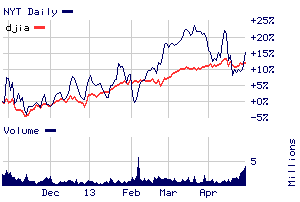
This chart (which I customized using a tool on the NYTCo corporate site) shows how the NYTCo stock has performed in the last six months, compared to the Dow Jones average, which has been on a tear. 

Leave a comment

Filed under business, Journalism, journalism history, New York Times, Uncategorized

The bombing case: “Total Noise”?

By Christopher B. Daly 

Here is a fine piece that features the author Jim Gleick thinking in print about the coverage of the Boston Marathon bombing and related events. (Full disclosure: I have known Jim since we were in college together, and I admired his books Chaos and The Information; I am not currently in touch with him.)

Gleick’s piece from New York magazine was also noticed by Maureen Dowd in her column today. She added value by actually taking him out for coffee and interviewing him.

Photo montage by New York magazine (including photo by BU student journalism Kenshin Okubo).

Photo montage by New York magazine (including photo by BU student journalism Kenshin Okubo).

Leave a comment

Filed under broadcasting, CNN, Journalism, journalism history, Photography, Photojournalism

When the news is wrong (for a stupid reason)

By Christopher B. Daly 

imagesAs many have observed, several front-line news organizations reported incorrectly on Wednesday afternoon that authorities had “arrested” or “taken into custody” a suspect in the Boston marathon bombing. As someone who spent 10 years working for The Associated Press (where our watchword was always, “Get it first, but get it right”), I feel bad for journalists who are chasing leads in the investigation into the bombing case. They are under tremendous pressure to advance the story, “break” news, and stand out from the crowd.

I feel bad for them, but that’s not my only response. I also feel appalled at the news media’s chronic inability to exercise restraint. As the afternoon unfolded, I had a sickening sense of deja vu: here we go again, with the race to be first.

But, first with what, exactly? If the cops or the FBI had really made an arrest, they were going to announce it — and quickly. So, what difference does it make if I find that out at 2:30 or 2:45 or 4:00? Is my life any better?

Besides, it’s not as if this is the kind of news that authorities try to hide. When they nab a bad guy, they’re proud of it. They want to stand there at the press conference (ties all straight, uniform gleaming) and take a turn at the podium to say the same clipped phrases they always say. Sure, that’s important, and someone should be there to report it. But we do not need an entire army of reporters trying to get this information first. The mania for being first upsets and erodes all other journalistic priorities.

This kind of frenzy for “scoops” is essentially a waste of journalistic resources and enterprise. There are many fine, experienced, tough reporters and photographers in Boston this week. They should not waste their time trying to surf a few feet ahead of the cops in pursuit of factual information that is going to be divulged anyway. This is particularly true when reporters get in the way: if journalists report, for example, that an arrest is “imminent,” doesn’t that tell the bad guys that it’s time to flee?

In fact, I don’t consider that kind of reporting a “scoop” at all. Real news consists of information that someone is trying to hide or that would not come to light unless an individual journalist gets out and gathers information and connects some dots. Reporters make a contribution to society when they generate information that we would not have otherwise.

So, get out there and find a real, true story — and tell me something I don’t know and that won’t be announced from a podium.

We can do better.

Leave a comment

Filed under CNN, Journalism, journalism history, leaks, Uncategorized

Digital media win another Pulitzer

By Christopher B. Daly

logoScore another victory for serious journalism that was born on the Web. The born-digital environmental website “InsideClimate News” won a Pulitzer Prize this week for national reporting based on its stories about an oil pipeline spill in the Kalamazoo River.

That follows earlier Pulitzers awarded to The Huffington Post and Politico (2012) and ProPublica (2011).

According to a story in the Washington Post, InsideClimate News was founded in 2008 and has just seven staffers. Founder David Sassoon is listed on the website as a graduate of Harvard and the Columbia Journalism School. With no office, InsideClimate News has virtually no overhead and zero “legacy costs.” Instead, they appear to depend for support in large part from foundations — including, ironically, the Rockefeller Brothers Fund, which is based on the fortune that the family made by dominating the market for, of all things, oil.

images

Leave a comment

Filed under blogging, Journalism, journalism history, Pulitzer Prize

Un-bundling the media

By Christopher B. Daly 

In his latest column, the New York Times‘ David Carr makes a smart argument about how the media — both entertainment and news — are coming apart under pressure from the Web. That’s coming apart, not falling apart. They are coming apart in the sense that the “bundles” of material that arose during the pre-digital era no longer make sense. 

Here’s his lead:

For the longest time in the media business, the concept of the bundle has been foundational. Ads go with editorial content in print, commercials go with programming on television and the channels you desire are paired with ones you did not in your cable package.
People were free to shop for what they wanted, as long as they were willing to buy a bunch of other stuff they did not. The box score last night for your home team? It was wrapped inside a bundle of paper that included everything from foreign news to ads for lingerie. If you liked a song, you generally had to buy an album full of others to get the goods.


I think he’s on the right track. Consider the newspaper, for example, as I did in my book Covering America. Here’s an excerpt from Chapter 13:

Another problem besetting newspapers (and, to a great extent, magazines and television news as well) was even more existential. When seen against the backdrop of the Internet, one fact about newspapers becomes painfully obvious: a newspaper is a fixed bundle of coverage that is good but ultimately second rate. Offering readers no choice, a newspaper presents coverage of a set matrix of topics: politics, crime, business, sports, arts, and something called lifestyle. In each case, though, people who really know or care about those fields understand that they are not going to find the absolute best, most detailed, most passionate coverage of their favorite topic in a daily newspaper. They know that the best coverage will be in some niche on the Web where obsessive amateurs or professional experts gather. And with the coming of the Web, the absolute best coverage is available to everyone, everywhere, all the time, for free. In politics, for example, readers can find pretty good coverage in the Times or Newsweek. But if they really live and breathe politics, they will want it faster and at a much higher level of granularity, so they will log on to a site like Politico or Real Clear Politics instead and get what they are looking for. The same is true for business, sports, even crosswords and recipes. Thus the question arises: What is the remaining value of reading merely pretty good coverage (and paying for it) when readers can unbundle the newspaper, go online, and plunge into first-rate coverage, written by real aficionados and provided at a price of zero?

One way to understand the decline of the newspaper is to ask the ultimate question: If newspapers did not exist, would it make any sense to invent them?

I wrote that about two years ago. The only change I would make now would be to drop the reference to Newsweek. The venerable weekly print newsmagazine went broke in 2012 trying to sell a fixed bundle of pretty-good coverage and was absorbed into a born-digital enterprise, The Daily Beast. I might also amend the statement that all the high-quality niches are free, since a small but possibly growing number do charge something.

Leave a comment

Filed under broadcasting, Journalism, journalism history, New York Times, publishing, software

Literary criticism: a reader writes

By Christopher B. Daly

Recently, a reader posted a largely critical “customer review” of my book Covering America, on the book’s Amazon page. The writer of the criticism, Ralph Poore, is, of course, entitled to his opinion and the free expression thereof. At the same time, I have my right to engage his criticism and explain my views.

First, let me thank Mr. Poore for reading my book and for reading it quite carefully, to judge by the granularity of his comments.

Here’s his review and one of my reactions:

If you like East Coast, elitist views of journalism, then Christopher Daly’s Covering America is the book for you.

Daly focuses mainly on journalism east of the Hudson River. He makes occasional visits to news media along the Potomac River, but he frankly doesn’t find much of value beyond those two regions. He covers a lot of the familiar territory found in other journalism histories by profiling one or more journalists of their time.

Missing is the westward trek of newspapers and editors in the late 18th and 19th centuries. Missing, too, are many publications that have played important roles in the history of journalism and of the country.

To be fair, any book that purports to cover a topic across 320 years of history has to leave something out, else no one would be able to lift it. And Daly makes it clear that his book is a narrative “about the broad scope of journalism in America… [and] not an encyclopedia” (p. 6).
Fair enough.

As I wrote in the preface, my approach was not encyclopedic. My stated criterion for inclusion in my book was innovation — especially in one or more of the following dimensions:

–the economics of news,

–the technology of news gathering and dissemination

–the philosophy of news

–the sociology of the newsroom or the audience

–the politics of the power balance between journalism and other institutions.

As it happened, most of that innovation took place on the East Coast, particularly in New York City. I did not cause that, and I don’t apologize for it. That said, my book does at least mention papers outside the Northeast: the Washington Post, the Chicago Tribune, the Los Angeles Times, the St. Louis Post-Dispatch to name a few, as well as the Atlanta-based CNN.

Here’s the rest of his review. I am not going to reply point-by-point, but I would encourage any readers of this blog who have also read my book to jump in and share your views.

But what Daly leaves out is a lot, and it is often important. For example, in looking at press coverage during the Civil War, Daly’s examination stops at the Mason-Dixon Line. Of the Southern press he says only, “Across the South, many newspapers simply collapsed” (p. 110). The major Southern newspapers didn’t collapse, and never mind that Southern correspondents, including a few women, wrote some of the best war coverage by any reporter North or South.

As Daly’s narrative moves closer in time to the present, its sins of omission and commission, as well as its elitism (and frankly snarky comments about conservatives), become more pronounced. I primarily would like to deal with several examples from the mid-20th to 21st centuries to make my point.

East Coast elitists have an almost cult-like attachment to President Franklin D. Roosevelt and his New Deal programs. It comes as no surprise then that the journalists who Daly profiles in the 1940s for his “broad scope of journalism in America” never raise any questions about the efficacy of New Deal programs.

FDR’s policies cost billions of dollars often with no real benefit to the nation and in some cases caused real harm to real people, including my parents and grandparents. In FDR’s second term, unemployment lines were long and getting longer. Joblessness got worse after almost every New Deal program started.

Instead of an explanation of why journalists let this state of affairs slide, Daly gives us a portrait of gossip columnist and radio host Walter Winchell supporting Roosevelt: “At a time when most American newspapers were published by businessmen who supported the Republican Party and hated Roosevelt, Winchell…was one of the few prominent voices raised in support of fighting fascism” (p. 220).

Republicans, businessmen and Nazis vs. Winchell and Roosevelt. Really? Either this is sloppy writing or a deliberate attempt to associate the GOP with anti-democratic forces. The effect is the same in either case.

Skip ahead to the 1980-1999 period when Daly takes on conservatives directly. He writes: “Conservatives railed against a media system they said favored big government, welfare, immigrants, and alternative lifestyles while denigrating family, country, and God” (396-397).

Daly dismisses these concerns with a sheer nonsensical statement: “In part, many conservative critics were misreading the media–finding an ideological intention where journalists were actually asserting their professional values. Often, critics on the Right interpreted the journalistic ideals of independence and skepticism as political commitments to antiauthoritarianism or partisan liberalism” (397).

It is hard to see how Daly can reconcile conservatives as believing the media both favored “big government” and “antiauthoritarianism.” Those are polar opposites. And it had become clear to almost any observer west of the Hudson River that by this time period elite journalists had merged their ideological and professional values.

Finally, there is the issue of blatantly distorting the facts when it comes to Fox News. Daly cites a 2003 study by the Program on International Policy Attitudes (PIPA) at the University of Maryland that purports that Fox News viewers were more misinformed about the Iraqi war (p. 419-420). PIPA claims “those who watched Fox News almost daily were significantly more likely than those who never watched it to believe….” and then goes on to list a series of supposedly false statements.

Neither PIPA nor Daly cites a single supposedly wrong or misleading fact reported by Fox News.

The Wall Street Journal has examined the clear flaws in PIPA’s methods. The so-called false statements are actually just prejudiced questions about people’s opinions. The opinions just don’t reflect the beliefs of media elites and liberals.

WSJ points to more objective and fact-based surveys by the Pew Research Center for the People and the Press which ranked Fox News viewers as among the most informed. At the bottom of Pew’s list were regular consumers of CBS News, Access Hollywood and the National Enquirer.

All of this was known or should have been known by Daly while he was writing his book. For some reason he chose to ignore it.

Meanwhile, you will look in vain in Covering America for even a brief mention of high-profile cases of deliberate misinformation on the part of the East Coast, elite media. For example, you will NOT find Daly criticizing those media for:

Walter Duranty, the Pulitzer Prize winning Moscow Bureau Chief of The New York Times (1922-36) who lauded Stalin and denied widespread famine and mass starvation in the Ukraine.

Janet Cooke (1980), who fabricated a story about a child drug addict for the Washington Post and won a Pulitzer Prize.

ABC’s 20/20 (1978), CBS’s 60 Minutes (1980) and NBC’s Dateline (1993) all ran stories that fabricated safety problems with cars and trucks.

Christopher Newton, an Associated Press reporter who in at least 40 stories (2000- 2002) quoted sources who did not exist.

Jayson Blair (2003), whose fabricated stories in the New York Times brought down Executive Editor Howell Raines and Managing Editor Gerald Boyd.

CBS’s 60 Minutes host Dan Rather and producer Mary Mapes 60 Minutes who used forged documents (2004) about President George W. Bush’s service in the Air National Guard less than two months before the presidential election.

And Daly worries about Fox News viewers being misinformed? Really?

The flaws in Covering America are unfortunate. Daly was a reporter for the Associated Press and the Washington Post before he began teaching at Boston University. He knows how to tell a good story.

There is much in Daly’s narrative that is solid and even insightful at times. But to get at the good stuff, the careful reader has to constantly act as an investigative reporter, questioning assumptions and checking facts. It is a lot of work.

Leave a comment

Filed under Covering America, Journalism, journalism history

To Steve Coll: Best wishes at Columbia

By Christopher B. Daly 

I admire Steve Coll.

I rely on David Carr.

I find Michael Wolff consistently annoying. (Also, he is often wrong, as he was in his recent column: The Washington Post is a diminished institution of journalism, but The New Yorker is certainly not.)

So, it seemed like a slim premise for Carr to use a recent snide, totally negative column by Wolff for Carr’s new column about Steve Coll. Wolff is not worth rebutting. But Coll is worth noting.

Steve Coll is the newly named dean of the Columbia Graduate School of Journalism (to use the full name — which signifies several things: it is the only Ivy school to have a real journalism school, and it does not offer a journalism major to undergrads. See pgs 151-156 of my book Covering America for the back story on the founding of the Columbia J-School, through the bequest of newspaper publisher Joseph Pulitzer.)

As the new dean, Coll will occupy the most visible and influential seat in American journalism education, so he will probably be in the spotlight a bit more than he is accustomed to. He may also find it harder to keep writing than he thinks. Many a writer has accepted an administrative position in higher ed with the best of intentions to remain productive, only to disappear into an endless round of meetings. The only writing most deans do extends to letters of recommendation and internal reports for the Provost’s office. Even so, Coll, as a two-time winner of the Pulitzer Prize and author of multiple important books, will do well if he can continue to write while serving as dean.

He succeeds Nick Lemann in that position. (Full disclosure: Nick has been a friend of mine since we were on the Harvard Crimson in the early to mid 1970s.) As Columbia’s dean, Nick did a great job — at least from the perspective of someone teaching at a would-be rival school. During Nick’s 10 years, Columbia remained at the top of the heap and kept improving, so that it kept getting harder and harder to keep up with Columbia — which offers pretty much everything and does so in New York City.

Good luck, Steve Coll.

Good luck, Steve Coll.

Leave a comment

Filed under Journalism, journalism history

Another Newspaper Landmark Closes

By Christopher B. Daly 

Of course, there are sad stories about the closing of the landmark building on Biscayne Bay that has housed the Miami Herald for the past 50 years. 

HERALD-1-articleLarge

BUT, it should also be noted that the hulking Herald building was essentially a factory — a walled-off manufacturing plant. First and foremost, it was designed to receive raw materials (newsprint arrived in barges; hence, the dock) and turn them into finished products (i.e., each day’s paper, which left the plant on trucks).

What is the purpose of such a building in the digital age? Newspapers should be thinking of themselves as being in the information-processing business, not the paper-processing business. They should be in cool, glass offices right in the centers of their cities. They should look like Apple stores, not like power plants or auto factories.

url


Leave a comment

Filed under Journalism, journalism history