By Chris Daly
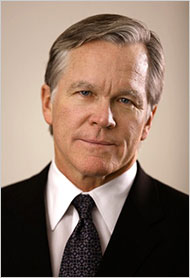
Bill Keller, the top editor of The New York Times, explained his view today of his newspaper’s role in the latest WikiLeaks release of classified government secrets.
Speaking on the Harvard campus, Keller maintained his distance from WikiLeaks founder Julian Assange and said that, so far at least, Obama administration officials have behaved like “grown-ups” – in contrast to the previous administration.
Keller spoke for about an hour Thursday afternoon at the Nieman Foundation for Journalism at Harvard. He was the keynote speaker for the foundation’s day-long conference, “From Watergate to WikiLeaks: Secrecy and Journalism in the New Media Age.”
Here is most of what he said, including most of the Q+A:
Since he took over the Times in 2003, Keller said no issue has provoked a higher pitch of “indignation” than publishing secrets.
And at least until this year, nothing done by the Times has ever caused so much consternation. That includes the paper’s story about the secret NSA wiretapping program and the 2006 revelations about the Treasury Department’s international program of surveillance of financial transaction.
Both those programs, Keller noted, were designed to catch terrorists – “and, by the way, I am in favor of that.”
Both programs were secret. In both cases, government officials requested that the Times withhold publication.
How rough did they play?
Keller said Bush told him that if the Times went ahead, the editor should “be prepared to be responsible for the next terror attack on America.”
Keller took issue with Bush’s description of the same events, which appears in Bush’s recently released memoir, “Decision Points.”
When the Times went ahead and published anyway, the White House reaction was “predictably fierce.” On the Treasury story, for example, Cheney and others denounced the Times and hinted at criminal charges. Members of Congress piled on, and one right-wing radio talk host suggested that the world would be a better place without Keller.
Reactions like these, Keller said, “may be hysterical but they are heartfelt.” He said there is “real confusion” as to why a newspaper editor should be allowed to disagree with the president in matters of national security.

Then the talk turned to WikiLeaks.
[Humor alert: “When I first heard of it, I thought it sounded like a brand of adult diaper!” Keller said to polite chuckles from about 100 journalists, academics and others in a conference room at Lippmann House, the home of the Nieman program.]
This time around, Keller said the administration’s reaction was quite different from what he had gotten used to under Bush. The Obama officials they consulted in advance of publication were “sober, responsible and grown up.” There was “no orgy of press-bashing.” Except for Joe Lieberman, no one has hinted at prosecution of the newspaper.
Still, he said there are critics. The criticism falls along three main lines:
1. The documents are of dubious value.
2. The disclosures put lives at risk.
3. By dealing with WikiLeaks, the Times has compromised its impartiality.
Addressing each, Keller went on.
1. He is puzzled by the complaint that the documents do not do more to rock our world. “The fact is, 99 percent of the news does not profoundly change our understanding.” The value of these documents is that they provide nuance, texture and drama. He said that if the stories about the diplomatic cables gets people more interested in foreign affairs, “then I believe we have performed a public service.
2. As for the risks of collaboration with WikiLeaks, Kelle said, “They are real.” Earlier, in the disclosures of the Iraq and Afghan war documents, WikiLeak named many names. With the diplo-cables, he said Wiki did a better job. It’s beyond Keller’s power to influence Wiki. “I can only answer for the Times.”
3. Does it complicate diplomacy? “I’m skeptical,” Keller said. He cited recent comments by Defense Secretary Gates to the effect that other countries cooperate with the U.S, “because they need us.” [Keller’s implication was that since they still need us, they will continue to talk to us, even in confidential cables.]
As for Julian Assange, founder of WikiLeaks, Keller did not seem ready to grant him the status of a full-fledged journalist and partner:
“We regard Julian Assange as a source. I will not say a source pure and simple, because sources are rarely pure or simple.”
“You don’t always agree with them.
“Your obligation is to verify, to supply context, and to make sense of it. That is what we attempted to do, as we would do with any documents that came into our possession.”
Currently, Keller noted, the Times has 9 staffers assigned to Iraq and Afghanistan – not including freelancers and support staff.
“There are few places you can go to find honest, on-the-scene reporting about what is happening.”
He also noted that the Times has suffered two deaths and four kidnappings. Most recently, a contract photographer, Joao Silva, lost both legs when an IED exploded while he was photographing U.S. troops on patrol in Afghanistan.
Consequently, he said, “We are invested in the struggle against murderous extremism.” He said the Times is struggling against it directly (in terms of threats to journalists’s safety) and indirectly (in terms of threats to free expression).
In recent years, Keller said journalists have revealed lots of things – about Abu Gharib, “black sites,” eavesdropping, extreme rendition, etc. Quoting his colleague Bob Kaiser of The Washington Post, Keller asked if anyone seriously would rather not know these things.
“Government wants it both ways: keep their secrets, but trumpet their successes.”
Keller also invoked the Pentagon Papers case of 1971, referring to the affidavit filed in the case by Max Frankel, then the Times’ bureau chief in Washington. Frankel observed that presidents create secrets in order to use them. Same with cabinet members, military service chiefs, even mid-level bureaucrats. Almost no one plans to keep a secret forever. They are used tactically.
“One man’s security breach is another man’s public realations campaign.”
Recently, Frankel commented on WikiLeaks for the Guardian (which was given the diplo-cables directly from WikiLeaks and shared them with the NYTimes). In that piece, Frankel said that any time 3 million people have access to a “secret,” it’s not much of a secret.
Keller then asked how editors reconcile the urge to inform people with the need to protect legitimate secrets.
“Sometimes it’s easy. Our reporters in Iraq and Afghanistan take care not to divulge operational intelligence.”
“In handling the WikiLeak documents, we excised names.”
Often, though, he said it’s not easy. “There is no neat metric. We make our best considered judgment.”
The Times does not always decide to publish.
“When we come down in favor of publishing, of course, everyone hears about it.”
But sometimes, the paper withholds information. Then, of course, no one knows what they don’t know.
Looking ahead, Keller said editors will continue to have to decide on a case-by-case basis.
“Frankly, I don’t see a way to alter journalistic practices unless we just defer to the government. Our responsibility is to publish information of interest to the public.
“We have a duty to be careful.”
“There is one thing we can do: we can be a little more judicious in our use of anonymous sources.”
Eliminating them is “high-minded foolishness” that would result in “press-conference stenography.” But cutting back on anonymous sources would improve credibility. Overuse adds to the suspicion that journalists make things up.
In legal terms, Keller said some people (he mentioned Gabriel Schoenfeld, who wrote in the WSJ.) want to use the Espionage Act of 1917 to punish the Times and other news organizations. Keller said the Espionage Act has never been applied that way.
“The main practical legal threat facing journalists these days is.. the subpoena.”
In the decades after the 1972 Branzburg case left journalists vulnerable, there were relatively few cases. Since 2000, according to the Minnesota Law Review, it has risen to hundreds a year.”
He said many journalists hope for a federal “shield law” – comparable to those that provide testimonial privilege for lawyers, ministers, and doctors. But Keller said passage does not seem imminent and, in any case, is likely to deny reporters any protection when their reporting involves national security.
Keller acknowledged that “the Internet has transformed landscape of journalism” – by bringing new levels of speed and openness.
He said this is “healthy change,” bringing new voices and new audiences.
But, he said, it has “blurred the definition of who is a journalist.”
“Personally I would urge a fairly expansive definition.” But he would not include everyone.
A real journalist (he did not use that term) is someone who spends a lot of time and energy checking things out. On those rare occasions when the Times gets sensitive secrets, the paper’s reporters spend a lot of effort verifying them – without security clearances, subpoena power, wiretaps or any other special power. He suggested that WikiLeaks is not that kind of outfit – at least not yet.
“The mainstream press may not enjoy the hegemony it had before the Internet.”
He said the current administration has been reacting calmly and professionally. “The previous administration? Not so much.”
“I’d like to turn the telescope around and ask: what are the security implications if we became MORE secretive? Would we be safer?”
Independent news coverage is “not just something to defend, it’s something to be celebrated.”
* * * * * * *
Q & A:
Q. What is the vetting process?
A. We put them into a database. We conducted keyword searches. Could be a country, a leader, a phrase. We searched. Consulted reporters who were experts. They gave us search terms.
That produced clumps of cables. Someone was assigned to go through them for stories. . .
The vetting had to establish, is this stuff ereal?
A number of reporters had seen the real thing before. They could confirm. No one has yet come forward (to dispute authenticity of these cables)
We went to government agencies. Let them raise any objections. Obviously, we did not offer them the right ro decide. We heard them out respectfully. I describe it as professional and grown-up. A lot of times, they wanted us to omit things that were just embaraassing. We said, ‘Sorry.’
Q. What is the schedule for publishing the other 99 percent?
A: There’s no schedule. The first two dumps (Iraq and afg war logs), WikiLeaks posted, after we had time. Essentially, it was an embargo. (a familiar if loathed practice)
The embassy cables were more complicated. The range was so broad, the volume so enormous. The different interests of different news organizations were large.
He said the Times held discussion with the European partners – The Guardian in the U.K. and Der Spiegel in Germany. Among them, they agreed on a calendar by which they would all write on the same topic on the same day.
“We agreed: day 1 would be ‘Pakistan day.’ Day 2 would be ‘Russia day.’ We agreed to give WikiLeaks the documents we planned to post with each day’s stories. (with redactions)
We have basically done the major stories that we plan do do.
I expect we will post future documents as we think of more stories that we want to do.
I have no idea what WikiLeaks intends to do.
We don’t intend to post the whole batch. Most of them are not very interesting.
Many of them are the diplomatic equivalent of “laundry lists”
Q. Relation with Assange?
A: Assange never said explicitly why he cut the New York Times off. But he has said some things.
Keller said Assange has said or implied that he is miffed because the Times did not link to WikiLeaks online. He said Assange was also unhappy about two Times stories: the reporting about suspected leaker Bradley Manning and the Times’s profile of Assange himself.
Q. Would you work with them again?
A. “They were a source, not a partner.
“I have no idea whether WikiLeaks will offer us anything again. I would accept it on the same terms – raw material that we would take a look at and publish if its interesting.”
Q. This is all about government information. What about private or corporate information, like banking?
A. Keller said he is not sure that would change anything.
“One thing I omitted is that we had lawyers involved along the way – very good lawyers, the kind who see it is their responsibility to see how we can get things INTO the paper.
“We discussed possible jeopardy. Reviewed British law. We ascertained that what we were doing was legal.
“I’m not sure it would be with a private entity.
In that case, Keller said, the charge to the lawyers would be to find a way.
“Beyond that, I don’t see a qualitative difference between government information and information from other powerful institutions.
“I might feel qualms about a private individual. But in the case of a major American bank. . . I’d be very interested in that.”
[Keller made clear that he would not be interested in just dumping bank account numbers online but he would be interested in secret memo that showed, for example, a particular bank’s role in the financial crisis and bailout.]
Q. Would you be troubled by a prosecution of Assange? How is the Times different from him?
A.
I’m not a lawyer. I think our lawyers would kill me if I offered an answer.
Is WikiLeaks a journalistic organization? I am humble about who gets to be called a journalist.
There are two things I would say: I don’t regard Julian Assange as a kindred spirit. If he’s a journalist, he is is not the kind of journalist I am.”
But Keller says WikiLeaks has already evolved into something more like a journalistic organization, abandoning its original position of total transparency.
“As an editor I find the Espionage Act a scary thing in the wrong hands. It’s an abuse-able law.”


 Prof Chris Daly's Blog