Category Archives: Journalism

Leaks (cont.)

By Christopher B. Daly

The able legal-affairs reporter Charlie Savage and Scott Shane have an interesting update in today’s Times about the issue of national-security leaks. The upshot is that the Obama administration has (surprisingly perhaps) emerged as the all-time record-holder among all U.S. presidential administrations for prosecuting leaks. (The piece has a helpful sidebar — which was better looking in print than online — that summarizes nine known leaks cases.)

A couple of related questions:

–Which administration holds the record for generating leaks? (probably a two-term president like Nixon, Reagan, G.W.Bush? or like Clinton?)

–Isn’t it worthwhile to distinguish between different types of leaks?

A. We might differentiate between authorized and unauthorized leaks.

B. We might differentiate between leaks to journalists and leaks to others.

C. We might differentiate between leaks that do harm and those that do not.

For example, it is one thing for a traitor to steal operational secrets and sell or give them to agents of a hostile power. That’s the kind of leak that should properly trigger Congressional outrage and lead to criminal prosecutions. That kind of leak raises no First Amendment issues.

It is quite a different thing for a troubled official to tell a journalist about a secret policy so that the public can debate whether that policy is a good idea. It is this kind of leak that usually induces partisan posturing and leak investigations that fizzle. It is also the kind of leak that requires a careful weighing of the First Amendment implications.
Leave a comment

Filed under First Amendment, Journalism, leaks, New York Times, publishing

Another view on the Times-Picayune layoffs

Here’ s an analysis by Rick Edmonds (via Poynter).

Worth considering.

Leave a comment

Filed under Journalism, publishing, Uncategorized

Questioning the President

By Christopher B. Daly 

Right-wing media are naturally having a field day over Neil Munro (not the Scottish writer and critic, but the person affiliated with the conservative website The Daily Caller who recently interrupted President Obama to shout questions about the president’s immigration policy). This part is really rich: What he shouted was something like, “Why do you favor foreigners over American workers?” [which is not only a loaded question, but one that sounds more like a provocation or a taunt than a question to which he seeks a real answer].

Turns out, Munro himself is a “foreigner” (born in Ireland) who is therefore enjoying a job that could be filled by an American.

The right-wing media say Bully for him! and take delight in anyone who disrespects this president (but god help anyone who disrespects the office, the flag, etc.). They say the rest of the media are a bunch of lapdogs who spend all day bowing down to the president.

I am actually of two minds about this one. My ambivalence is based on my experience. For a couple of years, I regularly took part in the state-level equivalent of the Rose Garden event. In fact, as the AP’s bureau chief, I usually asked the first question at the governor’s press conferences in Boston.

In that setting, pretty much everyone is a professional who is there to work. The chief executive has a message to convey, and reporters have questions to which they really need answers. Generally, there are ground rules that ensure that the working press can actually get its work done. Generally, those ground rules exclude grandstanding, taunting, heckling, and the rest, because those kind of activities are inimical to Q+A.

I have no objection to those activities, per se. I think our leaders need a good heckling from time to time. I just don’t see where this guy gets off breaking the ground rules and then acting as if he’s the injured party. There are reporters working at the White House who do not want to have to explain to their bosses that the reason they don’t have a story is that some bozo decided to turn the event into a shouting match.

I guess I come down this way:

If you want to heckle the president, go to a public event.

If you need to ask him a question, go to a press conference.

Leave a comment

Filed under Journalism, Politics

Happy Birthday, Ms.

By Christopher B. Daly 

Happy birthday to Ms. magazine. Hard to believe it is 40 years old.

The Times had a nice anniversary party story in the New York section, complete with this photo of Gloria Steinem.

Kristen Luce / NYTimes

Kristen Luce / NYTimes


For a lot more detail about the founding of Ms. in late 1971 and the launch in June 1972, go to chapter 11 in my new book, Covering America. It’s there on pages 348-351. Check it out.

Leave a comment

Filed under Journalism, journalism history

Inside the Meme Factory

By Christopher B. Daly

That phrase, Inside the Meme Factory, is the working title of my next book. It refers to an idea that is well illustrated in a piece on page 1 of today’s Times by the estimable James B. Stewart (lawyer, book author, contributor to both the New Yorker and the Times — is there more than one of him?). In his article, Stewart seizes on a comment made by Supreme Court Justice Antonin Scalia and tries to walk it back to its origins. The phrase involved a rhetorical question raised from the bench by Scalia during arguments over the national health care law, asking whether the government could make Americans do other things that are good for them, such as eating broccoli. Here’s the nub:

It turns out that broccoli did not spring from the mind of Justice Scalia. The vegetable trail leads backward through conservative media and pundits. Before reaching the Supreme Court, vegetables were cited by a federal judge in Florida with a libertarian streak; in an Internet video financed by libertarian and ultraconservative backers; at a Congressional hearing by a Republican senator; and an op-ed column by David B. Rivkin Jr., a libertarian lawyer whose family emigrated from the former Soviet Union when he was 10.

 Stewart’s painstaking track-back shows that the idea of challenging the limits of the Commerce Clause originated with libertarian thinkers and was sustained in a series of hand-offs by other libertarians and conservatives, all working within the universe of conservative institutions (Cato, Reason, Limbaugh, the Wall Street Journal op-ed page, Reagan-appointed judges, a former Clarence Thomas law clerk, et al.) And, as so often happens, several of those institutions get crucial amounts of funding from the Kochs and the Scaifes.

The “broccoli” story exemplifies a much larger truth: most of the themes, slogans, argument-stoppers, images, and jokes that shape our politics and much of our public conversation don’t come from nowhere. Many of them are the fruits of deliberate efforts, especially among conservatives, and many of those efforts take place in a nearly hidden network of institutions. Those institutions include an array of think tanks, publishers, and conservative media outlets that generate and amplify conservative “memes.” In my book, I trace the deliberate campaign to fund and build this network of interlocking conservative institutions in the decades after World War II.

Stay tuned.

Leave a comment

Filed under Journalism, journalism history, media, New York Times, Supreme Court

Newsroom half empty?

By Christopher B. Daly 

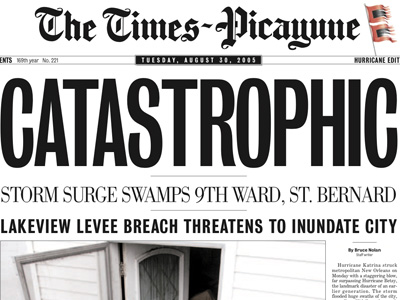
No one said this would be easy. The threatened layoffs have hit the newsroom of the New Orleans Times-Picayune (and other papers owned by the Advance Publications chain).

Things to keep in mind:

–Not all the layoffs are in the newsroom.

–Some of these folks will be replaced.

–The alternative could well be bankruptcy.


1 Comment

Filed under Journalism, media

Media hypocrisy check

By Christopher B. Daly 

With gasoline prices dropping, here’s my question:

If conservative media personalities really love this country and if they are really rooting for America, then why don’t they hail the good news of lower gas prices if those prices drop under a Democrat?

Hmmm. . .


Leave a comment

Filed under Journalism, Politics

Journalism on film

By Christopher B. Daly

Fun piece by columnist Dan Barry in the Times about the portrayal of journalists in U.S. feature films.

Two questions:

–How did he do this whole piece without ever mentioning the essential resource in this field: the Image of the Journalist in Popular Culture program at USC? Either he didn’t do a whole lot of research, or he didn’t want to steer readers to a more authoritative source?

–The Times piece is illustrated by a still b+w photo from the iconic film comedy “His Girl Friday.” So far, so good. But the photo is credited to “New York Public Library.” Now, the paper may have found the photo there, but that doesn’t mean the Library has the rights to it. In researching the illustrations for my book, Covering America, I found (to my regret) that the rights are owned by Sony Pictures Entertainment, which does not give away the right to reprint those images for free. For use of a different still from “His Girl Friday” in my book, Sony charged me $75.

[Note to Sony lawyers: I consider it “fair use” to post a copy of the version I paid for in this non-profit context for the purpose of illustrating my point.]

Still from the film classic “His Girl Friday,” set in a newsroom.

Leave a comment

Filed under Journalism, journalism history

Leaks investigation

By Christopher B. Daly

The Times editors probably should have slapped an “Analysis” label on this piece (which it carries online, but not in today’s print version) or put in the Sunday Review section. In any case, Charlie Savage has an intelligent analysis of why “leaks” investigations so often come to nought.

He makes a key legal point here:

Many people are surprised to learn that there is no law against disclosing classified information, in and of itself. The classification system was established for the executive branch by presidential order, not by statute, to control access to information and how it must be handled. While officials who break those rules may be admonished or fired, the system covers far more information than it is a crime to leak.

Instead, leak prosecutions rely on a 1917 espionage statute whose principal provision makes it a crime to disclose, to persons not authorized to receive it, national defense information with knowledge that its dissemination could harm the United States or help a foreign power.

And he goes on to make the point that prosecutors have a difficult showing the harm that flows from disclosures of classified information. It is almost never the case that a news media participant in a leak will divulge real, active military secrets. Instead, the practice of leaking is usually someone’s way of trying to win or shape a policy debate. It is the pursuit of politics by other means.


Leave a comment

Filed under First Amendment, Journalism, journalism history, leaks, New York Times, President Obama

Update on leaks

At his press conference later in the day (June 8), Obama had this comment on the issue:

“The notion that my White House would purposely release classified national security information is offensive,” he said. “It’s wrong. And people, I think, need to have a better sense of how I approach this office.”

Without confirming the accuracy of the information — which was revealed in two articles in The New York Times last week — Mr. Obama said the such leaks deal with the safety of the American people, its military and its allies.

“We don’t play with that,” he said, vowing to investigate the leaks. “We consistently, whenever there is classified information that is put out into the public, we try to find out where that came from.”


Of course, what else would he (or any president) say?

Leave a comment

Filed under Journalism, leaks, Politics, President Obama