Category Archives: history

Fall leaves: let’s leave them where they fall

By Christopher B. Daly 

Ah, another late-fall day here in New England. Full of watching the winter juncoes arrive, harvesting the last root vegetables, and listening to the roar of the leaf-blower. Sure enough, where I live just outside Boston, Monday mornings in fall bring an invading army of landscapers. Just after most of my neighbors have started their commute to work, those of us who work at home bear the brunt of the commercial landscapers’ day-long assault.

I am not advocating a radical, tear-up-your-lawn, no-mow approach (although there’s no harm in that, either.) Nor am I advocating a ban on lawn mowers and a return to hand-powered mowers (although there too, I think we could do a lot better).

I am calling for a deep reconsideration of a practice that has become de rigueur here in the suburbs, but which our ancestors would have considered demented. That is the compulsion to remove every fallen leaf from our lawns, driveways, and walks.

According to an article in the New York Times, there is a growing trend (is there any other kind?) toward re-thinking the assumption that all leaves must be whisked “away” to somewhere else. As an ecologist could tell you, there is no such place as “away.” Everything goes somewhere.

Let’s consider the leaf.

A leaf is part of a plant that allows it to live by conducting photosynthesis, converting sunlight into energy, which fuels the plant. In doing so, plants take in carbon dioxide through their leaves and emit oxygen. In this way, leaves do an enormous amount of good for the planet and for each one of us — also known as “ecosystem services.”

So far, so good.

In this part of the world, though, most plants drop their leaves in the fall to prepare for the rigors of a snowy, icy winter in which there may be no liquid water available for many months. The leaves fall to the ground, where they form “leaf litter,” a mat of leaves that — if left alone — would eventually decompose and join the soil, enriching it with organic material. The leaf litter is the plant’s attempt to shape the environment in its favor, as for example, when a pine tree drops some of its needles to form a dense, acidic mat below that discourages other plants but favors more pine trees. (I suspect that almost every plant harbors a secret plan to take over the world.)

This is what brings some plants into conflict with some humans. The conflict is particularly acute between the deciduous trees (like oaks and maples) and the suburban homeowner. Suburban homeowners are, by definition, also suburban landowners, so they are involved whether like it or not in land-use policy.

Overwhelmingly, suburban landowners are putting their land to use in the same way: growing grass for lawns. They are, in other words, farmers who grow a single crop, which is to say that they are involved in “mono-culture.” Oddly, suburbanites devote a lot of time and money to raising that one crop, only to cart it away and pay to dispose of it. They do not eat it, and they do not feed it to any livestock (rabbits do not count).

Part of the expense in maintaining a grassy lawn is the cost of protecting that lawn from the leaf litter. If all the trees in all the yards in an area like the one where I live in New England were allowed to drop their leaves undisturbed, our yards would soon begin to look like the forest floor rather than a grassy lawn. The leaves in the leaf litter layer would overlap and smother most grasses.

Hence, the great fall mania for leaf clean-up.

Originally, most Europeans who settled in this part of the world did not bother with a lawn. They sensibly built their houses close to the road, leaving just enough room for a front garden. In back, most people would have had a historic_societybarnyard — a patch of hard-packed dirt between the house and the barn. Most of the rest of the land would be fields and orchards or it would be left more or less wild as a living resource for harvesting wood and foraging all kinds of useful things. Those ancestral New Englanders had real outdoor chores demanding their time and strength, and they could not possibly have squandered any time raking leaves just for the hell of it.

In the 19th century, the lawn made its debut, and in the 20th century, the lawn conquered millions of acres of U.S. land.

At mid-century, when I was a child, most suburbanites handled their own yard care. In my neighborhood in Medford, Mass., I can recall only one family that hired a landscape service, and they were the wealthiest folks around. Everyone else just got out there and took care of their yards, or else they hired a teenager to do it for them. People like my father waited until the trees had dropped nearly all their leaves, then he started raking at the point farthest from the street. He raked the leaves into a long mound at the edge of the street. Then he did what everyone else did: he took  some matches out of his pocket (where he kept them because he was a smoker) and set the leaves on fire.

For a child, this was one of the great rituals of the year, a communal festival of sorts, with great sounds and smells and the infinitely absorbing allure of an open fire. As children, we tended those leaf fires, blowing on them, feeding them with dry leaves, trying to build the biggest fire the adults would tolerate. photo-chicago-boys-raking-and-burning-leaves-wilmette-street-1955Yes, there was some danger involved, I suppose, but at that stage in our national evolution, children were expected to learn to handle risk, not to avoid it. If the tail of your jacket happened to get burned while you were squatting to blow on some nearby embers, that was a lesson learned.

Sometime in the 1970s or 80s, under the banner of the environmentalist goal of clean air, every town I know of in New England banned the practice of open burning of leaves. (Yes, the air is cleaner, but, of course, something was lost in the process, too, and that needs to be acknowledged.)

Which brings us to the present. Nowadays, a dwindling number of suburban homeowners continue to do their own gardening and yard work. More and more, my neighbors summon commercial landscapers (and not the kid down the block, who is too busy anyway). This brings us an odd sight: like soldiers before battle, the landscape workers, who are engaged in a supposedly healthful form of outdoor exercise, first gear up with headphones, surgical masks, and sunglasses. After all, they know better than anyone just how obnoxious the portable, gas-powered leaf-blower is, and they want to protect their ears, their lungs, and their eyes.
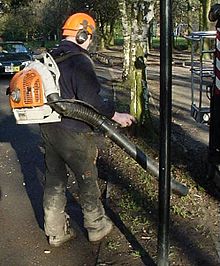
220px-Aa_backpackleafblowerThey need protection, too. The average leaf-blower emits up to 70 or more decibels of noise along with some amount of smoke from its unmuffled, two-stroke, gas-fueled motor. But that decibel rating is a figure for a single well-maintained blower. The ones I experience are often old and banged up, and the guys who use them often gang together forming sonic artillery three to four abreast. Motors roaring, they wave their tubes from side to side, like a sci-fi elephant.

If it’s wet, they just redouble their efforts, roaring longer and louder to try to move those wet leaves from here to there. If it’s dry, watch out. Blasting away with their jets of air leaving the nozzle at nearly 200 mph, the leaf-blowers move more than leaves. They also pulverize and aerosolize pretty much every other small thing on the ground: bird shit, mouse dung, mold, cigarette butts, dust, allergens, pollen, weed seeds — it all swirls together in a choking, irritating mini-cyclone of detritus. And, oh yes — if your landscaper sold you an application of a herbicide or pesticide, then some of those poisons are going up in the toxic swirl, too. No wonder the guys on the crew try to protect themselves.

Usually, they blow the leaves onto a huge tarp, which they haul to the street. Then, they use a giant vacuum cleaner to lift the leaf pile into the back of their truck. What happens next is another ecological crime.

They haul all the leaves away. In other words, they deplete the yard of a significant amount of organic material that would otherwise rot and recycle into the soil. So, the removal of the leaves seriously depletes the land of its natural fertility. This is clearly a demented activity. Why do homeowners let the landscapers pilfer this valuable material?

Then comes the kicker: the landscapers will be back in the spring to sell the homeowner a treatment with . . . artificial fertilizer! This is to compensate for loss of the free, natural fertilizer that the yard would enjoy if the leaves were left in place. This is the equivalent of a burglar selling you your own stuff back!

To make matters worse, the removal of all those leaves means that the landscaped yard has no leaf litter. That is, there is no part of the yard in which certain organisms can winter over and carry on their lives. Many beneficial insects depend on the leaf litter for food and shelter. Without it, the yard is nearly barren, featuring only the useless lawn. And of course, no bugs means no birds (unless the suburbanite also hangs a bird-feeder — another unnatural act; don’t get me started on that one!) as well as no toads or all kinds of other creatures that were here before us.

All in all, the landscaped suburban lawn is pretty much an ecological disaster. Too often, it is a wasteland of clipped grass and exotic ornamental shrubs, shaded by a couple of non-native trees like Norway maples. This is a high-maintenance, expensive, inefficient approach that alienates the homeowner from nature, exposes the landscaping crew and the neighbors to noise and air pollution, and impoverishes our landscape.

We can do better.

[In another post, I will try to suggest some ideas for bringing some ecological sanity to the suburbs. Meanwhile, get a rake and a broom.]


1 Comment

Filed under Environment, history, Politics, Wildlife

Whitey Bulger: Life without parole

By Christopher B. Daly 


In the end, the sentencing of James “Whitey” Bulger was oddly unsatisfying. Bulger  — the lord of the underworld, the big man with the killer’s coldness, the guy who struck fear into so many for so long – left the public stage without so much as a whimper. Playing the role of a stand-up guy (or at least, his version of one) all the way to the bitter end, Bulger not only refused to testify, he also refused to even make eye contact with his victims’ families.


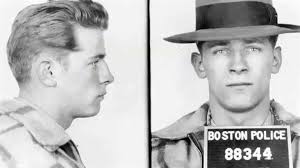
To make matters worse, Bulger committed one last robbery: he robbed all of us in the Boston area of the satisfaction of a real showdown with the forces of images-1justice. Bulger should have been on the witness stand (and his testimony should have been on television), but he denied us that. It was a petty crime, compared to all his monstrous crimes against individuals, but it was one more shot at a public that grew tired of him long ago.


His trial over, Bulger will now spend the rest of his few remaining days in prison, where he belongs. So be it. I don’t believe in the death penalty on other days, and I will stick to my position on this one. I will not give Bulger the satisfaction of getting me to make an exception for him. I will choose not to sink to his level. (No more special treatment for you, pal.)


The whole process of putting Bulger on trial took so long that when the final stages unfolded in federal court last week, there was an odd quality of a formality about it. After all, Bulger’s capture took place more than two years ago. Ever since, it was more or less assumed that Bulger would be found guilty and given a life term.


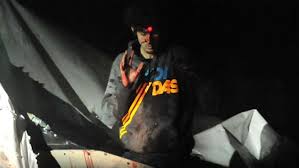
Indeed, the thoroughly predictable and highly scripted process of a criminal trial was overshadowed this year by a lot of other local news of spontaneous origin. In April came the horrible crime of the Boston Marathon bombing, in which a couple of miserable losers decided to try to rob us all of something wonderful — the

Dhokhar Tsarnaev surrendering, with his forehead marked by a sniper's infrared.

Dhokhar Tsarnaev surrendering, with his forehead marked by a sniper’s infrared.

spirit that always used to bloom in Boston on Marathon Monday, a mix of having fun and playing hooky and being nice to out-of-towners and trying to hurry spring along.


That was followed this year (simply in time, not in a great cosmic reckoning, as some would have it) by the quite unexpected rise of the Red Sox, who gave us something of a civic bouquet this year — not by winning the World Series, which was nice but a bit much. No, I think the Sox’ real gift to us this year came from seeing them having fun playing a child’s game as if it mattered and seeing them outperform expectations. All that, plus beards — what a treat.


*       *       *       *


Yet, there is still some unfinished business in the Bulger matter. Whitey Bulger owes us all the answers that we didn’t get when he chose not to testify. He may try to tell his story – on his terms, of course, with a book or letters – but he should have had to sit in the dock, under oath, and face questions not of his choosing.


For that matter, his brother Billy (the former president of the state Senate) images-2owes us some answers, too. What did he know about his brother, and when did he know it? Billy owes us these answers because he was not a private person all those years. He’s not in the same category as the third Bulger brother or their sister. No, Billy was at or near the center of public power during the very same years and in the very same city that Whitey was at or near the center of criminal power.


I will not compare or contrast the two brothers, except to say that as a journalist who covered Billy during that period and who often got the back of his hand, I believe that even rough justice demands that he give answers to the people whose money he spent and whose government he hijacked. No more of his grinning and winking and ducking. What did he know and when?


Other unfinished business?


There’s the FBI, for one. The agency has yet to offer a convincing explanation of how Whitey Bulger could have drafted the FBI’s Boston office into his protection racket or of how the agency is preventing a repeat by some other hoodlum.


Then there is the matter of how anybody could have fallen for the blarney that Whitey was a good guy who was keeping drugs out of South Boston or that Billy was a good guy because he gave away some turkeys at the holidays. Both of the Bulgers got too much power, and we are the ones who let them get away with it.


So, in the end, I suppose, the final reckoning is not with them but with ourselves. That’s a sentence with no parole, no appeal. In a way, we’re lifers, too.


1 Comment

Filed under Boston, history, Journalism, Politics, Uncategorized

Doris Kearns Goodwin turns to journalism history

By Christopher B. Daly 

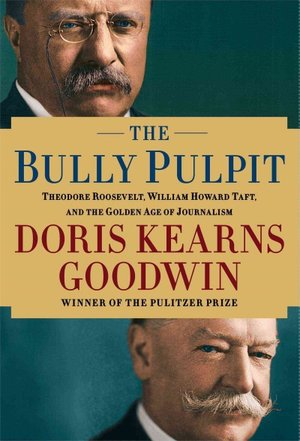
In her newest book, presidential historian Doris Kearns Goodwin takes a turn toward the history of journalism. Actually, she is working at the intersection of Presidential History and Journalism History in The Bully Pulpit: TR, Taft and the Golden Age of Journalism. In any case, I am happy to welcome her to the ranks of journalism 9781416547860_custom-cbfa6372bc5fbe63f5a575b089d8f201e92d1c0b-s2-c85historians, and I am always glad to see any professional historian from another specialty stray into journalism’s past.

I am also intrigued by her discovery of a “golden age” in the journalism at the turn of the last century. It was certainly a time of great achievement, thanks to the “Muckrakers” who investigated so much wrong-doing, corruption, and squalor. I look forward to reading the book and seeing why she considers that period so wonderful. (Personally, I would nominate the period from about 1968-74: rise of rock journalism/ heyday of “new journalism”/ Pentagon Papers / Watergate. Your nomination?)

Until then, here’s an interview Goodwin did recently with NPR.

One stunning excerpt: Goodwin recounts that the great muckraking journalist Lincoln Steffens decided to examine the performance of the U.S. government. So, Steffens wrote to the head of the outfit — none other than President Theodore Roosevelt.

“Mr. President, I want to investigate corruption in the federal government.”

According to Goodwin, TR’s reply was quite a stunner. He gave Steffens a calling card that he could use in his reporting and present to government officials as needed, which read, in part:

“Please tell Mr. Lincoln Steffens anything whatever about the running of the government that you know (not incompatible with the public interest) and provided only that you tell him the truth.”

Now, that‘s the way to treat a reporter! Just tell the truth.


1 Comment

Filed under history, Journalism, journalism history, Politics

JFK shooting: TV news grows up fast

By Christopher B. Daly 

With the approach of the 50th anniversary of that fateful day in Dallas, I thought it might be worth re-visiting my account of the assassination. Here is an excerpt from Covering America that looks at the media response to the shooting:

During the Kennedy presidency, television news became more powerful than ever. In the years since the quiz show scandals of the 1950s, television executives had been atoning by lavishing resources on their news divisions. Television sets were in the vast majority of homes by 1960, and the audience for the TV networks dwarfed that of any newspaper and even the readership of the entire Time-Life empire. The media president, Jack Kennedy, also introduced live television coverage of presidential news conferences and proceeded to thrive in the new forum. Television carried more news than ever, to more people.

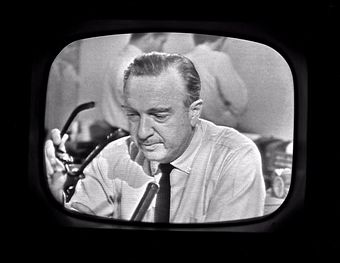
On November 22, 1963, television was the medium by which many Americans first got the news about the shooting. There it was, right on TV. The president and his wife were in a motorcade with Governor John Connally and his wife. Shots rang out, and the president was rushed to the hospital. No word on the shooter’s identity. It may not have been apparent to viewers, but television executives were scrambling to keep up. The networks did not have the equipment and staff needed to “go live” and put news on the air as it was unfolding. Just off camera it was pandemonium, as executives met to decide how to cover a presidential shooting in the new medium. Eventually they reached a consensus: they would stay with the story, without interruptions and without ads, for the duration. So it was that for three or four days the American people did something they had never done before: they stayed home and attended a funeral via television. If they were watching CBS, they saw Walter Cronkite dab at his eye when he announced the bulletin confirming Kennedy’s death. No matter what network they watched, viewers saw Jack Ruby shoot Lee Harvey Oswald; they saw the flag-draped caisson and the riderless horse; and they saw the salute given by the president’s young son. For the first time (and almost the last, as it happened), nearly the entire country had nearly the same experience at the same time.

CBS News anchor Walter Cronkite struggles to keep his composure on-camera as he announces the news of the death of President John F. Kennedy live on the air on November 22, 1963.     —Getty Images.

CBS News anchor Walter Cronkite struggles to keep his composure on-camera as he announces the news of the death of President
John F. Kennedy live on the air on November 22, 1963.
—Getty Images.


In the New York Times, on Monday, November 25, 1963, the front page featured a banner headline across the entire page, stacked three decks deep:

PRESIDENT’S ASSASSIN SHOT TO DEATH

IN JAIL CORRIDOR BY A DALLAS CITIZEN;

GRIEVING THRONGS VIEW KENNEDY BIER

The funeral was planned for later that day. Below the big headline was a photo (from the AP) of Jackie Kennedy and Caroline kneeling next to the president’s flag-draped casket. Underneath was a little single-column story headlined:

JOHNSON AFFIRMS

AIMS IN VIETNAM

Then, this ominous subhead:

Retains Kennedy’s Policy

of Aiding War on Reds


[To read my book, order Covering America from Amazon.]


Leave a comment

Filed under broadcasting, history, Journalism, journalism history, media, New York Times

Errol Morris on the Zapruder film of JFK’s shooting

By Christopher B. Daly 

As we approach the 50th anniversary of the assassination of JFK, there is some remarkable work being done by journalists and historians around this central but still perplexing event. Here is an article that brings together the journalist Ron Rosenbaum and the documentary filmmaker Errol Morris in a discussion of the famous Zapruder film — the DIY film of the exact moment at which President Kennedy was shot. There is a fascinating story behind a single frame of Abraham Zapruder’s home movie. Rosenbaum and Morris also discuss many of the leading works about the assassination, from conspiracy theories to debunking efforts. 

What is most amazing to me is that even now, there is no definitive explanation of the assassination — not for the physics of the shooting, not for the motives of assassin Lee Harvey Oswald, not for the roles that others may have played. In other words, the central public event of my childhood might or might not have occurred in the way it seemed to, and the grown-ups have yet to tell a convincing story.

Too sad.

imgres


1 Comment

Filed under history, Journalism

Keller v. Greenwald debate: Reporting v. Advocacy

By Christopher B. Daly

Bill Keller, former executive editor of The New York Times and keeper of the flame of traditional reporting, has squared off with Glenn Greenwald, the journalist who disclosed the Snowden leaks and an avatar of advocacy, in a debate over the meaning and future of journalism. Their debate is well worth reading and contemplating. 

Here’s my take: they are actually talking past each other. Each participant represents a different definition of journalism and cannot fathom the other’s values. As I argue in my book, Covering America, they come from competing visions of the essence of journalism, each of which has a long record.

Keller stands squarely for the tradition of responsible, dispassionate, nonpartisan, factual reporting. This was articulated forcefully by Adolph Ochs, the great-grandfather of the current Times publisher, when he bought the Times in 1896. Keller seems to believe that this tradition is the only legitimate one and that all others represent a deformation or corruption of “real” journalism.

Greenwald stands squarely for the tradition of journalism that prizes journalism for its ability to change the world. This is the polemical, analytical, interpretive form of journalism that considers advocacy the essence of journalism. Practitioners like Greenwald often look down on the reporting tradition as a weak, hypocritical, trouble-avoiding compromise.

It may come as a surprise that the advocacy tradition is actually older (much older) than the reporting tradition. In America, the first newspaper launched in 1704, and for more than a century after that, most journalism in America was a fact-free zone of argument and advocacy carried out by the likes of Sam Adams and Tom Paine.

The first full-time reporter in America (the obscure figure George Wisner of the New York Sun– pgs 61-62 in Covering America) wasn’t hired until 1833, and it took decades to establish the idea that the proper contents of a newspaper were value-free “facts” gathered by non-partisan professionals.

Personally, I don’t think one tradition is inherently more virtuous or more valuable than the other. I admire the best in both worlds.


2 Comments

Filed under blogging, history, Journalism, journalism history, media, New York Times, Politics

Textile production returns (sort of) to the US South

By Christopher B. Daly

According to a story in today’s NYTimes, the management of the big textile companies have finally achieved a long-sought goal: production without workers. In the book Like A Family, my co-authors and I tell the story of what happened when the U.S. textile industry moved in the early 20th century from its first home in New England to the Piedmont region of Southern states like Virginia, the Carolinas, and Georgia.

From the get-go, owners and managers sought to replace labor with capital whenever they could. Here’s an example of advertising we found in the trade press of the 1920s.

Screen Shot 2013-09-20 at 10.46.37 AM

Now, it appears the industry has reached rock-bottom in terms of employment and is actually able to compete with low-wage competition from India, China, and elsewhere.


Leave a comment

Filed under history

For Hemingway’s birthday, visit his papers

By Christopher B. Daly 

This Sunday, July 21, is the birthday of Ernest Hemingway — journalist, novelist, man of letters, beau ideal of a certain interpretation of masculinity. He would have been 114.

There are probably lots of ways to observe his birthday: you could go out and kill a top predator (like a lion or marlin), or you could go drinking and get a bartender at a famous bar to name a drink after you, or you could run with the bulls at San Fermin, or you could try to write ten simple declarative sentences in a row.

Alternatively, you could “visit” with Hemingway by rummaging around in his vast trove of papers and photos, which are archived as the Ernest Hemingway Collection at the John F. Kennedy Presidential Library and Museum in Boston. Much of the Hemingway collection remains to be digitized, so the only way to see most of those documents and objects is to visit the JFK Library, which would not be the worst thing — it sits right over Boston Harbor. But if you visit the website, you can click on the “media gallery” and cruise through Hemingway’s own photos.

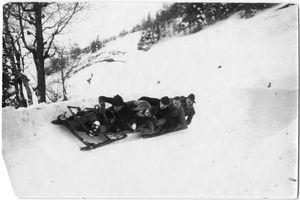
If the heatwave continues, try looking through the photos that feature Hemingway in the Alps. He is somewhere in this group bobsledding in Montreux. Enjoy.

EHPH-06901_lres

[Postscript: The Hemingway Collection site also offers an explanation for why the collection is housed at the JFK Library, which is not an obvious connection. I have not done any research into this question, so I can’t evaluate the accuracy or completeness of this version, but it’s worth reading.]

Update: The Boston Globe reports that the JFK Library has digitized the scrapbooks kept by Hemingway’s mother, which document his childhood. The Library has posted them on the website, too.

scrapbookcover2

Leave a comment

Filed under history, Journalism, journalism history

American revolution based on avoiding surveillance

By Christopher B. Daly 

During the current revelations about the extent of routine surveillance being conducted on American citizens by agencies ranging from the NSA to the Postal Service, it might be worth recalling how this liberty-loving country was founded.

In the 1760s and early 1770s, a growing minority of British colonists living in North America were developing longer and longer lists of grievances against the Crown and Parliament. These Whigs (or patriots) looked for ways to turn their concern into practical action to resist what they considered abuses of their rights as Englishmen.

Recognizing the power of information and coordinated action, they formed Committees of Correspondence — first in Boston and later in all the colonies. They eventually became tantamount to shadow governments, but they

Sam Adams, enemy of the surveillance state.  National Portrait Gallery

Sam Adams, enemy of the surveillance state.
National Portrait Gallery

began as a mechanism for sharing information, views, and debates. Immediately, the founders recognized a problem: most of the mail that passed through the British postal system was routinely read by postmasters. So, if the Whigs were going to get organized on a continental basis, they needed to find a way to escape from that surveillance if they were to avoid arrest and punishment.

The answer was the Committees of Correspondence, which developed a shadow post office to serve their needs. When one committee had an important message to send to another, the members dispatched a private post rider, who carried the message on horseback — from Boston to New York, say, or from Baltimore to Savannah. Alternatively, they might dispatch a loyal Whig aboard a ship carrying the printed or handwritten messages on his person.

One famous case in point: after the dumping of the tea into Boston Harbor in December,

Paul Revere thwarted postal surveillance.  By John Singleton Copley

Paul Revere thwarted postal surveillance.
By John Singleton Copley

1773, the Boston Committee of Correspondence dispatched none other than Paul Revere to carry the news to Manhattan. That was a trip of more than 200 miles by horseback, which Revere completed in less than a week, over pretty rough roads, as winter was settling in. Long before his famous ride to Lexington and Concord, the Boston copper- and silversmith made other, lesser-known but essential rides for the cause.


From the patriot point of view, this system was a clever, heroic, and indispensable work-around that was a vital means for advancing the cause of liberty.

From the British point of view, of course, this was an illegal conspiracy to commit treason. 

[Postscript: As soon as the revolution began, the (illegal) Continental Congress began trying to conduct foreign affairs in hopes of drawing other nations into the revolutionary battle against Britain. The Congress set up a “Committee of Secret Correspondence,” led by Benjamin Franklin. Members began reaching out to contacts in Europe, but of course they could not use the British postal system and the new revolutionary government had not established its own. So, they turned to private couriers, who carried the committee’s secret messages. Later, this committee was renamed the Committee for Foreign Affairs. Thanks to the U.S. State Dept Office of the Historian for that one.]

1 Comment

Filed under broadcasting, First Amendment, history, journalism history, Politics

Review of “Covering America” in Journalism History

I am posting this review of my book in the scholarly journal Journalism History here, because the journal charges a lot for access.

Journalism History 

Vol 13 (4), Winter 2013, p254-255

CA cover final 2Daly, Christopher B.

Covering America: A Narrative History of a Nation’s Journalism.

Amherst and Boston: UMass Press, 2012. 535 pp. $49.95.


Many a teacher of journalism history has heard students complain about how dull or inaccessible they find any one of several available media history textbooks. And many a journalism instructor has agreed with his or her students’ complaints about de-contextualized dates and names of publishers and their historically significant newspapers strung through those tomes. Covering America: A Narrative History of a Nation’s Journalism addresses these complaints. In Covering America, Christopher Daly has wrapped the story of American journalism from the colonial period through the digital age into a carefully researched, beautifully written, and memorable account of how news reporting mostly has grown as well as improved during the span of three centuries as innovators have exploited new technologies, constitutional protections, government subsidies, cultural trends, and business formulae to maintain their financial independence and journalistic standards while serving their readers and audiences ever more efficiently.

            Daly, an associate professor of journalism at Boston University with twenty years of experience covering New England for the Washington Post and writing for the Associated Press, concentrates in Covering America on newspaper, television, and digital news with only occasional references to early twentieth-century magazines and rare mentions of public relations and advertising. His focus is the changing and expanding definition of news over time. Daly admits that in Covering America, unlike Frank Luther Mott’s or Edwin Emery’s geographically broader approaches to journalism history, he emphasizes journalism originating in New York— although Boston, Philadelphia, Washington, D.C., and Chicago receive some attention when media in these cities contribute to the overall narrative. This exclusion of examples of western and southern journalism, however, contributes in two ways to the success of Covering America. It greatly reduces the clutter and detail that overwhelms so many students, and it allows Daly to hold the social, political, economic, and technological context constant as he explains the challenges and opportunities printers, for example, faced at roughly the same time and place. Rather than grasping at data, the reader finds the overall historical patterns of journalism more apparent and memorable.

            In describing his history as narrative, Daly accurately describes his method of organizing this book, which is apparent from the opening paragraph of his introduction through his final chapter on “Going Digital.” Covering America, not unlike other journalism history texts, begins with Benjamin Franklin, but does so with a narrative lead one might expect from a short story or magazine feature:

             On an early spring night in 1722, a young man hurried along the narrow streets of Boston, trying not to be seen. He was not a spy or a thief. He only wanted to be a writer. Just sixteen years old, Ben Franklin was hoping to get his writing published for the first time, and he had chosen a risky, roundabout route to do so.

 Daly then notes that young Franklin was “skulking” around the shop of the New England Courant, owned by his brother James, in order to slip a manuscript under the door for his older brother to discover and, he hoped, to print. In this description of Franklin’s actions, Daly finds several defining characteristics of American journalism still at work today: printing was a private business, journalism was open to the young with raw talent, and the pleasure of publication drives journalists into the field.

            In the first chapter on the “Foundations of the American Press, 1704-1763,” after explaining the organization of the print shop, its products, and its method of production, Daly returns to Franklin as an example of printers during this period of six decades before the American Revolution, devoting eleven of the chapter’s twenty pages to detailing his biography, readings, head for business, popular writings, and principles of journalism in his “Apology for Printers.” Within this chapter, Daly also describes the John Peter Zenger trial and acquittal for seditious libel, noting that Franklin helped Zenger obtain his attorney. Franklin receives briefer mentions in several more chapters, reminding readers the interconnections always present as journalism is transformed over time. This pattern of focusing on one or two individuals as representative of journalists from particular periods is a device of narrative compression that Daly uses in each of the chapters in Covering America. As Daly develops an overarching narrative to describe 300 years in the development of American journalism, he inserts short narratives of innovative journalists and publishers who exemplify traits of the period being described. This is how readers receive substantial information about Benjamin Day, James Gordon Bennett, William Lloyd Garrison, Frederick Douglass, Thomas Paine, Horace Greeley, Joseph Pulitzer, Ida B. Wells, William Randolph Hearst, Adolph Ochs, Henry Luce, Harold Ross, David Sarnoff, William Paley, Walter Winchell, Walter Lippmann, Dorothy Thompson, Edward R. Murrow, Ernie Pyle, John Hersey, A.J. Leibling, David Halberstam, Truman Capote, Gloria Steinem, Katherine Graham, Ted Turner, Al Neuharth, and other journalistic innovators who so comfortably populate Daly’s story of the news.

             Covering America would vastly improve the student experience of an often unappreciated journalism history course, particularly at the undergraduate and master’s levels. Journalism students will leave a class after reading Daly’s book with a clear understanding of the methods and values of the field they will soon enter. They will also gain some confidence that journalism will continue even if paper and ink disappear.

 Joseph Bernt, Ohio University

Leave a comment

Filed under broadcasting, Covering America, First Amendment, history, Journalism, Photojournalism, Uncategorized