Category Archives: broadcasting

How to break into the news business

By Christopher B. Daly

Well, here’s one way:

1. Start off with a career in modeling.

2. Become a Republican.

3. Never work as a reporter/editor/photographer.

4. Join FOX News as a highly paid on-air commentator.

That is the path reportedly being pursued by Scott Brown, according to a story in today’s Boston Globe and elsewhere. Now that Brown, the Republican who lost the 2012 race for U.S. Senate to Democrat Elizabeth Warren, is getting out of politics and becoming a big media star, he don’t need to talk to no stinkin’ reporters:

A Fox spokesman confirmed Brown is in talks to appear on the network, which recently announced it is not renewing contracts with big-name political commentators Sarah Palin and Dick Morris. It was unclear, however, what role Brown might have on the network. Though Brown has told several Republicans that he will have a gig on Fox, the spokesman said the talks are not final.

Brown would not comment to the Globe. When reached Wednesday night, he said, “I am right in the middle of dinner,” and hung up the phone.

All in all, Brown appears to be an example of the power of failing upward. Way to go, Scott.

Unknown

2 Comments

Filed under broadcasting, Uncategorized

New NYT exec: Up to the job?

By Christopher B. Daly 

Mark Thompson is wrapping up his first week as the new president and chief executive of the New York Times Company. That role puts him in a critical position in U.S. journalism, and he has little margin for error in leading the

Carl Court / AFP-Getty

Carl Court / AFP-Getty

country’s most important news-gathering organization through dangerous and economically challenging times. We all need him to succeed.

And yet.

It is beginning to appear that the Times Company’s principal owner and publisher of the flagship newspaper, Arthur Sulzberger Jr., may have picked the wrong person for the job. The reason for that has to do with Thompson’s last job, as an executive with the BBC. The British broadcasting empire, a tower of journalistic probity, is going through its own scandal.

To its credit, the Times is pursuing the question of what Thompson knew and when he knew it — apparently without much fear or favor. This is as it should be. My concern is that, fairly or unfairly, Thompson may be so damaged by his BBC baggage that he has to go.

Tentatively, I would say Thompson either knew of serious wrongdoing at the BBC and did nothing, or else he did not know and should have. Either way, he is compromised.


Leave a comment

Filed under broadcasting, Journalism, New York Times

Math for journalists (and everyone else too)

By Christopher B. Daly 

In the wake of last week’s election, many Republicans seems to be facing not only a political problem but also an epistemological one. Epistemology is the term philosophers use for the study of knowledge itself. It is an inquiry that asks: How do we know what we know? (or, How do we know what we think we know?)

Two recent pieces raise the issue.

David Carr,in his column in the New York Times, emphasizes the crisis that overtook Fox News on election night, when some professionals at the conservative news network were forced to choose — live, on television — between Republican orthodoxy and journalistic empiricism. Carr rightly applauds Megyn Kelly for insisting on a fact-based approach while she was on-air with Republican Party strategist, fund-raiser, consultant (have I left any roles out?) Karl Rove, who doubles as a paid news “analyst” for Fox. As the Ohio vote was being counted last Tuesday night, it was becoming clear that Obama would win the state and, thus, the country. Rove insisted that Fox set aside the facts and hold off on placing Ohio in the president’s camp.

Inexplicably, though, Carr did not cite the definitive quote in the exchange. Kelly turned to Rove and asked:

“Is this just math that you do as a Republican to make yourself feel better, or is this real?”

(Jon Stewart rightly pounced on it as a moment of political/journalistic/epistemological crisis, and you can see the video.)


How about math we do as Americans to determine reality?


Many of the same issues are raised in a searching piece in Politico today about the “cocooning” of many Republicans. On election night, some Republicans found it difficult to believe that Obama was actually winning, largely because they only watch Fox News and only hear the views of analysts like Karl Rove. The piece, by Jonathan Martin, points in the direction of the book I am working on about the rise of conservative media after WWII, with the working title: Inside the Meme Factory: The Rise of Conservative Media and Think Tanks. Stay tuned for that. (If you think that an idea/slogan like “the rich are job-creators” arises spontaneously, you got another think coming!)


Leave a comment

Filed under broadcasting, Fox News, Journalism, Politics

Dick Morris: wrong or stupid?

By Christopher B. Daly

Among the many satisfactions on election night 2012 was seeing Dick Morris, the smarmy former Clinton political adviser, get slapped around the head by the facts. Just a few days ago, Morris — who has been reborn as a mean conservative — was predicting not only that Romney would win but that the Republican would win in a landslide. You can read the interview he did with his enabler, Bill O’Reilly.

Morris debases the public sphere every time he speaks or writes.

And shame on Fox News for giving this guy airtime. 

2 Comments

Filed under broadcasting, Fox News

Tough call

By Christopher B. Daly 

I’m not sure why, but I am finding it hard to sort out the issues in the flap over CNN’s use of the diary of the late U.S. ambassador J. Christopher Stevens.

I guess it’s because I cannot reconcile these two imperatives:

1. Never violate someone else’s privacy — by, for example, reading a private diary. As a sporadic diarist myself, I know that I would be appalled by any reading of my diary that I did not personally approve. Private is private. If CNN were to cover a fire or explosion at a U.S. Post Office, would the reporter have a green light to start opening mail and reading private correspondence?

2. Never withhold useful, verified information from your audience. If you’ve got it, use it. CNN did not divulge any information that the average person would consider personal or intimate, and it did find other sorts of observations in Stevens’s diary that have a bearing on important public issues. What if CNN found the diary of the leader of Iran (who can spell Ahmadinejad?) and therefore could say definitively what his intentions are?


What’s your view?

Please leave your comments below (with your full name, please).


Leave a comment

Filed under broadcasting, CNN, media

Obama: Media Critic?

By Christopher B. Daly

Even on vacation, I couldn’t help noticing this piece in today’s Times about President Obama’s news-reading habits and his criticisms of some of the coverage. 

As a media critic myself, I am not sure how I feel about adding this new guy to the ranks. But he does seem to have a grasp on some major issues. From the Times:

The news media have played a crucial role in Mr. Obama’s career, helping to make him a national star not long after he had been an anonymous state legislator. As president, however, he has come to believe the news media have had a role in frustrating his ambitions to change the terms of the country’s political discussion. He particularly believes that Democrats do not receive enough credit for their willingness to accept cuts in Medicareand Social Security, while Republicans oppose almost any tax increase to reduce the deficit.

Privately and publicly, Mr. Obama has articulated what he sees as two overarching problems: coverage that focuses on political winners and losers rather than substance; and a “false balance,” in which two opposing sides are given equal weight regardless of the facts.

Mr. Obama’s assessments overlap with common critiques from academics and journalism pundits, but when coming from a sitting president the appraisal is hardly objective, the experts say.

Irony alert: after quoting Obama on the problem of false balance and explaining the concept, the piece goes on to engage in the very practice.

To his credit, Obama seems to read a lot, and that can’t be a bad thing.

Now, back to the beach.

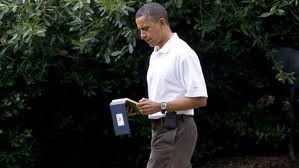
Obama reads his iPad while walking. ABC News.com

Obama reads his iPad while walking. ABC News.com

Leave a comment

Filed under broadcasting, Journalism, Politics, President Obama

NYT error: Fox News is not top rated

By Christopher B. Daly 

Today’s Times has an interesting (though somewhat thin) story about the relationship between president Obama and Fox News.

One thing caught my eye:

But now, with the presidential campaign entering its most competitive phase, the simmering tensions between Mr. Obama and the country’s highest-rated news channel threaten their fragile détente.

Problem is, Fox News is NOT the “country’s highest-rated news channel.” It is the highest-rated cable news channel, with about 1.3 million viewers. But it comes nowhere near the size of even the lowest-rated broadcast news channel. And it is still a tiny fraction of the combined audiences of ABC, NBC, CBS, and PBS, which have well over 20 million viewers in all.

(Yes, there is a bit of an apples/oranges issue here, but, come on: Fox is in a different universe from the broadcast networks.)

(A further thought: in a nation of 300+ million people, does Fox News with 1.3 million viewers deserve the attention it gets?)


3 Comments

Filed under broadcasting, Fox News, New York Times

“Forgive us our press passes”

By Christopher B. Daly

I heard a fantastic story yesterday on the “This American Life” radio program. It was about the business/ethics/professional issues raised for the field of journalism by a new-ish company called Journatic. The story, by producer Sarah Koenig had the brilliant memorable headline “Forgive us our press passes.” It explained the creepy side of how out-sourcing has arrived, almost completely under the radar, in the American newspaper business. Turns out, lots of the routine fillers (school lunches, ordinary obits, etc.) that fill up small-town and suburban newspapers are actually “written” by worker bees in the Philippines, Eastern Europe, and Africa. They toil away for peanuts, then transmit their “stories” to editors in the states, who get paid next to nothing to “edit” those “stories,” even though the editor could be more than 1,000 miles away from the community being “covered” in this way. The whole operation seems to make a mockery of the idea of “hyper-local” news. 

Sheesh.

To her credit, Koenig really pursues the issue in great depth and nuance.

Also, a note to journalism teachers: you should share this piece with your classes. It is really a two-fer: it tells some important truths about the direction the news business is heading in, and it is a model of how to use audio to tell a complicated story. It is must-listen journalism.


2 Comments

Filed under broadcasting, Journalism, local news, media, NPR

Journalism 101: Read the whole opinion

By Christopher B. Daly

It comes down to this: two major news organizations (CNN and Fox News) blew their initial coverage of the most important Supreme Court ruling this decade. They did so because reporters at both cable news outlets made a rookie mistake by generating headlines without reading the whole SCOTUS opinion. In these situations, reporters often face an apparent dilemma: Do you want to be first? Do you want to be right?

The answer, of course, is that a conscientious reporter should want to be the first one who is also right.

And, just so I don’t let anyone else off the hook, this message needs to be embraced and shared by editors, desk people, and top management. The message has to be sent early, often, and unambiguously.

How do I know?

Aren’t I just a professor, safely watching this from the sidelines?

Well, yes and no. I worked for almost five years in a news cockpit, covering the state government of Massachusetts for the AP. In that role, one of my duties was to read the opinions of the Massachusetts Supreme Judicial Court (the SJC, the oldest continuously sitting court in the English-speaking New World, older than SCOTUS). When those opinions were newsworthy, as they often were, I had to bang out an immediate hard-news lead. Directly across the room from me in the Statehouse Press Gallery, my competitors at UPI were doing the same thing. We could tell from the sound of our typing who was writing and who was finished and had transmitted the story. The stakes were not as high as they were on Thursday at SCOTUS, but covering the SJC is essentially the same challenge.

So, here are my takeaways from the health-care bulletin fiasco:

–News organizations need “beat” reporters. That is, they need reporters who specialize in an area (health care, let’s say, or covering the Supreme Court) and become experts in it. General-assignment reporters (and god love ’em, we need them too) cannot be thrown at every new situation and expected to learn on the fly.

–The Supreme Court should re-institute the “embargo” system. An embargo occurs when the news media are given material in advance, on condition that they agree to withhold it until a specific time. When that agreed-upon moment arrives, the journalists are all released from their promise and can all disseminate the news at the same time. That system has several advantages. It means that reporters are quarantined for a period of time that they can use to their benefit — they can read the whole opinion, maybe more than once; they can check their notes and background materials; they can even call experts for analysis and comment. They can use the time to craft a story that is accurate and complete, knowing that no other news organization that participated in the embargo is going to scoop them. Granted, it is not natural for a news professional to endorse any system that delays the delivery of news. But the reason we sometimes accept embargoes is that they ultimately serve the best interest of our audiences, which is what we should care about the most.

–We need bloggers too. A delicious irony from Thursday is that two big-deal professional news organizations (yes, I am lumping Fox News in here, arguendo) discovered their mistake in part by reading a blog! The highly regarded SCOTUSblog got the story right and prompted part of the correction process. So, let’s give a hat tip to the power of a small group of experts using the Web to communicate.

(And a special salute to Lyle Denniston of SCOTUSblog, seen at right. Talk about beat reporters! He has been covering the Supreme Court for 54 years, or far longer than any of the current justices has served.)

Leave a comment

Filed under blogging, broadcasting, CNN, Fox News, Journalism, Supreme Court

A throwback?

By Christopher B. Daly

The U.S. Supreme Court has ruled that two broadcasters who aired material that was arguably indecent can get off on a technicality. The court ruled yesterday that the FCC, which regulates broadcasting (because broadcasting uses the electromagnetic spectrum, which we all own, collectively), did not give the broadcasters sufficient notice.

The real question is this: what the heck is the FCC still doing trying to regulate the content of television? That is a question that SCOTUS apparently decided to sidestep in the latest case.

Since Congress created the fore-runner to the FCC in 1927, the FCC has been overseeing radio, television, and other communications that use the public’s airwaves.  Leaving the merits of their decisions aside, is there any rationale for FCC interference in what can be shown on cable television (which does not use the airwaves and relies instead on entirely private property)?

The landmark case in this area remains FCC v. Pacifica — the one involving the late comedian George Carlin’s famous “seven words you can’t say on radio” skit.

Leave a comment

Filed under broadcasting, Supreme Court