Is Obama Reading Journalism History?

by Chris Daly

It looks that way, judging from his new interview in Rolling Stone. He was asked by RS founder/editor Jann Wenner for his opinion about Fox News. Here’s the relevant chunk:

What do you think of Fox News? Do you think it’s a good institution for America and for democracy?
[Laughs] Look, as president, I swore to uphold the Constitution, and part of that Constitution is a free press. We’ve got a tradition in this country of a press that oftentimes is opinionated. The golden age of an objective press was a pretty narrow span of time in our history. Before that, you had folks like Hearst who used their newspapers very intentionally to promote their viewpoints. I think Fox is part of that tradition — it is part of the tradition that has a very clear, undeniable point of view. It’s a point of view that I disagree with. It’s a point of view that I think is ultimately destructive for the long-term growth of a country that has a vibrant middle class and is competitive in the world. But as an economic enterprise, it’s been wildly successful. And I suspect that if you ask Mr. Murdoch what his number-one concern is, it’s that Fox is very successful.

Leave a comment

Filed under Fox News, journalism history, President Obama

Honoring Halberstam

By Chris Daly

I am very pleased to see that David Halberstam is to be memorialized by the naming of a chunk of Harvard Square in his honor. His first newspaper, The Crimson, broke the news a while back. Now comes word that it has been approved, and the ceremony is set for about two weeks from now, at 4:00 on October 6.

For those who know the area, it is a triangle in a fairly prominent area, just past the point where Mt. Auburn Street passes in front of the Tennis & Squash Shop — which I think Halberstam, who wrote often and well about sports, would have liked.

One drawback: the square honoring Halberstam is smack in front of the building that houses the Lampoon (an undergraduate humor publication), and about a block and half away from the building that houses Halberstam’s beloved Crimson.

Halberstam was a public-school kid who got into Harvard in the 1950s, made it onto the staff at the Crimson, then went on to one of the greatest careers in American journalism history. It is timely to recall that he once wrote a book questioning the policy that led the U.S. into a combat role in a distant land where we did not speak the language, understand the history, or have a vital national interest at stake. This would be a good occasion to read either his The Making of a Quagmire or The Best and the Brightest.

2 Comments

Filed under David Halberstam, Harvard, Harvard Crimson, history, Journalism, journalism history

Arianna speaks

On Tuesday (9/14) I had a chance to attend a talk by Arianna Huffington at the Kennedy School. She was there to talk about her new book (of which she gave away copies!), but she also talked about trends in online journalism, which she is helping to drive.

Here are some highlights of her talk:

When she was starting HuffPo from scratch in 2005, she knew that a key issue would be to earn trust. One key step in that direction was adopting a policy of “human moderation of comments.” That way, new users could find a particular kind of environment, free of trolls, flaming and other kinds of junk.

Another key step: we “went after  great voices” — starting with the late historian Arthur M. Schlesinger Jr., who invited her to the Century Club for an initial lunch. In going after other “great voices,” she said she makes special arrangements. For one thing, HuffPo offers what she calls “concierge service” for contributors like Schlesinger who are not very computer savvy. Those contributors use the concierge service by calling a special telephone number, where HuffPo staffers take dictation, then convert the material into files that can be posted. She said that’s how Larry David submits his posts. (This brought me back to my days at AP and the Washington Post, where everybody had to know how to both dictate and take dictation. I didn’t know anyone was still doing it.)

Now, there are 10,000 bloggers at HuffPo.

From the beginning, the idea was to present news online, 24/7.

Now, there are 30 reporters and editors, including an investigative unit (out of a total staff of 190). There are also 45 million unique visitors a month, she said, and 3.5 million comments a month.

“My dream was to combine the best of the old traditional journalism (accuracy, credibility, etc.)  with the best of the new (immediacy, transparency, engagement).”

In terms of revenues, HuffPo is “100 percent ad-based.” She said it is “now profitable.”

Arianna was asked about  fact-checking. One thing she wants to do is fact-check public statements. As an example, she said that if Sen. Grassley mentions “death panels,” there should be some kind of bubble that appears citing the relevant portion of the bill. (I’m pretty sure she was talking about TV at this point, but she sort of lost me here.)

As for fact-checking at HuffPO, she said: “We are doing our part. We have an ombudsman who works all night.” The ombud reviews the site and sends memos to her and the managing editor. Sometimes, these notes involve “minor things” like transgressions of AP Style rules. Sometimes the ombud raises major factual issues.

“It’s incredibly important, especially when there is so much out there that is wrong.”

“The Internet is a two-edged sword. It’s easier to spread errors, but it’s also faster to correct things.”

Q. How did you go from blogging by yourself to running a huge site?

A. Arianna gave generous credit to her early partners. She cited her co-founder, Kenneth Lerer, who came from AOL. “The two of us raised half of the money each, just over one million dollars. Literally, I raised it from friends. Larry and Laurie David were first. When they divorced, they split it.”

Later, there were two more rounds of financing — one by a bank, one by Oak Ventures (a Silicon Valley venture capital firm).

She was also asked about Andrew Brietbart? (founder of Big Government and other conservative sites).

“He used to work for me. He  also worked primarily for Drudge. I asked Andrew to help us work out the news part of Huffington Post.  Yes, he was part of (it).”

“Ideologically, he was always the same.”

“What he believes is different from what I believe.” Her major point was that he was hired for technical assistance and he rendered it. The rest was outside the scope of his duties for her.

Q. You and Nick Denton are writing the new rules of online news. One rule is unpaid writers. How can we have quality without pay?

A. At Huffington Post we have 190 fulltime staff, plus dozens of moderators (paid but part time) paid interns, unpaid sumer iterns. We are hiring right now. Our goal is to keep hiring. We particularly like to hire young people right out of college. We just hired former arts editor of Yale Daily News. If you know anybody who wants a job, we are hiring… Especially people right out of college – that’s a fantastic demographic for us.”

Q. How long will the New York Times survive in print?

A. Indefinitely. Something in our dna loves newspapers. I subscribe to several newspapers. I don’t have time to read them all, but  I like having them around.”

“From the day we launched I said the future is hybrid.”

Leave a comment

Filed under Arianna Huffington, Huffington Post, Journalism, New York Times

Follow the Money (cont.)

Hard to believe that — all of a sudden — David Westin just decided at age 58 that it is time for him “to move on.” When a person in the public eye says that, it always means look for a real reason.

Could it be the reason the Times mentioned in the 7th paragraph? That is, that the parent company Disney is insisting that Westin’s delivery of 5 percent profit a year isn’t good enough and that he should come across with 15 percent. Unless there are a whole bunch of advertisers willing to pay a lot more to sell adult diapers and heart medicines to the viewers of ABC News, the higher profit goal can only be met one way: cut expenses. And in the news division, that means get rid of journalists, close bureaus, scale back coverage.

Why should that decision be made at Disney corporate headquarters in Burbank?

Here’s a hint, from the company’s “investor relations” page:

The company’s primary financial goals are to maximize earnings and cash flow, and to allocate capital toward growth initiatives that will drive long-term shareholder value.

Nothing in there about the news.

Leave a comment

Filed under Uncategorized

Farewell, John Henning

By Chris Daly

Today comes news of the death of one of the greats in Boston television news: John Henning.

In a medium that often cares more about the television than about the news, Henning stood out as a dead-serious reporter. He cared about facts and information, not about his hair or the lighting.

Henning also stood out among the Boston press corps for another reason (and not just his towering physique): He was a true gentleman. By this I mean that he was consistently considerate of other people.

I can vouch for this because I was part of a cohort of Boston journalists who all overlapped in being assigned to cover the Statehouse during the mid and late 1980s — i.e., the Dukakis years. When I arrived to cover state politics for the AP sometime in 1983 or ’84, one of the first people I met was John Henning. I was startled because I already “knew” him from seeing him regularly on the local TV news. I could not believe that he would give the time of day to “the new guy” for the AP. And yet, he went out of his way to greet me, swap information, invite me to join him in interviewing big-shots, allowing me to tag along for food or drink.

John was also very generous in another way (one that really matters in journalism): He was always willing to share his vast storehouse of Massachusetts political history to explain to a newbie what was really going on, why somebody hated somebody else from his same party, where the bodies were buried. He was a key figure in the transmission of political lore that takes place used to take place in Statehouse press galleries across the country when they were fully staffed. Anybody looking for a spot-on, often hilarious primer on Massachusetts political history will now have to look harder.

I learned a lot from John Henning, and I fear that I never really got to thank him.

So, John, let me say: Thanks a lot, to a real gentleman.

1 Comment

Filed under Uncategorized

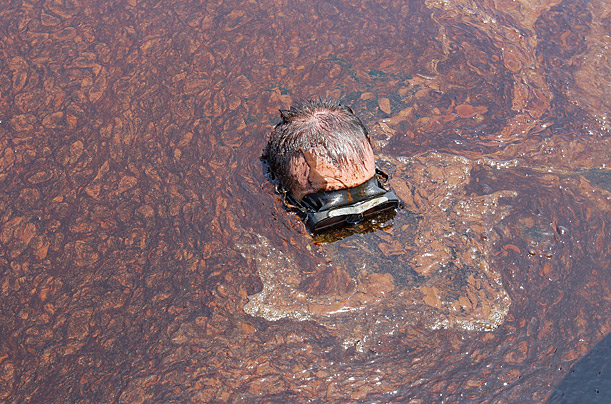
Brave or stupid?

You make the call!

AP photographer Rich Matthews plunges into coverage of the Gulf oil spill. This takes coverage of the oil business from the era of Ida Tarbell to the era of I Dodge Tar Balls.

1 Comment

Filed under Uncategorized

Reckless? Pointless?

By Chris Daly

In today’s NY Times, there is a story about the arrest of two suspected terrorists that contains a troubling paragraph. (It was the 15th graf in the version I read on-line.)

A law enforcement official said the undercover officer who made the secret recordings was in his 20s and was a five-year police veteran of Egyptian descent.

The troubling thing about this paragraph is that it presents apparently gratuitous details about an undercover agent. Readers can learn the following:

–the undercover officer is “in his 20s”

–the undercover offices has worked for NYPD for five years,

–the undercover officer is “of Egyptian descent.”

To those in the know, this much information is probably more than enough to identify this person. This much information could readily compromise this investigation or other investigations that this undercover officer is involved in.

The question: WHY?

This information is of zero value to the average reader. There is no indication that this undercover officer has done something wrong or anything of the kind of misconduct that might possibly justify “outing” the agent.

So, what was the point? Why did the anonymous “law enforcement official” pass that information along to the Times? Why did the reporter put it in the story? Why did several editors let it get out to the public?

Leave a comment

Filed under Journalism, New York Times

Journalism Myths

Great discussion today on NPR’s show “On Point” about myths that have grown up in the history of journalism. The guest was the estimable Prof. W. Joseph Campbell, talking about his book, “Getting it Wrong: Ten of the Greatest Misreported Stories in American Journalism.”

Have a listen.

Leave a comment

Filed under history, Journalism

A Must-Read

By Chris Daly

The new Atlantic has an important piece by James Fallows. In it, he tries to bridge the chasm of suspicion and cultural alienation that exists between Google and the “legacy media.”

In short, he argues that some important people at Google are looking at the future of journalism and coming to the conclusion that if Google wants to stay in the search business, it will need great content to give people a reason to search. Who will produce that great content? Apparently not Google. But Google execs and visionaries realize that they have a stake in the success of the content-creators.

One key idea (that I spoke about last week at BU): the internet has “un-bundled” the news that once came packaged in the form of a printed daily paper or an evening news broadcast. In that model, news arrived at fixed times and it offered fixed groupings of topics and stories. If you bought the paper for sports, you got political news anyway. If you watched the evening news for politics, you got a fluffy “kicker” about some do-gooder.

In a world of on-line search, that bundling does not happen. If you want fluffy kickers, you can have them. If you want politics, you know where to find it. And so on.

The future of journalism is…..  here.

Leave a comment

Filed under Journalism

Apple and Bloggers (cont.)

I am re-posting an earlier blogpost, from 2005, for two reasons:

1. It seems timely in light of the stolen iPhone case and the “shield law” protections that might or might not extend to a blogger,

and

2. I still cannot figure out how to salvage all my archives from my former host (Lunarpages). Help!?

ARE BLOGGERS JOURNALISTS?

LET’S ASK THOMAS JEFFERSON

by Christopher B. Daly

Who is a journalist?

In America, where we don’t license journalists, that is not always a simple question. Lately, the issue has come up in a new light because of the claims made by people who post Web logs. Bloggers came to prominence during the 2004 election, often criticizing or correcting the “mainstream media.” Recently, the first blogger in history was issued credentials to cover the White House. And just last month, a California judge was asked to decide whether bloggers who write about Apple computers can enjoy the legal protections of that state’s “shield laws.”

Not surprisingly, most bloggers insist that they are journalists, entitled to equal rights with older media. Others disagree, saying bloggers are not journalists by any stretch. Recently, for example, Los Angeles Times media critic David Shaw argued that bloggers should not be considered journalists because they have no experience, they have no editors, and they have no standards.

Who is to say?

One approach to an answer is historical. In fact, bloggers stand squarely in a long-standing journalistic tradition. In this country, their roots go back to the authors of the often-anonymous writings that helped to found America itself by encouraging the rebellion against Britain.

Beginning around 1760 and continuing at a quickening pace, the colonists began taking part in a great public argument — about the rights of Englishmen, the nature of civil society, and the limits of power. What began as a trickle of protest grew into a torrent of polemic.

Hundreds upon hundreds of pamphlets were printed in the colonies between 1760 and 1776, providing the intellectual setting for the debate over independence. Those writings — and their authors — played a role that was at least as important as established newspapers in giving expression to the growing political crisis.

The pamphlets were crucial to the rebellion because they were cheap, because they presented provocative arguments, and because it was impossible for the royal authorities to find their authors and stop them. The authors of the pamphlets were not professional writers, nor were they printers. They were lawyers, farmers, ministers, merchants, or — in some cases — men whose true identities are still unknown. It was a well-established practice in colonial times for writers to use pen names, even when writing on non-controversial subjects.

With the coming of conflict with England and the fear of reprisals by the authorities, most pamphleteers resorted to writing under a nom de plume such as Cato or Centinel — the “Wonkette” and “Instapundit” of the day.

They would use a sympathetic printer’s press under cover of night, then sneak the pamphlets out for distribution. As a result, the pamphleteer had one great advantage over the printer: he could state the boldest claims against the Crown and not have to fear any penalties. The pamphleteers amounted to the nation’s first version of an underground press, a guerilla counterpart to the established newspapers.

The greatest pamphleteer of the age was certainly Thomas Paine. He arrived in Philadelphia late in 1774. Already 37, Paine was not a terribly impressive figure (you might even call him a “slacker”). Born in England, he had failed in the family’s corset-making business and later got fired as a tax-collector. His first wife had died, and he was separated from his second one. Jobless and nearly penniless, he set sail for a new life in America. On the way, he fell ill and nearly died.

Then his life began to turn. He began writing essays for The Pennsylvania Magazine. He met and became friends with several advocates of independence, including the prominent doctor Benjamin Rush and the visiting Massachusetts lawyer John Adams. After a few months, Paine left the magazine but continued writing. Soon, he wrote a pamphlet of his own.

Titled Common Sense, it appeared on Jan. 10, 1776, and it shook the world. The impact of that pamphlet, out of the hundreds then circulating, was unprecedented. Paine later estimated that some 150,000 copies were sold, so it was probably read by about half a million people — at a time when the entire colonial population was about 2 million.

Like most other pamphleteers, Paine wrote Common Sense anonymously, but his central idea was unmistakable.

Paine embraced republicanism — the idea that people can govern themselves without a hereditary or religious central authority.

His first target was the monarchy itself. In Paine’s view, when stripped of all its ermine robes and gilded scepters, the monarchy consisted of naked power, plain and simple. In language that sounds a lot like ranting, Paine said the English crown could be traced to William the Conqueror, whom he dismissed as “a French bastard landing with an armed banditti.”

He went on to call for “an open and determined declaration for independence,” and he promised his readers that “the sun never shined on a cause of greater worth.” These were radical ideas, and Paine became a wanted man.

Common Sense and other pamphlets like it were precisely the kind of political journalism that Jefferson had in mind when he insisted on a constitutional amendment in 1790 to protect press freedom — anonymous, highly opinionated writing from diverse, independent sources. In historical terms, today’s bloggers are much closer in spirit to the Revolutionary-era pamphleteers than today’s giant, conglomerate mainstream media. On those grounds, blogs deserve the full constitutional blessings that the First Amendment guarantees.

But that is not to say that bloggers have carte blanche. It is important to remember that the First Amendment is a limit on the government’s power to impose prior restraint — that is, to prevent ideas from reaching the public by shutting down a newspaper before publication. It has always left journalists open to consequences that might arise after publication — such as being sued for libel or being ordered by a judge to reveal a confidential source.

It is clear that bloggers enjoy First Amendment rights, which are strongest at protecting opinions.

It is less clear that they should be entitled to the protections of all the other laws that have been passed since the Founding that affect journalists.

Consider, for example, the state and federal “shield laws,” which in general allow journalists to protect confidential sources, as in the Apple case. Many bloggers say they should be covered by those laws.

Here again, history offers a guide. Most laws protecting journalists are much newer than the First Amendment. They were passed in recent decades in order to protect and foster a specific activity called reporting.

What we think of as reporting — the pursuit, on a full-time basis, of verifiable facts and verbatim quotations — was not a significant part of journalism in the time of Jefferson and Paine. In fact, the practice of reporting began around 1833 in New York’s “penny papers” and gradually spread during the 19th Century.

Nowadays, when we ask whether someone is a journalist, we may need to refine the question. We should ask: Is this the kind of journalist who presents analysis, commentary, or political rants? Or, is this the kind of journalist who offers the fruits of reporting? Or some of both? The issue is not the job title but the activity.

Anyone who engages in reporting — whether for newspapers, magazines, radio, television, or blogs — deserves equal protection under those laws, whether the news is delivered with a quill pen or a computer.

“What do we mean by the Revolution? The war? That was no part of the Revolution; it was only an effect and consequence of it. The Revolution was in the minds of the people, and this was effected, from 1760 to 1775, in the course of fifteen years before a drop of blood was shed at Lexington. The records of 13 legislatures, the pamphlets, newspapers in all the colonies, ought to be consulted during that period to ascertain the steps by which the public opinion was enlightened and informed…”

–John Adams, writing to Thomas Jefferson, 1815.


1 Comment

Filed under Uncategorized