JFK Remembered

By Christopher B. Daly 

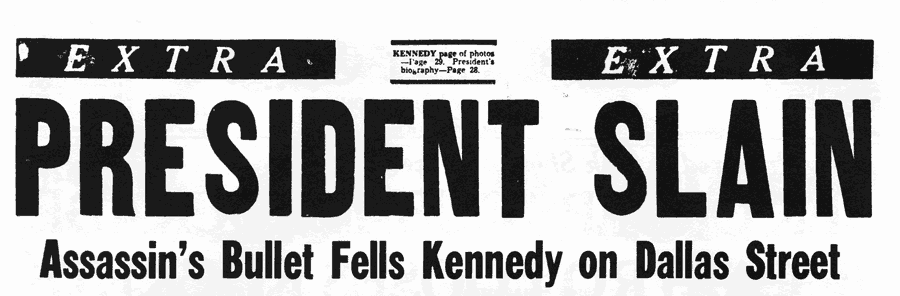
Among the many journalistic efforts to commemorate the assassination of John F. Kennedy on its 50th anniversary, one of the best is a production by JFK’s hometown newspaper, The Boston Globe. In its print editions of today, the Globe wrapped the day’s regular edition in a special four-page supplement made up on reproductions of the paper’s actual pages in 1963.

In the online edition, the Globe has links to an interactive graphic. The graphic consists of images of historic front pages from Nov. 22 to Nov. 29, 1963. If you scroll over articles, you can click through to the full text of each. Beautiful, powerful, useful.

112263-evening1_01

Some highlights from that week:

–the old Globe, like most American newspapers, was wider then, running to eight columns wide (instead of today’s standard of 6)

–the Globe ran ads on page 1, which was commonplace until the glory days of the 1970s and 1980s, when a lot of U.S. papers were profitable enough to forego those ads as a point of pride.

–the paper featured a lot of wire-service copy, mostly from AP but including the famous “scoop” by UPI’s Merriman Smith on the assassination. Here’s the lead:

DALLAS (UPI) –President Kennedy was assassinated here today.

A single shot through the right temple took the life of the 46-year-old Chief Executive. He was shot as he rode in an open car in downtown Dallas, waving and smiling to a crowd of 250,000.

Smith beat out the AP by using the car phone in a limousine in the motorcade to dictate his lead, then bending over the phone to physically block it from the AP reporter, who pummeled Smith for access to the phone but could not get his hands on it.

–In the Nov. 23 edition of the Globe, the front page features stories by UPI’s Helen Thomas, who only recently gave up covering the White House, and by Mary McGrory, whose son Brian now edits the Globe.

–On the 28th, the Globe ran a page 1 column by Walter Lippmann, the great mid-century syndicated columnist. True to form, Lippmann held forth in his most olympian mode, saying little but sounding momentous.


Leave a comment

Filed under Boston, Journalism, journalism history

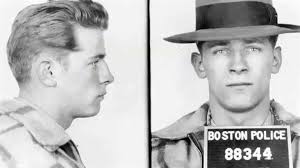
Whitey Bulger: Life without parole

By Christopher B. Daly 


In the end, the sentencing of James “Whitey” Bulger was oddly unsatisfying. Bulger  — the lord of the underworld, the big man with the killer’s coldness, the guy who struck fear into so many for so long – left the public stage without so much as a whimper. Playing the role of a stand-up guy (or at least, his version of one) all the way to the bitter end, Bulger not only refused to testify, he also refused to even make eye contact with his victims’ families.


To make matters worse, Bulger committed one last robbery: he robbed all of us in the Boston area of the satisfaction of a real showdown with the forces of images-1justice. Bulger should have been on the witness stand (and his testimony should have been on television), but he denied us that. It was a petty crime, compared to all his monstrous crimes against individuals, but it was one more shot at a public that grew tired of him long ago.


His trial over, Bulger will now spend the rest of his few remaining days in prison, where he belongs. So be it. I don’t believe in the death penalty on other days, and I will stick to my position on this one. I will not give Bulger the satisfaction of getting me to make an exception for him. I will choose not to sink to his level. (No more special treatment for you, pal.)


The whole process of putting Bulger on trial took so long that when the final stages unfolded in federal court last week, there was an odd quality of a formality about it. After all, Bulger’s capture took place more than two years ago. Ever since, it was more or less assumed that Bulger would be found guilty and given a life term.


Indeed, the thoroughly predictable and highly scripted process of a criminal trial was overshadowed this year by a lot of other local news of spontaneous origin. In April came the horrible crime of the Boston Marathon bombing, in which a couple of miserable losers decided to try to rob us all of something wonderful — the

Dhokhar Tsarnaev surrendering, with his forehead marked by a sniper's infrared.

Dhokhar Tsarnaev surrendering, with his forehead marked by a sniper’s infrared.

spirit that always used to bloom in Boston on Marathon Monday, a mix of having fun and playing hooky and being nice to out-of-towners and trying to hurry spring along.


That was followed this year (simply in time, not in a great cosmic reckoning, as some would have it) by the quite unexpected rise of the Red Sox, who gave us something of a civic bouquet this year — not by winning the World Series, which was nice but a bit much. No, I think the Sox’ real gift to us this year came from seeing them having fun playing a child’s game as if it mattered and seeing them outperform expectations. All that, plus beards — what a treat.


*       *       *       *


Yet, there is still some unfinished business in the Bulger matter. Whitey Bulger owes us all the answers that we didn’t get when he chose not to testify. He may try to tell his story – on his terms, of course, with a book or letters – but he should have had to sit in the dock, under oath, and face questions not of his choosing.


For that matter, his brother Billy (the former president of the state Senate) images-2owes us some answers, too. What did he know about his brother, and when did he know it? Billy owes us these answers because he was not a private person all those years. He’s not in the same category as the third Bulger brother or their sister. No, Billy was at or near the center of public power during the very same years and in the very same city that Whitey was at or near the center of criminal power.


I will not compare or contrast the two brothers, except to say that as a journalist who covered Billy during that period and who often got the back of his hand, I believe that even rough justice demands that he give answers to the people whose money he spent and whose government he hijacked. No more of his grinning and winking and ducking. What did he know and when?


Other unfinished business?


There’s the FBI, for one. The agency has yet to offer a convincing explanation of how Whitey Bulger could have drafted the FBI’s Boston office into his protection racket or of how the agency is preventing a repeat by some other hoodlum.


Then there is the matter of how anybody could have fallen for the blarney that Whitey was a good guy who was keeping drugs out of South Boston or that Billy was a good guy because he gave away some turkeys at the holidays. Both of the Bulgers got too much power, and we are the ones who let them get away with it.


So, in the end, I suppose, the final reckoning is not with them but with ourselves. That’s a sentence with no parole, no appeal. In a way, we’re lifers, too.

 

1 Comment

Filed under Boston, history, Journalism, Politics, Uncategorized

Celebrating advocacy journalism: TNR salutes High Times

By Christopher B. Daly 

A hat-tip to TNR for recognizing the impact of High Times, the magazine that has stayed laser-focused on its advocacy of legalizing marijuana use in the United States.  (Memo to TNR: in your drive to be resolutely counter-intuitive about everything, you overuse superlatives. High Times is obviously influential to anyone who stops to think about it for a second. You don’t need a headline saying it “may be the most influential.”)

Based in New York, High Times was founded in 1974 by Tom Forcade.

From Wikipedia:

The magazine was founded in 1974 by Tom Forçade of the Underground Press Syndicate.[1] High Times was originally meant to be a joke, a single issue lampoon of Playboy, substituting dope for

First edition

First edition

sex. But the magazine found an audience, and in November 2009, celebrated its 35th anniversary.[2] Like Playboy each issue contains a centerfold photo, but instead of a nude woman, High Times typically features a choice grade of cannabis plant.

The magazine soon became a monthly with a growing circulation audited by ABC reaching 500,000 copies an issue; rivaling Rolling Stone and National Lampoon. The staff quickly grew to 40 people. In addition to high-quality photography, High Times featured cutting-edge journalism covering a wide range of topics including politics, activism, drugs, sex, music and film.

High Times has long been influential in the marijuana-using counterculture. Past contributors include Charles Bukowski,William S. BurroughsTruman CapoteHunter S. Thompson and Andy Warhol.

As I have written elsewhere, this approach to journalism puts High Times squarely in a long, glorious tradition in American journalism: the advocacy tradition.

From Sam Adams to Tom Paine. . .

. . . from William Lloyd Garrison to Frederick Douglass

. . . From Ida B. Wells to Ida Tarbell

. . . from Jacob Riis to Lewis Hine

. . . from Upton Sinclair to Lincoln Steffens

. . . from Elizabeth Cady Stanton to Gloria Emerson

. . . from Jann Wenner to Hunter Thompson

. . . from Westbrook Pegler to Sean Hannity

. . . from the Hearstpress to the Lucepress

. . . from Daniel Ellsberg to Edward Snowden

They’re advocates all!


1 Comment

Filed under Uncategorized

Bloomberg’s China coverage: pulling punches?

By Christopher B. Daly 

I admit to being a little puzzled about recent stories concerning Bloomberg’s coverage of China. I think the NYTimes is trying to tell us something but is constrained by journalistic conventions. Reading between the lines, here’s what I think the Times is trying to say:

A reporter for Bloomberg named Michael Forsythe wrote a terrific article exposing how the powerful in China become rich. His editors, including editor in chief Matthew Winkler, got cold feet out the fear that the article would anger the powerful in China, who would retaliate against Bloomberg by refusing to buy any more of Bloomberg’s profitable capital-tracking machines (and maybe by blocking Bloomberg content from reaching the huge Chinese market). So, the squelched the article, which has yet to appear. 

Now the other shoes are starting to drop:

–The reporter was “suspended” (whatever that means).

–Last week, veteran journalist and stand-up editor Amanda Bennett (whom I knew in college, and she was a tough cookie back then) announced that she was leaving Bloomberg.

I suspect that Bloomberg top execs are opting for short-term gain over long-term investment. When the NYTimes ran a similar expose about China’s “Princelings,” the Times news report was banned in China — although the Times‘ correspondents were not kicked out of the country. That means that, for now, Times ads are not seen by a huge potential audience. But that’s just a temporary hit. In the longer run, the Times has established itself as a truly independent news operation, and I know that the rising generation of Chinese journalists admire the Times. Ultimately, I think the Times will come out on top and will be flourishing in China long after Bloomberg terminals are tossed onto the dustbin of history.

If you have figured this all out, please leave a comment.


1 Comment

Filed under Uncategorized

Surveillance state: Cops don’t like GPS tracking either

By Christopher B. Daly 

This is rich.

Today’s Boston Globe has a story  about a contract dispute between Boston’s street cops and the city. The city wants to put GPS tracking devices in all Boston Police cruisers, ostensibly so they can mobilize patrolmen more rapidly in a crisis.

Turns out, the cops don’t want GPS trackers to be used on them. They don’t like it any better than the rest of us do, and they want to bargain with the city to keep GPS devices out of their cruisers.

Great quote from the Globe story:

“No one likes it. Who wants to be followed all over the place?” said one officer who spoke anonymously.

And another one — from the patrolmen union’s lawyer:

“This thing keeps a permanent record of where an officer is all day. If he stops to go to the bathroom, that stop appears on the screen. If he goes a mile over the speed limit, someone can question that. It’s quite an intrusion on people’s lives.”

Exactly. This is exactly why ordinary, law-abiding citizens don’t want to be watched all the time either.

This comes on the heels of a U.S. Supreme Court ruling back in January, in which the court held that it was an invasion of privacy for police agencies in general to slap a GPS tracker on the automobile of a suspect who has not been charged with a crime.

I welcomed that decision, but now the Boston police cruiser case raises a question: why not track the cops? After all, when they are on duty, this is a workplace issue, not a privacy issue. We give them those cruisers and the guns they carry and the power that goes with the badge. For 40 hours a week, while they are exercising that awesome power, and if they are put on notice first, then I would be okay with monitoring the cops. After all, someone has to watch the watchers.

Quis custodiet ipsos custodes? 


1 Comment

Filed under surveillance

Preserving video news (before it’s too late)

By Christopher B. Daly

Three cheers for WGBH-Tv in Boston and the Library of Congress, which are teaming up to preserve a significant trove of television news footage from public TV. According to the Boston Globe, the project will also result in digitizing the material and putting it online, where everyone will have access.

In researching my book, Covering America, on the history of journalism in America, I found the most difficult kind of historical material to get hold of was radio and television. In general, broadcasters have done a terrible job of preserving their original news programs (and you can just about forget about transcripts), and they are terribly ephemeral. If something is not done, a big chunk of US history will just be lost.

Thanks to the Corporation for Public Broadcasting for under-writing all this.

Leave a comment

Filed under broadcasting, Journalism, journalism history

Michael Kinsley on politics

By Christopher B. Daly

Thanks to fog-cutter Michael Kinsley, who always manages to write in a way that is fresh, direct, and to-the-point. His latest: a review in the Sunday NYTBR dissecting the reporting, thinking, and writing in “Double Down,” the latest presidential campaign account by Mark Halperin and John Heilemann. The review includes this wonderful paragraph, which captures a lot about the perils of “straight” political reporting:

Halperin and Heilemann tell it pretty straight. You cannot guess, from reading the book, whom they voted for. But you can sense their devotion to a higher creed, that of the political journalist. Two provisions of that creed stand out in particular. First, no detail is too trivial to report. Blame Politico, the newspaper about politics and its accompanying Web site (for which I used to work), for this. It has built an empire on the droppings of less-successful publications. Item 2 in the creed is respect for professionalism, however it manifests itself. Political advisers ought to know when and how to lie, cheat and steal for their candidates. That’s their job, and they should do it well. It is the journalist’s job to expose them if she can. And if we all do our jobs well, we don’t need to worry about things like, well, lying, cheating and stealing. 

Thanks, Mike.

1110-bks-Kinsley-vover-articleLarge


Leave a comment

Filed under Uncategorized

JFK: a roundup of historical commentary

By Christopher B. Daly

A hat-tip to the worthwhile History News Network, an online resource for historians based at George Mason University, for compiling a considerable amount of recent commentary and analysis by historians about John F. Kennedy. The topics range from his presidency to his assassination and elsewhere.

If you like, your should subscribe to HNN. You will learn something every week.  You will also be supporting the fine work of HNN’s sponsor, the Roy Rosenzweig Center for History and New Media. 

rrchnm-logo

1 Comment

Filed under Uncategorized

Fun with maps: a “catrogram” explains US politics

By Christopher B. Daly 

A hat-tip to The New Republic for this piece about how to visualize our current political alignments. (And a double hat-tip to UMichigan researcher Mark Newman who thought this up.) The key to understanding this view of politics is a device known as a “cartogram” — which is a map that depicts geography according to some criterion other than space. So, if you map the United States based on the density of population, then the big empty spaces don’t register very much.

To dramatize:

Here’s a conventional map showing the United States in terms of counties, with red depicting counties that are majority Republican and blue depicting ones that are majority Democratic. It’s a gorgeous map but very misleading, because it creates the impression that the U.S. is basically a “red” country with some pockets of “blue.” If I were a Republican, this is the kind of map that would encourage me to think about taking “my” country “back.”

countymaprb1024


But, of course, that’s not the whole story. In fact, the country has a narrow Democratic majority. But how to depict that?

This cartogram is one way:

countycartpurple1024


In the cartogram, units of space are resized to reflect the population of each county and the margin of victory in the last presidential election. This view makes the U.S. look like a bluish/purplish country with some red swirls mixed in. Very different visual impact.

Here is a link to Newman’s software, so you can make your own cartograms!

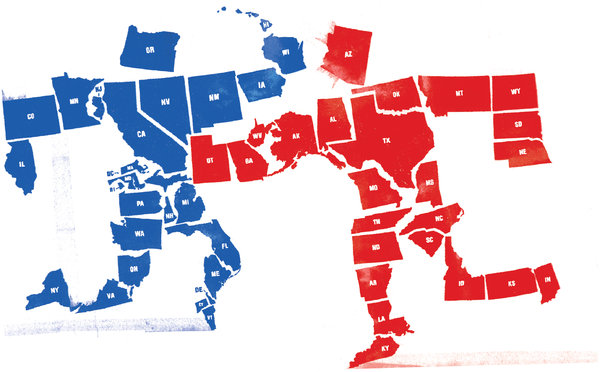
For a different view of U.S. politics, consider this cartogram by the NYTimes. It makes me want to move to North Dakota or Wyoming — almost.

02chart_large


This map shows each state re-sized in proportion to the relative influence of the individual voters who live there. The numbers indicate the total delegates to the Electoral College from each state, and how many eligible voters a single delegate from each state represents.

1 Comment

Filed under Uncategorized

Goodwin on muckrakers: an update

A quick update to yesterday’s post about Doris Kearns Goodwin’s new book:

Here is today’s review in the NYTimes, which gave it a respectful endorsement (and helpfully points out that the book is a monster at more than 900 pages!).


Leave a comment

Filed under Uncategorized