Category Archives: Uncategorized

Covering Romney

By Chris Daly

Here’s the text of a letter I submitted to the New York Times for publication yesterday. Since they have had 24 hours to act on it and have not contacted me, I am assuming that they are not going to use it. (Everyone makes mistakes.) So, I am posting it here:

TO THE EDITOR: 

Re: “Tall Tales about Private Equity” (Op-ed, May 23): 
Steven Rattner makes a valid point about Republican presidential candidate Mitt Romney’s track record of job creation while Mr. Romney was the head of Bain Capital. Mr. Rattner argues that Bain’s primary goal was to make money and that job creation was secondary. He notes that in the case of Bain’s involvement with Staples, Mr. Romney claims credit for all of the 89,000 jobs Staples had by 2010, rather than the 42,000 employees it had when Mr. Romney left Bain in 1998.
From another point of view, even the 42,000 figure may be too high, because it is not a net figure. Staples is a big-box office supply chain whose success led indirectly to the closing of some uncounted number of small stationery shops, all of which once had employees too. When the loss of those jobs is reckoned against the gains at Staples, the net number of jobs gained in that retail field is probably much lower.
–CHRISTOPHER B. DALY
Boston, May 23, 2012

Leave a comment

Filed under Uncategorized

Do college students study enough?

By Chris Daly

Recent news reports about college life focus on the findings of the latest National Survey of Student Engagement, which is run by Indiana University with funding from Pew and Carnegie. The upshot seems to be that college students don’t study enough — or at least, they don’t study as much as college students used to study.

I don’t know if that’s true, and I don’t think the NSSE has been around long enough to provide meaningful data about study habits during the Baby Boomers’ college days (a vague metric that seems to underlie a lot of the news coverage).

But as a college professor myself (at a large, selective, private university), I would venture to offer two reasons why today’s college students might study less than their counterparts from the 1970s, when I was in college:

1. Many of today’s students are working during the school year to help their families meet the exorbitant cost of college education. Whenever I propose an out-of-class assignment, the hands immediately go up, and students tell me that they can’t do it because they are working.

2. Many of today’s students are caught up in the expansion of NCAA sports. For one thing, under Title IX, the number of female athletes has exploded in recent decades. Not only that, but many NCAA teams require their “student-athletes” to train year round. I had a student last semester on the B.U. swim team who had to miss a few classes due to travel to swim meets during the winter season. When the season ended, I mentioned that she must be finding it easier to keep up. She said: no, the coach expects them to keep showing up for practice. This is a common fact of life for college athletes — they are competing or training continuously throughout the school year. There goes 3-4 hours a day.

Both of these trends really impinge on the time students could possibly devote to studying. Assuming they want to.


Leave a comment

Filed under Uncategorized

Woody Sez: See this play

By Chris Daly

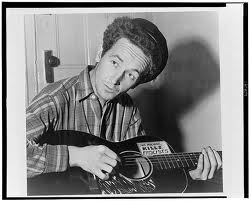
I had the pleasure of seeing a new play/musical revue about Woody Guthrie the other night at the A.R.T. Theater in Cambridge (Mass.). The show, called “Woody Sez,” is a fantastic telling of Woody’s amazing life, mainly through his own songs. It is nearly a one-man show, featuring David Lutken, who is charming and disarming. He is supported by Andy Teirstein, Darcie Deaville, and Helen Jean Russell — all playing a constantly shifting array of acoustic stringed instruments. All told, they use four guitars (including two old Martins), three fiddles, a viola, a dulcimer, a double bass, a mandolin, and a banjo — along with a bunch of non-string instruments, including autoharp, harmonica, pennywhistle, jaw harp and spoons.

The show is a real hoot. (A special treat: seeing more than a hundred or so egg-heads stomping their feet and clapping time to songs like “Union Made” and “Biggest Thing that Man has Ever Done.”)

There were big chunks of Woody’s life that were familiar from reading Woody’s own 1943 autobiography, Bound for Glory, as well as Joe Klein’s 1980 biography, Woody Guthrie: A Life. Still, “Woody Sez” managed to bring up material that was new to me.  I had never noticed how much Woody suffered. Like another great American original , Mark Twain, Woody knew terrible suffering, early and often throughout his life.

Many thanks to David Lutken and his collaborator, Nick Corley for putting this together, and for getting it on-stage in time for the centennial of Guthrie’s birth, which is coming up on July 12.

My only issue is that I would love to see this show break out of the confines of a pricey theater like the A.R.T. and get into every high school, dance hall, barn, and fire station in the country. That’s where this music really belongs.

Leave a comment

Filed under Uncategorized

AP Apologizes for WWII Blunder

By Chris Daly

I was very pleased to see that my old employer, The Associated Press, finally did the right thing and apologized to a great correspondent who was wronged in 1945 as he broke the news about the end of the fighting in Europe. The apology came earlier this week on the 67th anniversary of the surrender of Germany.

Settle in: There’s quite a story behind the story of the end of the fighting in World War II in Europe. The date of the official celebrations was May 8, 1945, known as V-E Day, for victory in Europe. Much fighting remained to be done in the Pacific, where Japan was still refusing to recognize the now-inevitable Allied victory.

Back to Europe.

In early May, 1945, the Supreme Headquarters of the Allied Expeditionary Forces (SHAEF) command selected 17 correspondents from the world’s press and flew them to Riems, France to witness the surrender on behalf of the rest of the press and the people of the world.

There were very few Americans in the group. The ones who were there represented the big wire services and syndicates. In fact, not a single reporter representing a U.S. newspaper was present.

According to the allied military commanders, the news was to be embargoed: that is, you had to accept a deal. In exchange for access to the event, you had to agree to hold the news until the Army said you could release it. The SHAEF press officer said: “I pledge each one of you on his honour as a correspondent and as an assimilated officer of the United States Army not to communicate [the news] until it is released on the order of hte Public Relations Director of SHAEF.”

It remains unclear what constitutes an “agreement” under such conditions (what were the correspondents supposed to do — get up and walk out of an airplane?), but they proceeded to witness the ceremony.

The surrender by the German high command came in the early hours of May 7. Ordinarily, you might expect that the surrender would touch off immediate celebrations.

Not so fast.

The press officer announced that orders had come “from a high political level” to impose a news blackout until 8 p.m. the next day, when the news would be announced simultaneously in Paris, London, Moscow and Washington. (Turned out, Stalin was insisting on the delay so he could make a show in Berlin.) In other words, all the correspondents who had been eyewitnesses would lose their scoops. Instead, some desk-bound rewrite man or editor would get all the glory. The reporters protested tothe SHAEF press officer, but to no avail. The political leaders had decided.
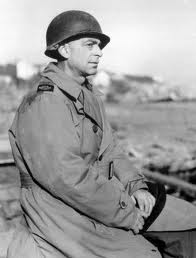
Ed Kennedy, the Paris bureau chief for the AP and a veteran of coverage of the North Africa and Italian campaigns.

Among the press corps, one of the most upset was Edward Kennedy — not the late Democratic senator from Massachusetts but a man by the same name who was the chief correspondent in Europe for the AP. Bear in mind, Kennedy was in a special position. He had been burned earlier in the war when he cooperated with military brass. In 1943, Kennedy had agreed to suppress a story about Gen. George Patton and had gotten scooped by someone else. (See my book, Covering America, pgs 269-70.) Kennedy also knew that his account of the German surrender could probably reach more people on the planet than any other. He knew, too, that the AP thrives on being first and that throughout the ages, AP men (and a tiny but growing number or women) had gone to great lengths to be first to deliver the news.

Besides, he figured, no embargo on such a momentous story could hold for that long. (Nor, perhaps should it.) He was still fuming when the correspondents were marched back onto the military plane. They were flown from Reims back to Paris. Still, the world knew nothing of the surrender. Still, soldiers in Europe kept shooting at each other.

When they landed, Boyd Lewis of United Press got the first jeep from the airport to the Hotel Scribe in Paris, which had been serving as the outpost for most of the press corps. When Lewis got to the press center, he tried to tid up all the available telegraph outlets. Next in line was James Kilgallen of INS, who had beaten Kennedy to the spot by throwing his typewriter at Kennedy’s legs, slowing him down.

Kennedy was beside himself. Then he heard that SHAEF had ordered German radio to announce the surrender.

Kennedy went to the censors and announced that he was breaking the embargo. Using a telephone, he called the AP bureau in London and dictated the following lead:

REIMS, France, May 7_Germany surrendered unconditionally to the Western Allies and the Soviet Union at 2:41 a.m. French time today.

The surrender took place at a little red schoolhouse that is the headquaters of Gen. Dwight D. Eisenhower…..

Within minutes, the news was flashed to the world, and wild celebrations began.

SHAEF was furious and suspended AP filing facilities throughout Europe. The rest of the press corps was furious, too. More than 50 correspondents signed a protest to SHAEF Supreme Commander Dwight Eisenhower, calling Kennedy’s action “the most disgraceful, deliberate and unethical double cross in the history of journalism.”AP’s president apologized to the nation. AP brass told Kennedy he could keep his job if he admitted he had done wrong. He wouldn’t and was fired.

What might seem amazing today — aside from the lack of cell phones and other forms of instant global communication — is how unanimously the correspondents fell in line with the military. Today, I dare say, U.S. reporters would be at least split about the ethics of something that they new to be both true and life-saving.

Two weeks later, writing in The New Yorker, A.J. Liebling, the great World War II reporter and press critic, took up the issue of Kennedy’s firing in his column “The Wayward Press.” (May 19, 1945) Liebling’s take:

The great row over Edward Kennedy’s Associated Press story of the signing of the German surrender at Reims served to point up the truth that if you are smart enough you can kick yourself in the pants, grab yourself by the back of the collar, and throw yourself out on the sidewalk. This is an axiom that I hope will be taught to future students of journalism as Liebling’s Law.

I certainly teach it that way. His piece continued:

I do not think that Kennedy imperiled the lives of any Allied soldiers by sending the story, as some of his critics have charged. He probably saved a few, because by withholding the announcement of an armistice you prolong the shooting, and, conversely, by announcing it promptly you make the shooting stop. Moreover, the Germans had broadcast the news of the armistice several hours before Kennedy’s story appeared on the streets of New York. . . The thing that has caused the most hard feeling is that Kennedy broke a “combination,” which means that he sent out a story after all the correspondents on the assignment had agreed not to. But the old-fashioned “combination” was an agreement freely reached among reporters and not a pledge imposed upon the whole group by somebody outside it.

There’s a lot more to learn from Liebling’s piece, but that’s the nub.

I wonder how Liebling would greet the news this week that the AP has finally apologized to Kennedy. I wonder how Kennedy, who died in 1963, would have greeted the news. (For more on Kennedy, see the newly published memoir Ed Kennedy’s War: V-E Day, Censorship, and the Associated Press.

As for me, I say the AP was late — 67 years late.


Leave a comment

Filed under history, Journalism, journalism history, Uncategorized

Why don’t men wear hats?

By Chris Daly 

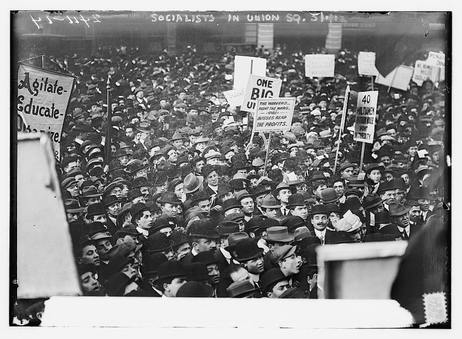
Union Square Rally, 1912 (Library of Congress)

Now, we have the answer — or at least, an answer — from the reliably delightful Robert Krulwich. The culprit: Dwight Eisenhower, who did in fact wear hats from time to time. Ike’s role in eliminating the hat was more roundabout, according to Krulwich. Ike is credited with launching the Interstate Highway system,which made the automobile the No.1 way of getting places. The automobile, in turn, actually did in the hat, because the typical car does not have enough room above the occupants’ heads to accommodate a real hat.

Seems plausible enough to merit a hat-tip for Krulwich.

3 Comments

Filed under Uncategorized

My book on TV

By Chris Daly

Just learned that my book will be featured on C-Span’s BOOK-TV.

Tune in next Sunday, May 6, at 8 p.m.

Here’s the notice: http://cs.pn/ICYGY2

Sunday, April 29, 2012

U.S. History

“Covering America: A Narrative History of a Nation’s Journalism”

Christopher Daly

About the Program


Christopher Daly, journalism professor at Boston University recounts 300 years of reportage in the United States.  Mr. Daly examines the current arguments that journalism is in danger and points to the numerous obstacles that the news industry has faced throughout its history, which, according to the author, has presented reporters with opportunities to create innovative ways to collect and distribute the news.  Christopher Daly speaks with Nicholas Lemann, dean of the Columbia Journalism School at Columbia University Graduate School of Journalism in New York City.


About the Authors

Christopher Daly


Christopher Daly is the co-author of Like a Family: The Making of a Southern Cotton Mill World.  He has reported for the Associated Press and Washington Post and is currently an associate professor of journalism at Boston University.
Buy the author’s book from: Amazon | Barnes & Noble | Indiebound 

Program Information

"Covering America: A Narrative History of a Nation's Journalism"

Future Airings

  • Sunday, May 6th at 8pm (ET)
Shop C-SPAN Gifts!


Leave a comment

Filed under Uncategorized

Murdoch scandal (cont.) By Chris Daly –

Murdoch scandal (cont.) By Chris Daly  – – Murdoch scandal (cont.) By Chris Daly  – Murdoch scandal (cont.) By Chri… http://ow.ly/1jdINw

Leave a comment

Filed under Uncategorized

New review of “Covering America” Thi –

New review of “Covering America” Thi – – New review of “Covering America” Thi – New review of “Covering America” Th… http://ow.ly/1jdINr

Leave a comment

Filed under Uncategorized

New review of “Covering America” Thi –

New review of “Covering America” Thi – – New review of “Covering America” Thi – New review of “Covering America” Th… http://ow.ly/1jcTpo

Leave a comment

Filed under Uncategorized

Murdoch scandal (cont.) By Chris Daly –

Murdoch scandal (cont.) By Chris Daly  – – Murdoch scandal (cont.) By Chris Daly  – Murdoch scandal (cont.) By Chri… http://ow.ly/1jcTpt

Leave a comment

Filed under Uncategorized