Category Archives: New York Times

Tyler Hicks: photos from Timbuktu

By Christopher B. Daly

The intrepid Tyler Hicks, conflict photographer for The New York Times, has made it to Timbuktu, recording the campaign to oust the Islamic militants who briefly held the remote city and the aftermath of the city’s liberation. Hicks (a graduate of the program where I teach at Boston University) has been to all the major hot spots in recent years and has survived a number of threats, including kidnapping. We should all treasure his work:

An ancient manuscript saved from destruction. Photo by Tyler Hicks / NYT

An ancient manuscript saved from destruction.
Photo by Tyler Hicks / NYT


2 Comments

Filed under Journalism, New York Times, Photography, Photojournalism

The Times loses institutional memory

By Christopher B. Daly 

New York Times public editor Margaret Sullivan, who is supposed to be looking out for us readers, acknowledges in her column today what many have long suspected — that is, the current round of staff reductions in the Times newsroom would target the older (higher cost) reporters and editors. That, in turn, means that the newsroom is losing some folks with some special virtues that are hard to make up for in younger hires.

1. They remember stuff. Even while older people start forgetting this and that (and I put my forefront of this trend), we have been around so long that we remember things that are hard to know any other way but by living through them. Does Ed Koch deserve a big send-off? Was he a jerk? Is something that just happened really “unprecedented” or just unusual? Should a newspaper publish everything it can get its hands on, or are some things better left alone?

2. Odds are, the older people are a little less intimidated by the people who hold formal power. They are the kind of people who (might) speak up in a meeting and say “So what?” or “Why?” Usually, the younger people are eager to agree and just want to know how high to jump. Case in point: Jonathan Landman. When he was on the Times city desk a decade ago, he had the nerve to doubt one of the paper’s rising stars — Jayson Blair. He tried to stop Blair from his serial inventions and plagiarism, and that is no easy thing to do in any newsroom.

So as they shuffle off to early retirements, a tip of the hat to some of those newsroom veterans. It will take a long time to replace them.

Leave a comment

Filed under Journalism, New York Times

News from Timbuktu

By Christopher B. Daly 

Could there be a more exotic dateline than this one?:

TIMBUKTU, Mali

That’s the dateline on today’s news from west Africa. The Times’s Lydia Polgreen, hot on the heels of the Islamic radicals being chased out by the newly reinforced Malian army, offers readers a first-day story. The story may not be perfect or complete, but it is impressive as hell that a legacy news organization can get a correspondent to a place that is synonymous with remoteness.

One highlight of the coverage is this photo (by Benoit Tessier of Reuters) of two guys who obviously know a thing or two about survival:

Mali-articleLarge


The story contains a lot of heartbreak and misery, but to my mind, the worst part was the public amputation ordered by the Islamists during their brief reign of terror. I was also struck by this juxtaposition in the piece, near the end:

After the young man’s hand was cut off, the Islamists held it aloft and shouted “God is great” over and over, he said.

Dr. Maiga and his team hustled the young man into the ambulance and rushed him into the operating room to cauterize the wound, giving him powerful painkillers.

“I did what I had to do,” he said. “God help us.”

So, there you have it: one loving god on both sides. I’d say “heaven help us,” but I wouldn’t count on it.


Leave a comment

Filed under Journalism, New York Times

Uh-oh. Layoffs loom at NYT

Here’s the New York magazine version, complete with the memo from Jill Abramson.

No matter how you slice it, this is not good news.

NYT executive editor Jill Abramson

NYT executive editor Jill Abramson


4 Comments

Filed under New York Times

Ada Louise Huxtable, 1921-2012

Whether you agreed with her or not, it must be acknowledged that Ada Louise Huxtable elevated the practice of American journalism just by being in it. I recall how many of her pieces were events in themselves.

Thank you, Ada.

Ada Louise Huxtable, with Arthur Ochs Sulzberger, in 1970, when she won the first Pulitzer Prize for distinguished criticism.

Ada Louise Huxtable, with Arthur Ochs Sulzberger, in 1970, when she won the first Pulitzer Prize for distinguished criticism.

Leave a comment

Filed under Journalism, journalism history, New York Times

Legacy media showing signs of life

By Christopher B. Daly

David Carr has a worthwhile column today in the New York Times, making the point that many of the brand-name “legacy media” that were so recently written off are quietly staging a comeback. According to Carr, the dinosaurs are learning to dance. (In the final chapter of my book, COVERING AMERICA, I used a slightly different metaphor: I said the dinosaurs had to learn to ice skate!)

Here’s an excerpt:

In the last year, the Standard & Poor’s 500-stock index was up 13.4 percent, which was a significant advance, but legacy media giants like Comcast, News Corporation and Time Warner absolutely surpassed it in terms of share price.

Viacom, which has had serious ratings trouble with MTV and Nickelodeon, still managed to be up 16.1 percent on the year. We keep hearing how traditional networks are getting clobbered, but Viacom’s sibling, CBS, was up a whopping 40.2 percent.

News Corporation, despite being racked by scandal, was up 43 percent, and fellow global media conglomerates like Disney and Time Warner were up more than 32 percent. And Comcast, which has both the pipes and programming — cable and NBCUniversal — soared 57.6 percent.

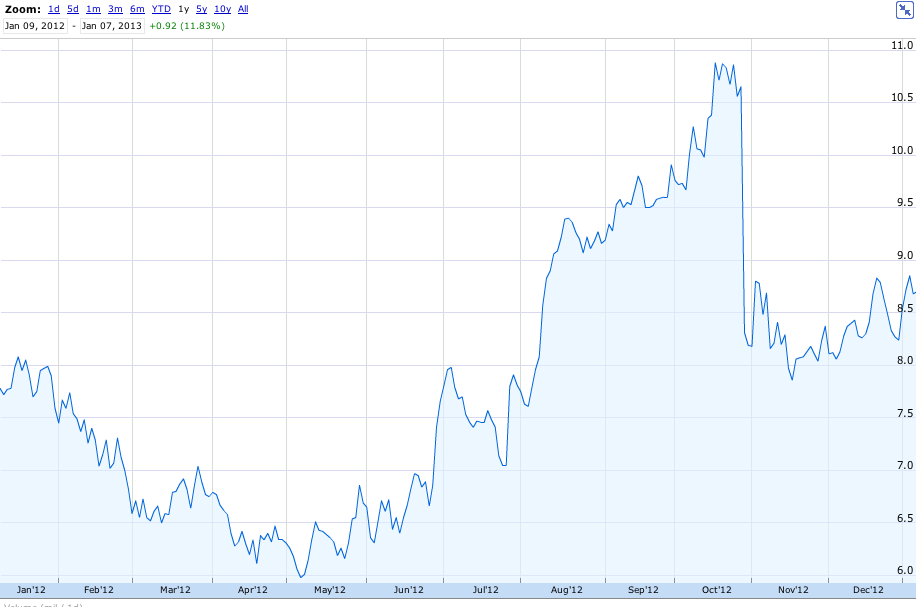
One piece of data that Carr did not cite is the recent history of the market fortunes of his own employer, the New York Times Co. So, here it is:

Screen Shot 2013-01-07 at 12.18.06 PM


Turns out, the value of Times Co. stock has been on a roller-coaster track over the past 12 months. The company had a terrific six months, from May to October, during which the value of a share of NYTCo stock almost doubled. Somewhere around Halloween, the stock cratered, and it has been basically crawling sideways since then. So, the Times Co. experience does not fit Carr’s trend story. I would say that would be a good subject for him to take up next: why doesn’t the Times‘ journalistic excellence translate into financial success?

It’s an important question to answer, because without making money, the Times will not long be able to dance or ice skate. Like other dinosaurs, it will die out.




1 Comment

Filed under Journalism, New York Times

State of the Art: Multimedia journalism

By Christopher B. Daly 

Just catching up with a landmark in multimedia journalism: the New York Times project titled “Snow Fall: The Avalanche at Tunnel Creek,” which was originally posted just before Christmas. IMHO, it is very nearly the state of the art in using multimedia to tell a story, especially a narrative.

The piece (if that’s the right word… project?) was a success in many ways — it was beautiful (in a terrifying sort of way), it was deeply informative, and it brought the Times a whole lot of welcome traffic from new visitors. Snow Fall It remains to be seen if any of those drop-in readers become regulars or subscribers. I would say “Snow Fall” is on a par with the best work done by MediaStorm or NatGeo, or even one of my all-time favorites, Bear71.

That said, could the Times have done a better job on Snow Fall? I hasten to say I could not have done better but I can think of two suggestions: First, the Times took some well-deserved flak for annoying subscribers by sending out a “breaking news” alert about Snow Fall, when it was clearly not breaking news. I trust they will not do that again.

More important, I would venture to say that the essential story could have been stronger. There were a lot of protagonists, and we barely met a few of them before they were all engaged in dramatic actions, and it was hard to keep them straight. It is very hard to drive a narrative without a clear hero or villain, and I found the focus wavering. Still, a salute to the lead reporter/writer, John Branch. And, thanks to the Times for tackling the whole project.

Courtesy of Jim Romenesko, here is a comment to the Times staff from the paper’s executive editor, Jill Abramson.


Leave a comment

Filed under Journalism, New York Times

The power of reporting

By Christopher B. Daly

Today presents a good example of what makes the New York Times so valuable. When the “controversy” over the anti-Muhammad movie called “Innocence of Muslims” broke a couple of months ago, many news organizations covered it for a few days. Eventually, to judge by the evidence so far, they all threw in the towel and gave up trying to get to the bottom of the story of the Coptic deadbeat/activist Nakoula Basseley Nakoula (if that really is his name). All except the Times. In today’s edition, the paper presents a page-1 story with a double byline. Top billing went to Pulitzer-winner Serge Kovaleski, backed up by Brooks Barnes. But that’s not all. At the bottom of the story is a credit line that mentions four more people:

Ana Facio-Krajcer and Noah Gilbert contributed reporting from Los Angeles, and Mai Ayyad from Cairo. Jack Begg contributed research.

So, that is six journalists and counting. All of which is not to mention the folks on the photo desk and the several layers of editors who worked on this piece as well. In all, I would estimate that the full team was in the low double digits.

That is real reporting power. That is the Times’s way of saying: We don’t care how long it takes or how many people it takes, if we get interested in something, we are going to pursue it.

Is the Times perfect? Does the Times pursue every story you would like it to. Obviously not, but where would we be without it?

A man identified as Nakoula Basseley Nakoula (in white scarf) engages in a “perp walk” in California in September. Photo: Bret Hartman / Reuters

1 Comment

Filed under Journalism, New York Times

New NYT exec: Up to the job?

By Christopher B. Daly 

Mark Thompson is wrapping up his first week as the new president and chief executive of the New York Times Company. That role puts him in a critical position in U.S. journalism, and he has little margin for error in leading the

Carl Court / AFP-Getty

Carl Court / AFP-Getty

country’s most important news-gathering organization through dangerous and economically challenging times. We all need him to succeed.

And yet.

It is beginning to appear that the Times Company’s principal owner and publisher of the flagship newspaper, Arthur Sulzberger Jr., may have picked the wrong person for the job. The reason for that has to do with Thompson’s last job, as an executive with the BBC. The British broadcasting empire, a tower of journalistic probity, is going through its own scandal.

To its credit, the Times is pursuing the question of what Thompson knew and when he knew it — apparently without much fear or favor. This is as it should be. My concern is that, fairly or unfairly, Thompson may be so damaged by his BBC baggage that he has to go.

Tentatively, I would say Thompson either knew of serious wrongdoing at the BBC and did nothing, or else he did not know and should have. Either way, he is compromised.


Leave a comment

Filed under broadcasting, Journalism, New York Times

Quote Approval: NYTimes bans it

By Christopher B. Daly 

It was the only decision they could have made, but credit New York Times executives with deciding to ban the pernicious practice of “quote approval.”

In an announcement made Thursday, the paper said it would no longer allow its reporters to grant their sources the power to approve their own quotes before they appear in news stories. The Times was slow in figuring this out, but a right decision is always welcome.

Here’s the takeaway:

. . .starting now, we want to draw a clear line on this. Citing Times policy, reporters should say no if a source demands, as a condition of an interview, that quotes be submitted afterward to the source or a press aide to review, approve or edit.

That should have been self-evident.

Leave a comment

Filed under Journalism, New York Times, Uncategorized